"Every learner who places their trust in Rich Global becomes our responsibility."

Study in Canada guide for international students highlighting Canadian universities, English-taught degree programs, research opportunities, co-op education, and multicultural campus life.

πŸŽ“ Study in Canada: A Comprehensive Guide for International Students

  • Canada has firmly established itself as one of the world’s most welcoming, secure, and academically prestigious study-abroad destinations. Combining world-leading research universities, innovative co-op education programs, absolute personal safety, and a multicultural society that embraces global students, Canada offers an extraordinary, high-value educational journey for Indian 12th-grade students and postgraduate applicants.
  • With 100% English-medium degree programs across globally recognized universities and colleges, international students can earn elite qualifications that open doors to exceptional global career pathways and permanent residency opportunities.

πŸ›οΈ Overview of Higher Education in Canada

  • Regulated at the provincial level and maintained by rigorous national quality assurance standards, higher education in Canada is globally renowned for its academic excellence and practical relevance.

Higher education institutions in Canada comprise:

  1. Universities: Comprehensive research-led public institutions offering undergraduate Bachelor’s degrees, Master’s degrees, and doctoral Ph.D. programs.
  2. Colleges & Institutes of Technology: Providing career-oriented diploma, advanced diploma, post-graduate certificate, and applied degree programs with extensive industry co-op placements.
  • All qualifications are universally respected across international academic and corporate sectors.

🌏 Canada: Country Profile and Key Facts

  • Official Name: Canada
  • Capital City: Ottawa
  • Major Educational Hubs: Toronto, Vancouver, Montreal, Edmonton, Calgary, Ottawa, Waterloo, Halifax
  • Official Languages: English and French; English is universally spoken and utilized across academic institutions and major urban centers
  • Currency: Canadian Dollar (CAD / C$) | 1 CAD β‰ˆ β‚Ή60–₹63 INR (exchange rates fluctuate naturally)
  • Global Innovation & Economic Leader: Renowned for world-leading advancements in artificial intelligence, technology, engineering, finance, healthcare, and natural sciences
  • Safety & Quality of Life: Consistently ranked among the top countries globally for quality of life, personal safety, multicultural diversity, and welcoming student communities

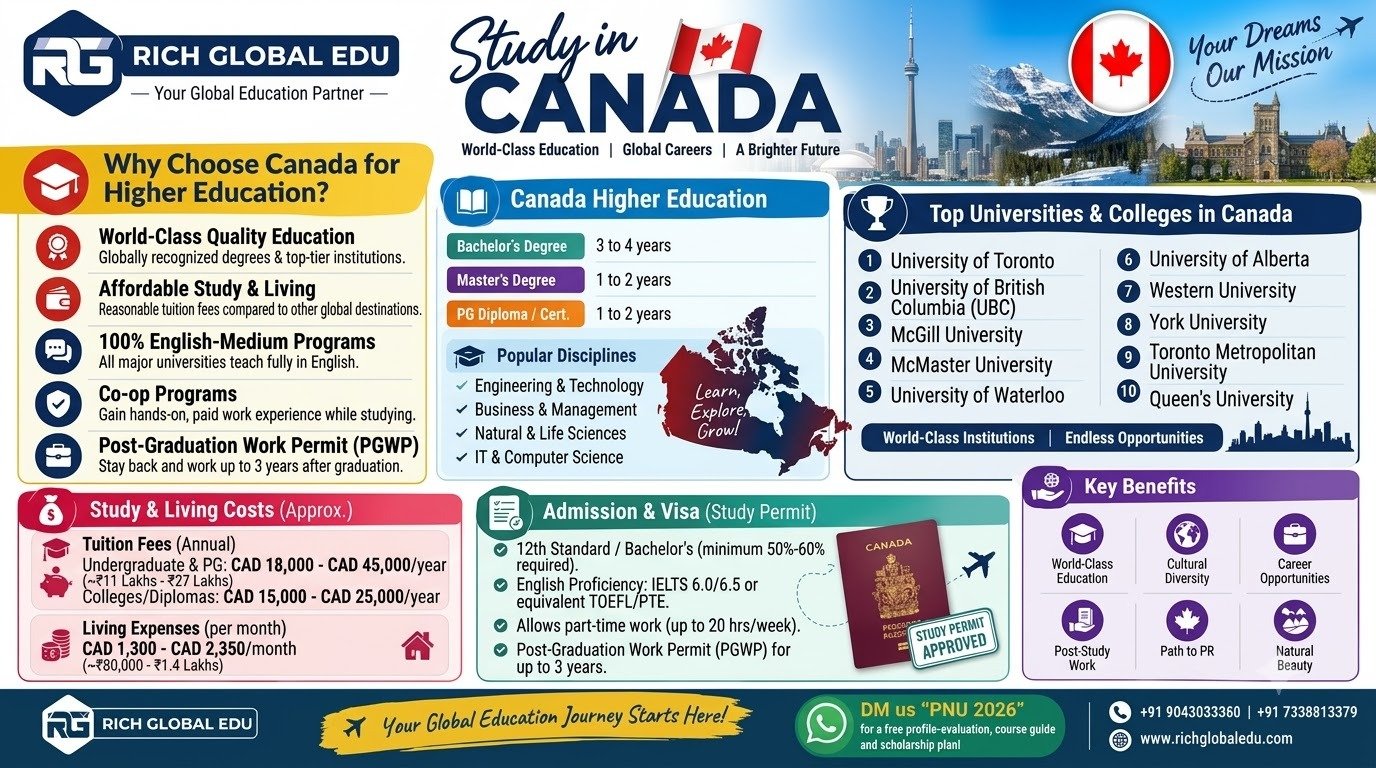
πŸš€ Why Choose Canada for Higher Education?

  • World-Class Global Universities: Canadian universities consistently feature prominently in the top tier of global rankings (QS World University Rankings and Times Higher Education).
  • 100% English-Medium Curriculum: Entire academic degrees, lectures, and campus interactions are conducted in English, ensuring a smooth transition for Indian students.
  • Co-op Education & Practical Work Experience: Integrated co-op work terms allow students to earn money and gain valuable Canadian professional experience while studying.
  • Post-Graduation Work Permit (PGWP): Generous post-graduation stay-back rights (ranging from 1 to 3 years) enabling graduates to gain international work experience.
  • Multicultural & Inclusive Society: A warm, diverse nation with thriving international student communities and robust student support structures.

πŸ“š Canada’s Higher Education System

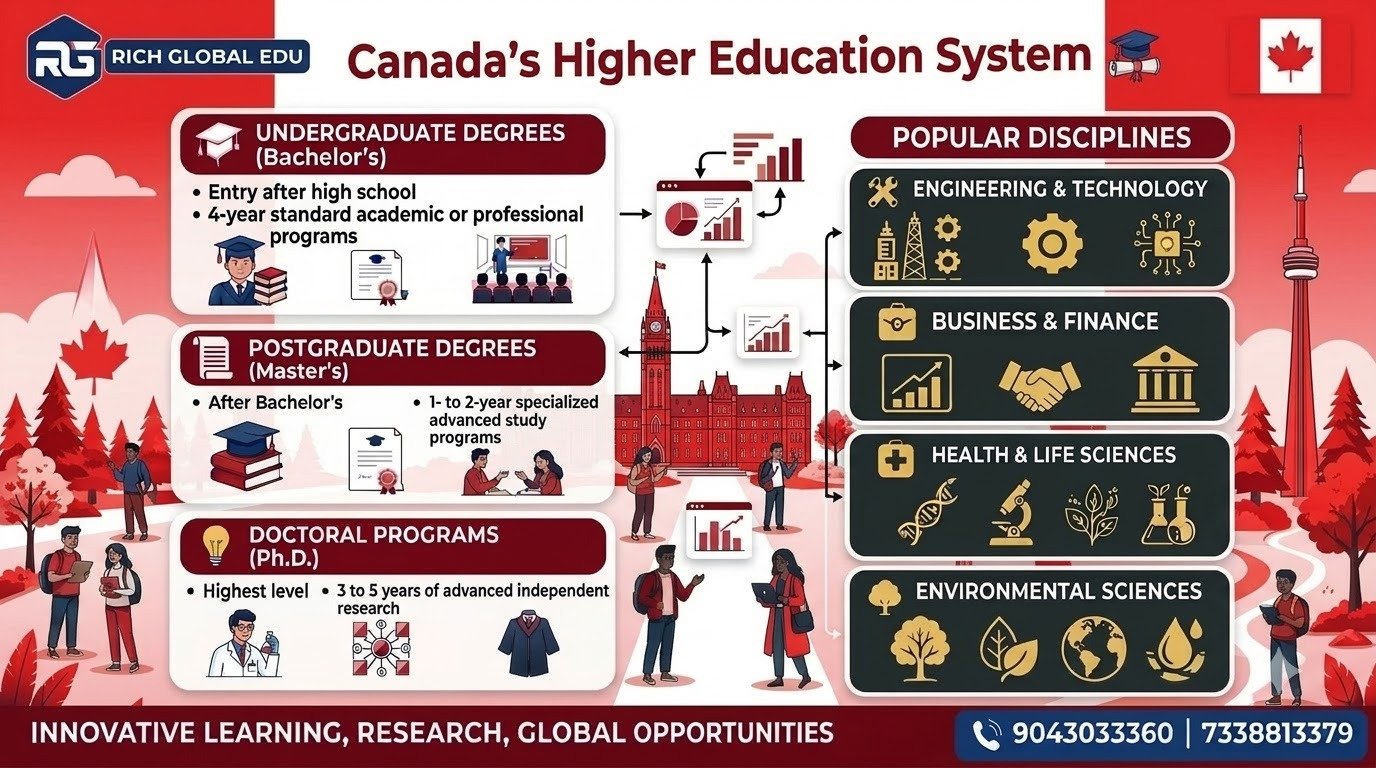
Canada’s higher education system featuring bachelor’s, master’s, and doctoral degrees in engineering, technology, business, healthcare, and environmental sciences.
  • Undergraduate Degree Programs (Bachelor’s): Typically 4 years of structured academic study.
  • Postgraduate Degree Programs (Master’s): 1 to 2 years of advanced coursework or specialized research training.
  • Doctoral Programs (Ph.D.): 3 to 5 years of intensive research.
  • Popular Disciplines for International Students:
  • Engineering & Technology: Software Engineering, Artificial Intelligence, Computer Science, Cybersecurity, Data Analytics, Civil Engineering
  • Business, Finance & Management: Master of Business Administration (MBA), International Business, Finance, Supply Chain Management, Business Analytics
  • Health & Life Sciences: Nursing, Public Health, Biotechnology, Biomedical Science, Pharmacy
  • Environmental & Applied Sciences: Environmental Science, Renewable Energy, Forestry, Agricultural Science

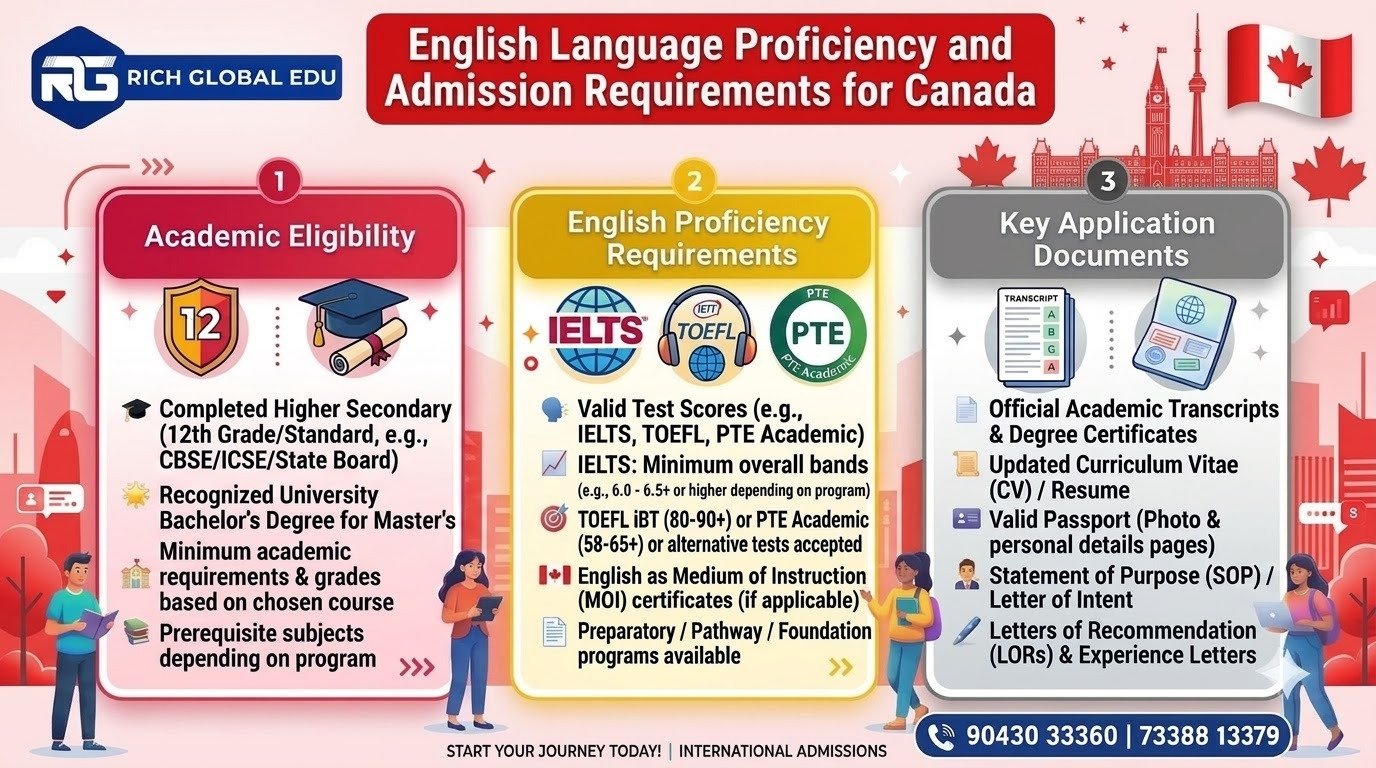
πŸ“ English Language Proficiency and Admission Requirements

Canadian university admission requirements for international students, including Class 12 qualifications, bachelor’s degrees, IELTS, TOEFL, PTE, academic transcripts, and application documents.
  • Admission procedures for international students are streamlined, transparent, and merit-oriented:

Academic Eligibility:

  • For Undergraduate / Bachelor’s Programs: Successful completion of 12th standard (CBSE, ICSE, or State Board) with competitive aggregate percentage scores.
  • For Postgraduate / Master’s Programs: A recognized Bachelor’s degree in a relevant academic discipline from an accredited institution.

English Proficiency Requirements:

  • Standardized English test scores such as IELTS (Academic band 6.0 to 6.5+), TOEFL iBT, or PTE Academic are mandatory for admission and study permit compliance.
  • Key Application Documents: Academic transcripts, 10th and 12th mark sheets, degree completion certificates, valid passport copy, Statement of Purpose (SOP), letters of recommendation, and Curriculum Vitae (CV).

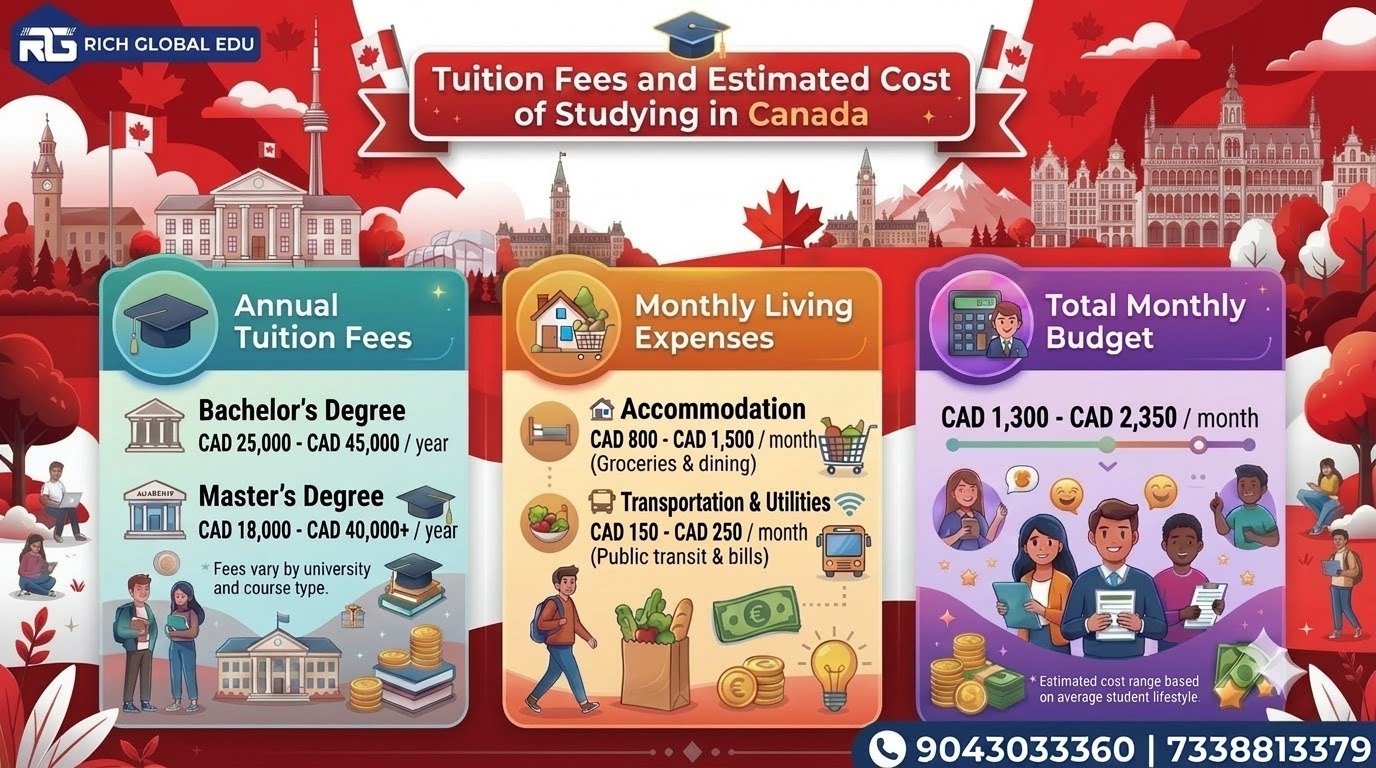
πŸ’³ Tuition Fees and Estimated Cost of Studying in Canada

Estimated Canadian university tuition fees and living expenses for international students, including accommodation, groceries, transportation, and monthly budgets in Canadian dollars and Indian rupees.

Annual Tuition Fees Overview

Bachelor’s Degree Programs:

  • Approx. CAD 25,000 to CAD 45,000 per year (Approx. β‚Ή15,25,000 to β‚Ή27,45,000 / year)

Master’s Degree Programs:

  • Approx. CAD 18,000 to CAD 40,000+ per year (Approx. β‚Ή10,98,000 to β‚Ή24,40,000+ / year)

Monthly Living Expenses (Toronto/Vancouver vs. Regional Hubs)

Accommodation (Student Residences / Homestays / Shared Rented Housing):

  • CAD 800 to CAD 1,500 per month (Approx. β‚Ή48,800 to β‚Ή91,500)

Food & Groceries:

  • CAD 350 to CAD 600 per month (Approx. β‚Ή21,350 to β‚Ή36,600)

Transportation & Utilities:

  • CAD 150 to CAD 250 per month (Approx. β‚Ή9,150 to β‚Ή15,250)

Total Estimated Monthly Living Budget:

  • CAD 1,300 to CAD 2,350 per month (Approx. β‚Ή79,300 to β‚Ή1,43,350 depending on housing choices and city location)

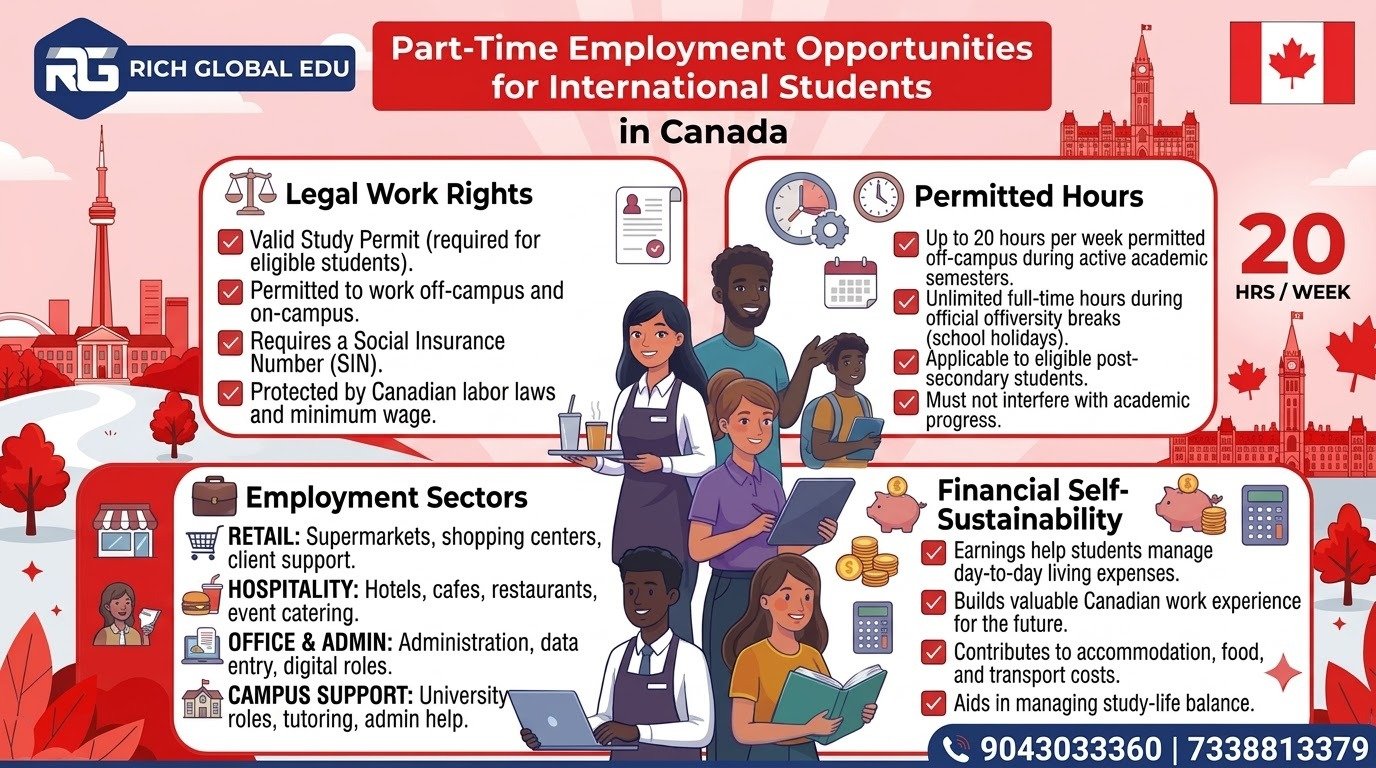
πŸ’Ό Part-Time Employment Opportunities for International Students

Part-time job opportunities for international students in Canada, including retail, hospitality, customer service, tutoring, administration, and campus support roles.
  • Legal Work Rights: International students holding a valid Study Permit are legally permitted to work part-time.
  • Permitted Hours: Up to 20 hours per week off-campus during active academic semesters, and unlimited full-time hours during scheduled university holiday breaks.
  • Employment Sectors: Abundant part-time opportunities across retail, hospitality, customer service, administration, tutoring, and campus support roles.
  • Financial Self-Sustainability: Part-time earnings assist students in covering day-to-day living expenses while building local Canadian professional networks.

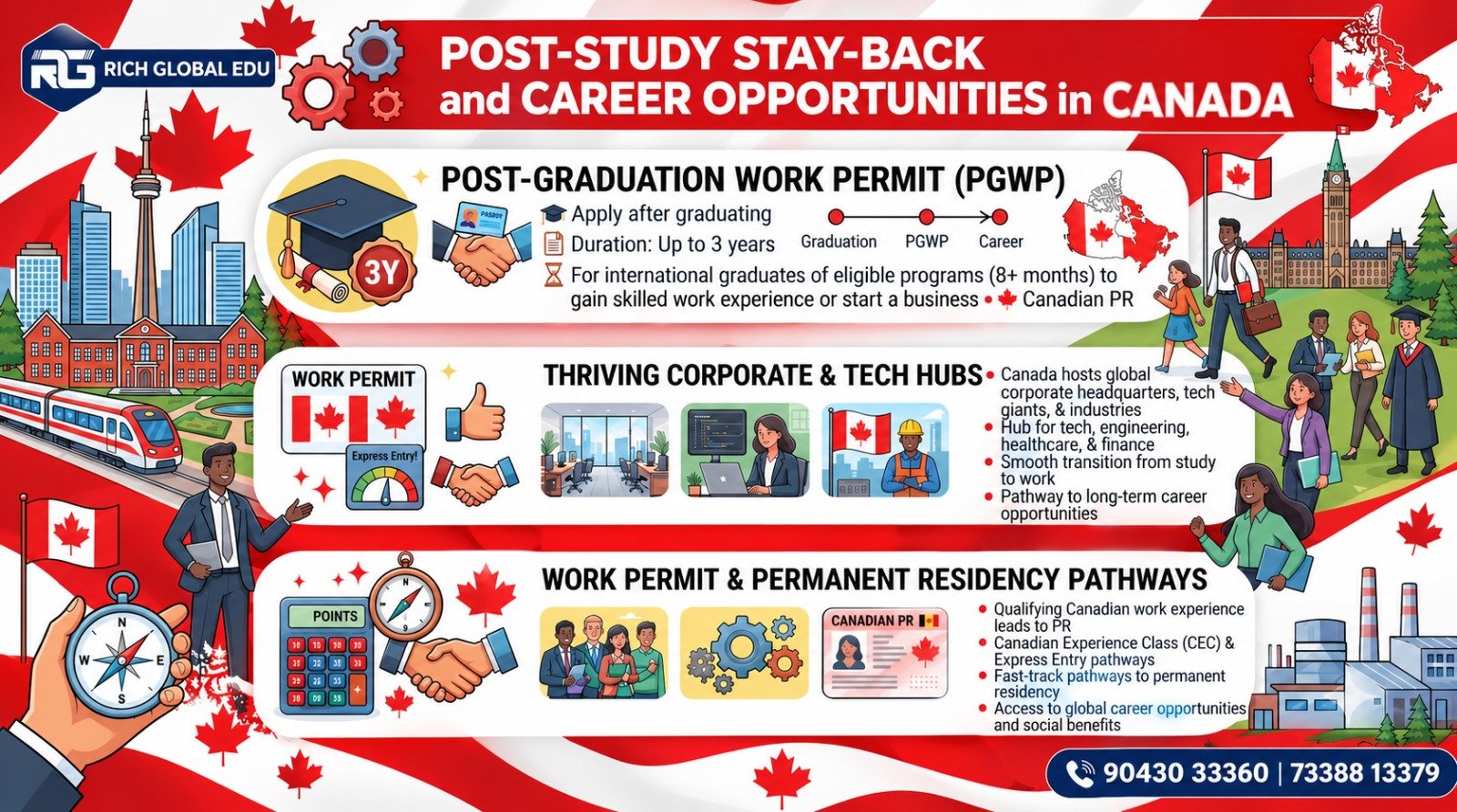
πŸ“ˆ Post-Study Stay-Back and Career Opportunities

Post-study career opportunities in Canada for international graduates, including Post-Graduation Work Permits, skilled employment, and potential permanent residence pathways.
  • Post-Graduation Work Permit (PGWP): International graduates completing eligible programs of 8 months or longer can obtain an open work permit valid for up to 3 years, depending on the length of their study program.
  • Thriving Corporate & Tech Hubs: Canada’s booming corporate sectors, tech enterprises, engineering firms, and healthcare systems actively recruit skilled global graduates.
  • Permanent Residency Pathways: Gaining qualifying Canadian work experience under the Canadian Experience Class (CEC) and Express Entry system provides structured pathways toward permanent residency.

πŸ—“οΈ University Intakes and Admission Periods

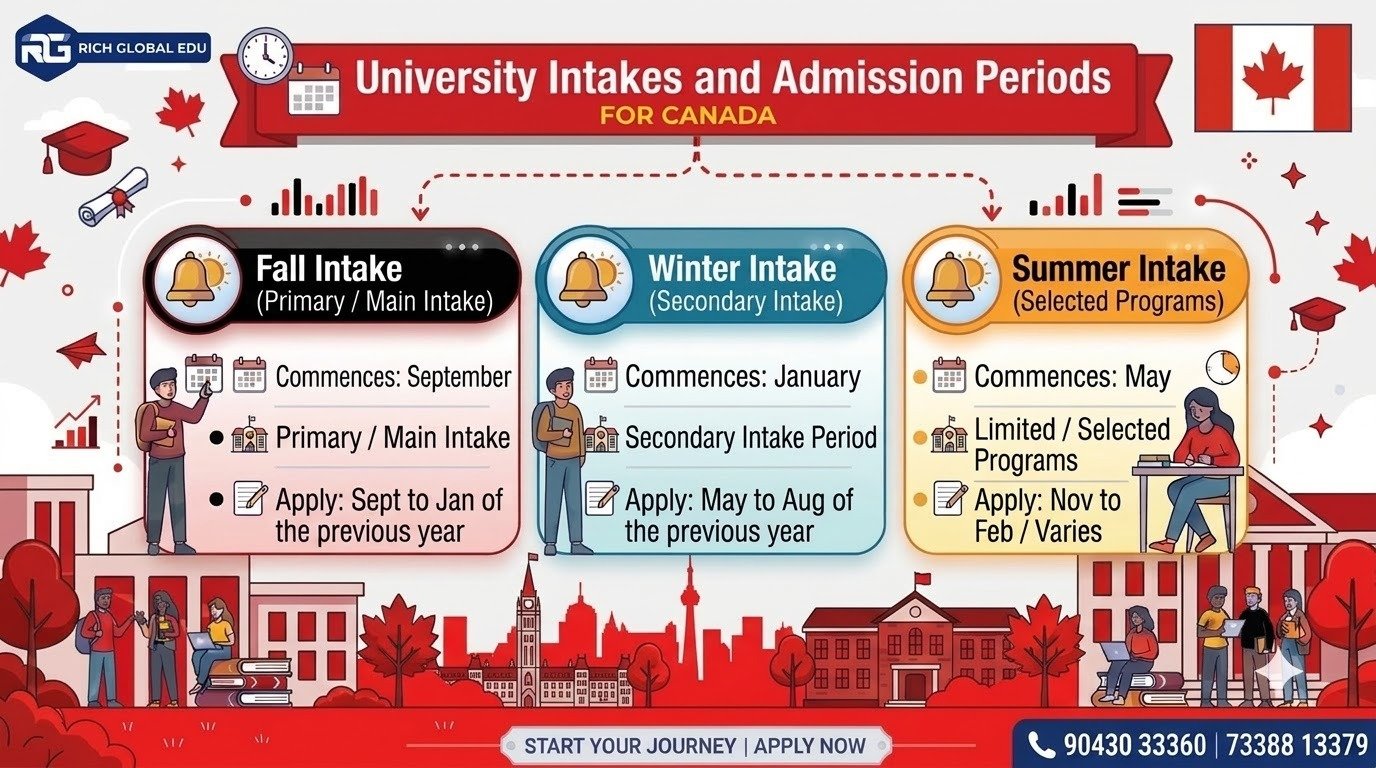
Canadian university intake calendar showing the main fall semester in September, winter semester in January, and selected summer programs beginning in May.
  • Canadian universities operate primarily on a multi-semester academic calendar:

Fall Intake (Primary / Main Intake):

  • Semester Commences: September
  • Application Window: Opens between September and January of the preceding year.

Winter Intake (Secondary Major Intake):

  • Semester Commences: January
  • Application Window: Opens between May and August of the preceding year.

Summer Intake (Selected Programs):

  • Semester Commences: May
  • Application Window: Varies by institution.

⭐ LIST OF POPULAR UNIVERSITIES IN CANADA

  1. University of Toronto
  2. University of British Columbia (UBC)
  3. McGill University
  4. McMaster University
  5. University of Alberta
  6. University of Waterloo
  7. Western University
  8. University of Calgary
  9. Queen’s University
  10. University of Ottawa
  11. Dalhousie University
  12. University of Manitoba
  13. Simon Fraser University
  14. University of Victoria
  15. University of Saskatchewan
  16. Carleton University
  17. York University
  18. Concordia University
  19. UniversitΓ© de MontrΓ©al
  20. Memorial University of Newfoundland
  21. University of Guelph
  22. University of New Brunswick
  23. University of Regina
  24. Brock University
  25. Wilfrid Laurier University
  26. Toronto Metropolitan University
  27. University of Windsor
  28. Lakehead University
  29. Trent University
  30. Acadia University

πŸ‘₯ Study Abroad Counselling and Student Support Services

Navigating Canadian university applications, provincial attestation letters, study permit applications via IRCC, tuition fee deposits, and accommodation requires meticulous planning. Professional study-abroad counselors support families through:

  • Tailored academic program matching across research universities and career-focused colleges.
  • Comprehensive application tracking, document verification, and SOP guidance.
  • Study permit and visa documentation support.
  • Pre-departure briefings, accommodation arrangements, and arrival support services.

❓ Frequently Asked Questions About Studying in Canada

1. Is Canada safe for international students moving abroad for the first time?

  • Yes. Canada is universally recognized as one of the safest, most stable, and peaceful nations in the world, featuring low crime rates, high living standards, and welcoming multicultural communities.

2. Can I work while studying in Canada?

  • Yes. International students on a valid study permit can work up to 20 hours per week off-campus during academic semesters and full-time during scheduled holidays.

3. What is the Post-Graduation Work Permit (PGWP)?

  • The PGWP allows international students who graduate from eligible Canadian designated learning institutions (DLIs) to work anywhere in Canada for up to 3 years, helping them gain valuable Canadian work experience toward permanent residency.

4. Are scholarships available for international students in Canada?

  • Yes. Many Canadian universities offer entrance scholarships, bursaries, and merit-based awards to help international students offset tuition expenses.

πŸ“ž Connect With Our Global Admissions Team

πŸ“© DM us “PNU 2026” on WhatsApp for a free profile evaluation, course guide, and scholarship plan!

πŸ“± Call / WhatsApp: 9043033360 | 7338813379

🌐 Website: www.richglobaledu.com

Rich Global Edu β€” PIONEER in making global education affordable to all. 🌍✨

Study Abroad. Get Licensed. Go Global.

Book your Free Counselling

About Us

Business Legal Name

RICH GLOBAL

Quick Links

Countries for MBBS Abroad

Top Universities for MBBS

FAQs

Best Countries for Studying MBBS Abroad

MBBS in Moldova

MBBS in Nepal

MBBS in USA

Β© 2024Β Rich Global Edu

error: Content is protected !!