"Every learner who places their trust in Rich Global becomes our responsibility."

Austria’s higher education system featuring bachelor’s, master’s, and doctoral degrees, with popular English-taught programs in engineering, business, life sciences, and social sciences.

🎓 Study in Austria: A Comprehensive Guide for International Students

  • Austria has firmly established itself as one of Central Europe’s most culturally rich, economically robust, and intellectually prestigious study-abroad destinations. Fusing centuries-old academic heritage with modern research innovation, stunning alpine living standards, and exceptionally affordable public tuition structures, Austria offers an extraordinary global educational pathway for Indian 12th-grade students and postgraduate applicants.
  • With an expanding portfolio of English-taught degree programs across world-class public universities and universities of applied sciences, international students can pursue elite European qualifications without language barriers inside the classroom.

🏛️ Overview of Higher Education in Austria


  • Regulated by the Austrian Federal Ministry of Education, Science and Research, higher education in Austria adheres fully to the European Bologna Process (Bachelor’s, Master’s, and Ph.D. cycles).

The Austrian higher education system is primarily structured into two distinct institutional categories:

  1. Public Universities (Universitäten): Offering comprehensive academic research and theoretical degree programs across all major disciplines.
  2. Universities of Applied Sciences (Fachhochschulen): Focusing on practical, career-oriented training, mandatory professional internships, and close industry integration.
  • All academic credentials utilize the European Credit Transfer and Accumulation System (ECTS), ensuring seamless credit transfer and universal recognition across the European Union and globally.

🌏 Austria: Country Profile and Key Facts

  • Official Name: Republic of Austria (Republik Österreich)
  • Capital City: Vienna
  • Major Educational Hubs: Vienna, Graz, Linz, Innsbruck, Salzburg, Klagenfurt
  • Official Language: German; English is widely spoken and utilized across international university degree programs, corporate business sectors, and urban hubs.
  • Currency: Euro (€ / EUR) | 1 EUR ≈ ₹90–₹92 INR (exchange rates fluctuate naturally)
  • Strategic European Heart: Centrally located in Central Europe, sharing borders with Germany, Switzerland, and Italy, with open-border travel across the entire 27-nation Schengen Area.
  • Safety & Living Standards: Consistently ranked among the safest, cleanest, and highest-quality living environments in the world, featuring rich classical music history, alpine beauty, and secure student communities.

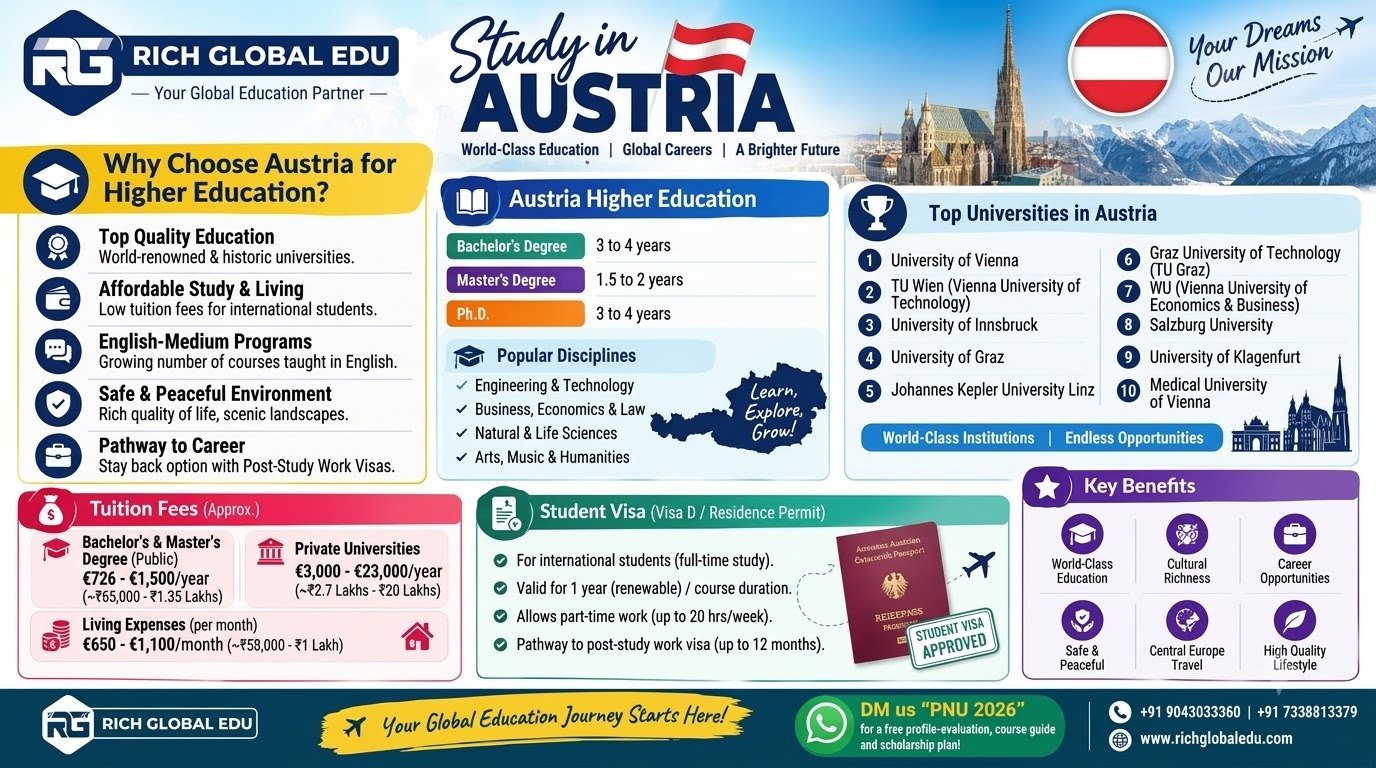
🚀 Why Choose Austria for Higher Education?

  • Globally Respected European Degrees: Earn prestigious EU-accredited degrees recognized across international job markets and academic institutions worldwide.
  • Extremely Affordable Public Tuition: Public universities offer remarkably low tuition fees for international students compared to Western Europe, the UK, or North America.
  • English-Medium Degree Programs: Growing availability of undergraduate and postgraduate degree courses taught entirely in English, particularly in STEM, business, and international relations.
  • High Standard of Living & Safety: Experience a peaceful, culturally vibrant, and student-friendly lifestyle in the heart of Europe with world-class public transport and healthcare.
  • Schengen Travel Freedom: Student residence permits allow visa-free travel across all 27 European Schengen Area countries during academic holidays.

📚 Austria’s Higher Education System

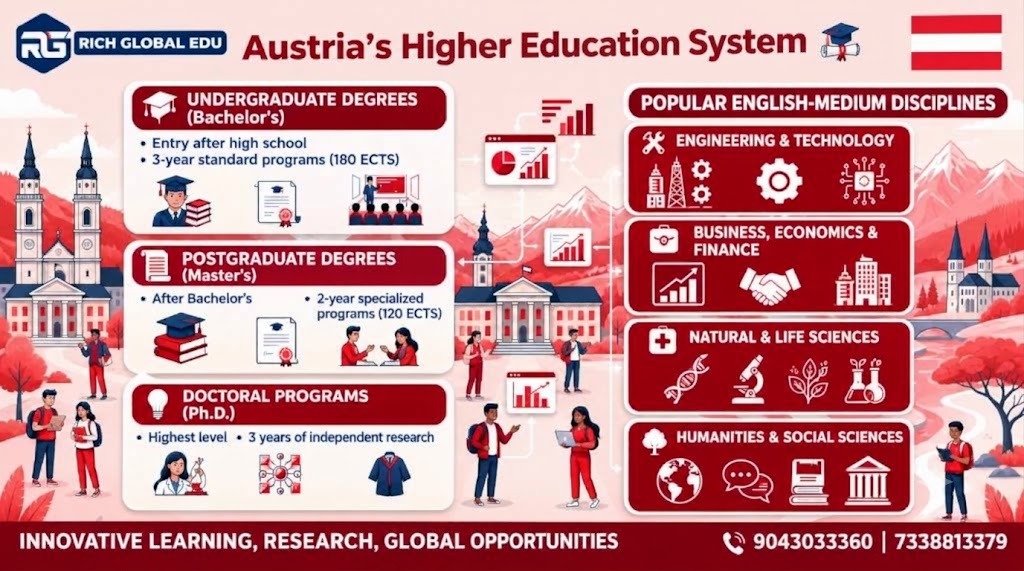
Austria’s higher education system featuring bachelor’s, master’s, and doctoral degrees, with popular English-taught programs in engineering, business, life sciences, and social sciences.
  • Undergraduate Degree Programs (Bachelor’s): Typically 3-year standard programs (180 ECTS credits).
  • Postgraduate Degree Programs (Master’s): 2-year specialized advanced study programs (120 ECTS credits).
  • Doctoral Programs (Ph.D.): 3 years of independent advanced academic research.
  • Popular English-Medium Disciplines for International Students:
  • Engineering & Technology: Computer Science, Software Engineering, Artificial Intelligence, Environmental Engineering, Mechanical & Industrial Engineering
  • Business, Economics & Finance: International Business Administration, Finance, Management, Supply Chain Management
  • Natural & Life Sciences: Biotechnology, Environmental Science, Molecular Biology, Renewable Energy
  • Humanities & Social Sciences: International Relations, European Studies, Global Public Policy

📝 English Language Proficiency and Admission Requirements

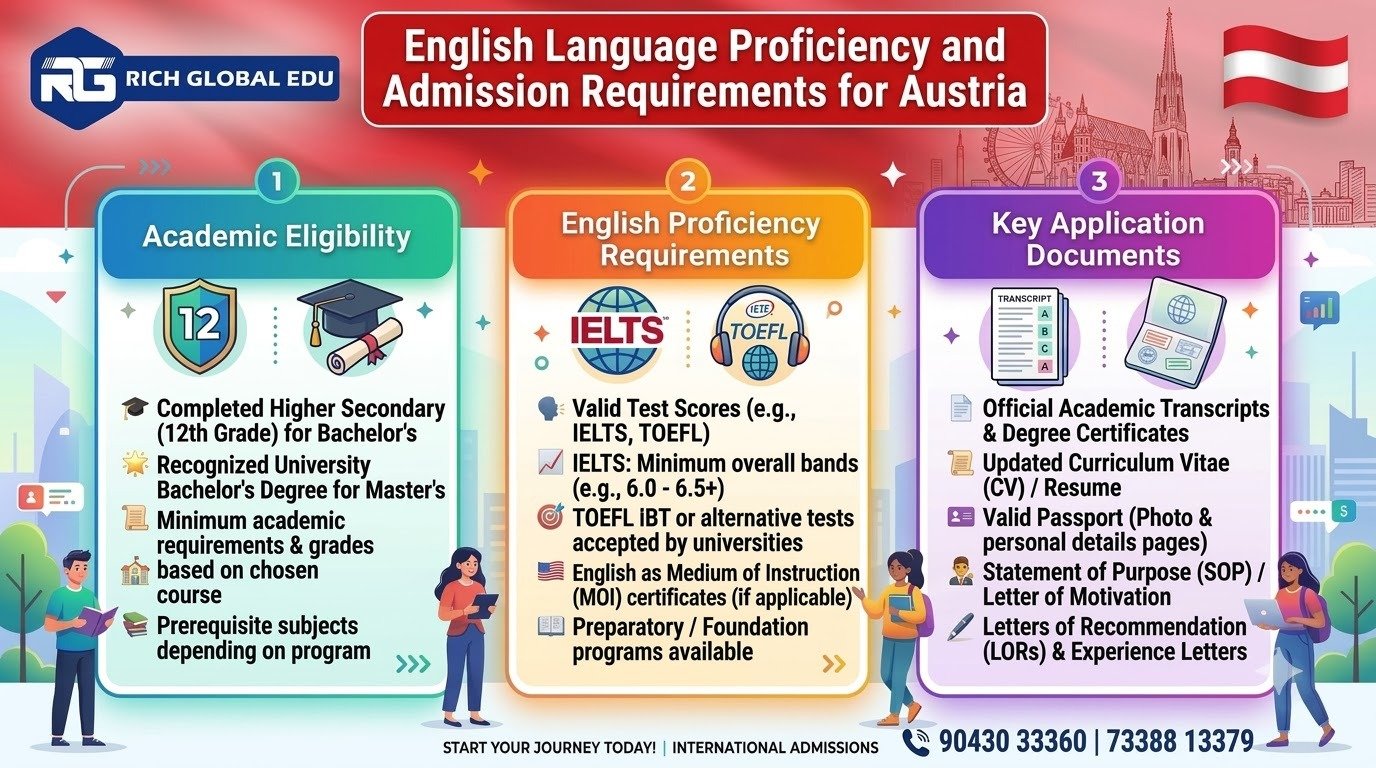
Admission requirements for international students in Austria, including academic qualifications, IELTS or TOEFL scores, transcripts, passport, statement of purpose, and recommendation letters.

Admission procedures for international applicants are structured, transparent, and merit-based:

Academic Eligibility:

  • For Undergraduate / Bachelor’s Programs: Successful completion of 12th standard (Higher Secondary School Certificate) from a recognized board (CBSE, ICSE, or State Board). Note: Some public universities require proof that the student is eligible for university admission in their home country.
  • For Postgraduate / Master’s Programs: A recognized Bachelor’s degree in a relevant academic discipline.

English Proficiency Requirements:

  • Standardized English test scores such as IELTS (typically band 6.0 to 6.5+) or TOEFL iBT are required for English-taught degree tracks.
  • Key Application Documents: Academic transcripts, high school or university graduation certificates, valid passport copy, Curriculum Vitae (CV), Statement of Purpose (SOP), and letters of recommendation.

💳 Tuition Fees and Estimated Cost of Studying in Austria

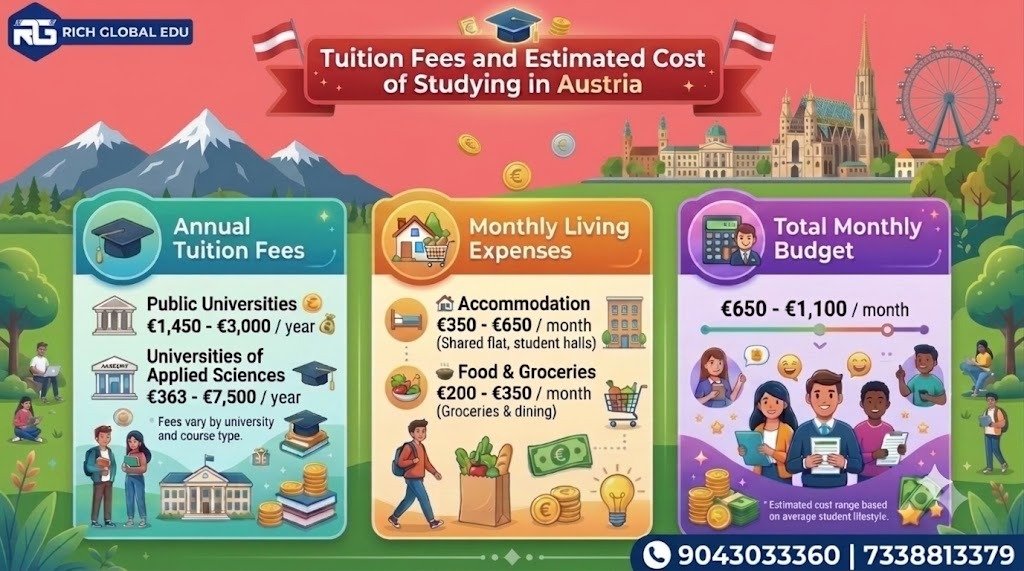
Estimated tuition fees and monthly living expenses in Austria for international students, including accommodation, food, transportation, and university costs in euros and Indian rupees.

Annual Tuition Fees Overview

Public Universities (Non-EU International Students):

  • Typically €726 to €1,500 per semester (Approx. €1,450 to €3,000 / ₹1,30,500 to ₹2,70,000 per year) plus a nominal student union fee (ÖH-Beitrag).

Universities of Applied Sciences (Fachhochschulen):

  • May vary by program, ranging from €363 to €7,500 per academic year depending on the specific faculty.

Monthly Living Expenses (Vienna & Major Student Hubs)

Accommodation (Student Residence Halls / Shared Apartments):

  • €350 to €650 per month (Approx. ₹31,500 to ₹58,500 — student dormitories via OeAD are the most economical)

Food & Groceries:

  • €200 to €350 per month (Approx. ₹18,000 to ₹31,500)

Local Transportation, Utilities & Study Materials:

  • €50 to €100 per month (Annual student transit passes offer heavy regional discounts)

Total Estimated Monthly Living Budget:

  • €650 to €1,100 per month (Approx. ₹58,500 to ₹99,000 depending on lifestyle and city)

💼 Part-Time Employment Opportunities for International Students

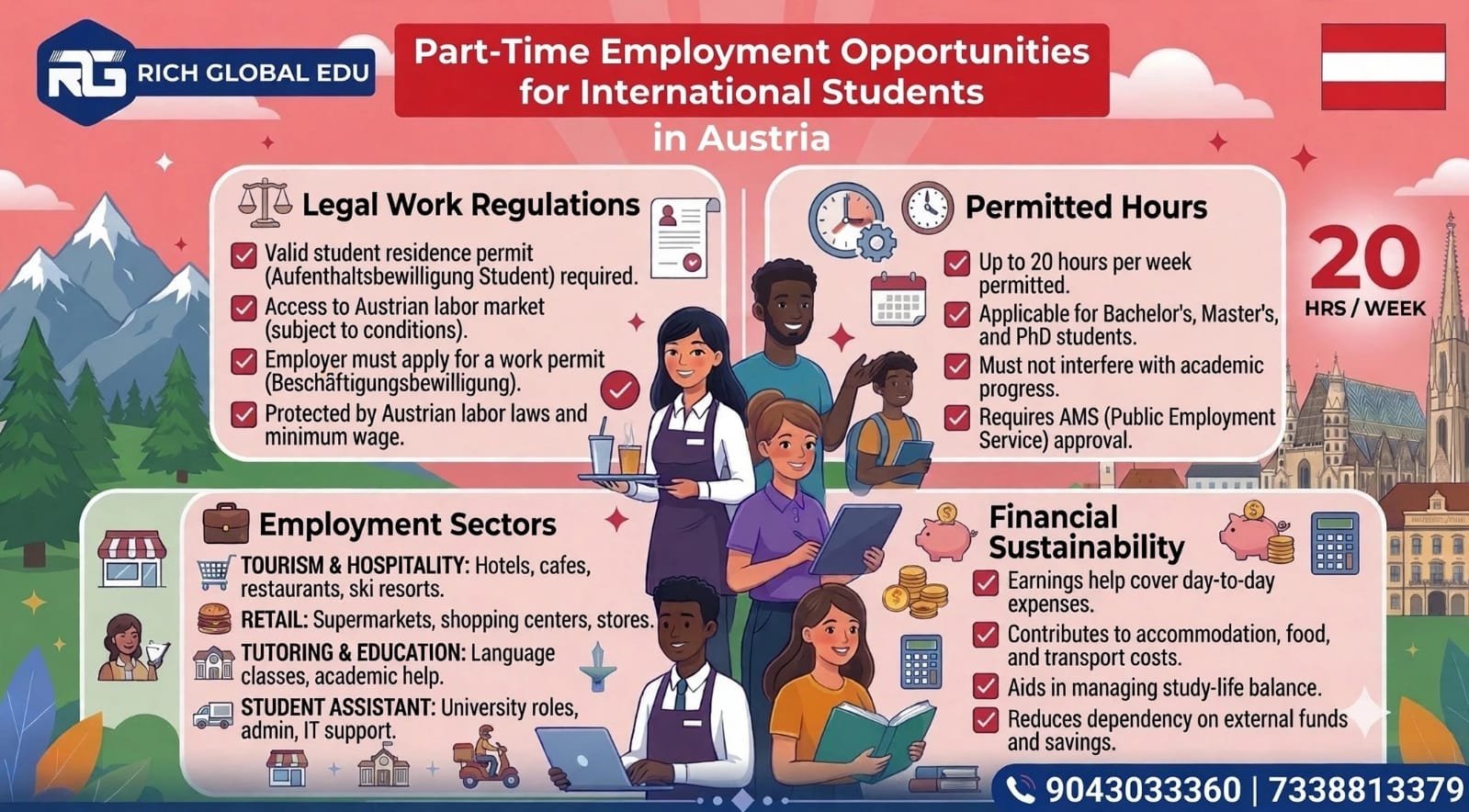
Part-time employment opportunities for international students in Austria, including hospitality, retail, tutoring, tourism, and university student assistant jobs.
  • Legal Work Regulations: International students holding a valid student residence permit (Aufenthaltsbewilligung Student) in Austria are legally permitted to take up part-time employment.
  • Permitted Hours: Up to 20 hours per week during active academic semesters, allowing students to balance professional work with rigorous coursework.
  • Employment Sectors: Thriving opportunities in Vienna and regional hubs across tourism, hospitality, tutoring, retail, and corporate student assistant roles (Tutorien / Wissenschaftliche Mitarbeiter).
  • Financial Self-Sustainability: Part-time earnings help students manage day-to-day living expenses while building valuable European work experience.

📈 Post-Study Stay-Back and Career Opportunities

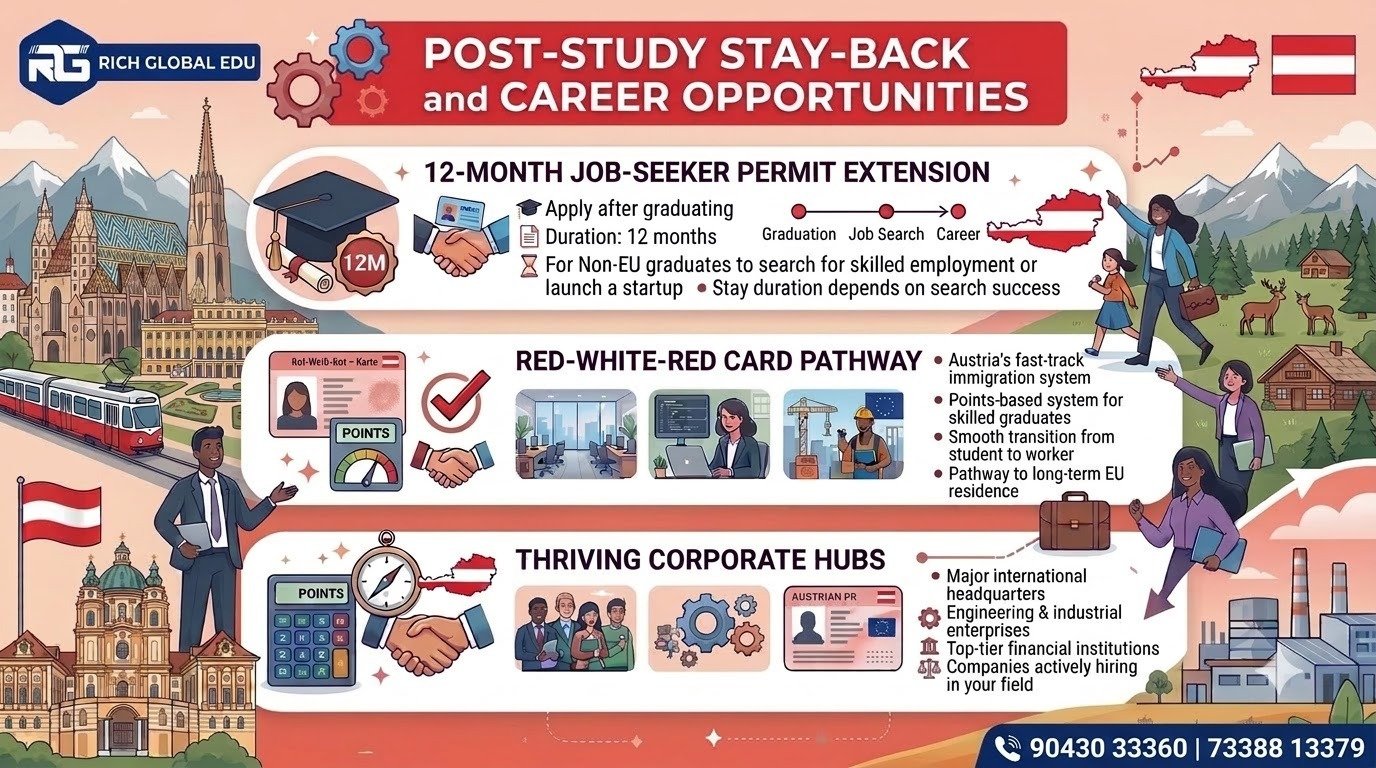
Post-study career opportunities in Austria for international graduates, including the 12-month job-search extension, skilled employment, and Red-White-Red Card pathways.
  • 12-Month Job-Seeker Permit Extension: Non-EU graduates from Austrian higher education institutions can apply to extend their residence permit by 12 months to search for skilled employment or launch a startup.
  • Red-White-Red Card Pathway: Securing a qualifying job offer enables graduates to smoothly transition into Austria’s fast-track immigration system (Rot-Weiß-Rot – Karte), paving the way for long-term EU residence.
  • Corporate Hubs: Austria hosts major international headquarters, engineering enterprises, and financial institutions, offering excellent graduate career entry points.

🗓️ University Intakes and Admission Periods

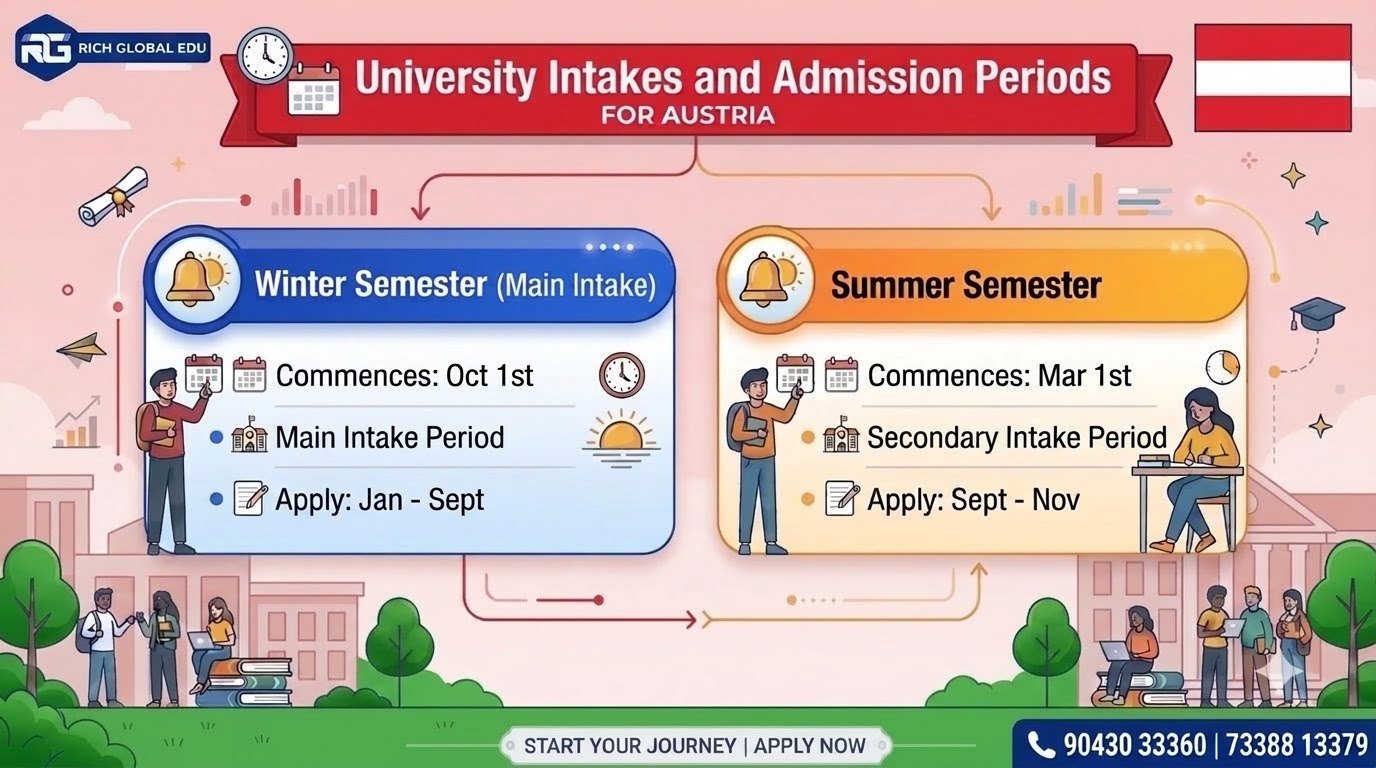
Austrian university admission calendar showing the winter semester beginning in October and the summer semester beginning in March, with application periods for international students.
  • Austrian higher education institutions primarily operate on a two-semester academic calendar:

Winter Semester (Main Intake):

  • Semester Commences: October 1st
  • Application Window: Generally runs from January through September (with priority deadlines often ending in May or July for international applicants).

Summer Semester (Secondary Intake – Selected Programs):

  • Semester Commences: March 1st
  • Application Window: Opens between September and November of the previous year.

⭐ LIST OF POPULAR UNIVERSITIES IN Austria

  1. University of Vienna
  2. Vienna University of Technology (TU Wien)
  3. Medical University of Vienna
  4. University of Innsbruck
  5. University of Graz
  6. Graz University of Technology (TU Graz)
  7. Johannes Kepler University Linz
  8. University of Salzburg (Paris Lodron University)
  9. Alpen-Adria-Universität Klagenfurt
  10. University of Leoben
  11. University of Natural Resources and Life Sciences, Vienna (BOKU)
  12. Vienna University of Economics and Business (WU Vienna)
  13. University of Veterinary Medicine Vienna
  14. Mozarteum University Salzburg
  15. University of Applied Arts Vienna
  16. Academy of Fine Arts Vienna
  17. IMC University of Applied Sciences Krems
  18. Management Center Innsbruck (MCI)
  19. FH Campus Wien (University of Applied Sciences)
  20. Technikum Wien (University of Applied Sciences)
  21. FH Joanneum (University of Applied Sciences)
  22. Upper Austria University of Applied Sciences (FH OÖ)
  23. Carinthia University of Applied Sciences (CUAS)
  24. IMC Krems University of Applied Sciences
  25. IMC Fachhochschule Salzburg
  26. Burgenland University of Applied Sciences
  27. Lower Austria University of Applied Sciences
  28. New Design University St. Pölten
  29. Webster Vienna Private University
  30. Modul University Vienna

👥 Study Abroad Counselling and Student Support Services

Navigating Austrian university admission portals, visa applications, residence permits, and housing arrangements requires expert oversight. Professional education counselors assist families through:

  • Tailored academic program matching aligned with academic scores, career goals, and budget targets.
  • Complete guidance for university admissions and student union requirements.
  • Document notarization, translation coordination, and application submission tracking.
  • Residence permit (Aufenthaltsbewilligung) and consular visa documentation support.
  • Pre-departure briefings, student housing bookings (OeAD housing), and arrival guidance.

❓ Frequently Asked Questions About Studying in Austria

1. Is Austria safe for international students moving abroad for the first time?

  • Yes. Austria is consistently ranked among the safest and most peaceful countries in the world, featuring low crime rates, excellent public infrastructure, secure student housing, and welcoming communities.

2. Can I complete my degree entirely in English in Austria?

  • Yes. Austrian universities offer a variety of undergraduate and postgraduate degree programs taught 100% in English, particularly in business, technology, and international sciences.

3. Are tuition fees expensive at public universities in Austria?

  • No. Public universities in Austria offer very affordable tuition structures for international students compared to Anglo-Saxon countries, making high-quality European education financially accessible.

4. Can international students work part-time in Austria?

  • Yes. International students holding a valid student residence permit are legally permitted to work up to 20 hours per week, helping cover everyday living expenses and gaining practical career exposure.

📞 Connect With Our Global Admissions Team

📩 DM us “PNU 2026” on WhatsApp for a free profile evaluation, course guide, and scholarship plan!

📱 Call / WhatsApp: 9043033360 | 7338813379

🌐 Website: www.richglobaledu.com

Rich Global Edu — PIONEER in making global education affordable to all. 🌍✨

Study Abroad. Get Licensed. Go Global.

Book your Free Counselling

About Us

Business Legal Name

RICH GLOBAL

Quick Links

Countries for MBBS Abroad

Top Universities for MBBS

FAQs

Best Countries for Studying MBBS Abroad

MBBS in Moldova

MBBS in Nepal

MBBS in USA

© 2024 Rich Global Edu

error: Content is protected !!