"Every learner who places their trust in Rich Global becomes our responsibility."

Japan as a world-class study abroad destination for international students, offering advanced education, prestigious universities and cultural experiences.

πŸŽ“ Study in Japan: A Comprehensive Guide for International Students

  • Japan has firmly established itself as one of the world’s most technologically advanced and intellectually rigorous study-abroad destinations. Combining cutting-edge research infrastructure, world-renowned Imperial and National universities, absolute personal safety, and rich cultural heritage, Japan provides an elite, high-value educational pathway for Indian 12th-grade students and parents seeking prestigious international qualifications.
  • With a massive expansion of Global 30 and English-taught degree programs (G30/IGP), international students can pursue world-class degrees in engineering, science, economics, and global studies without requiring fluency in Japanese upon entry.

πŸ›οΈ Overview of Higher Education in Japan

  • Supervised by Japan’s Ministry of Education, Culture, Sports, Science and Technology (MEXT), the Japanese higher education system is globally respected for its rigorous academic standards, innovation, and intense industry integration. Institutions are broadly categorized into National universities, Public prefectural universities, and premier Private universities.
  • Japanese higher education institutions boast state-of-the-art research laboratories, modern campuses, and robust academic partnerships with global corporate giants. Degrees earned in Japan are universally recognized and hold immense prestige across international employment markets.

🌏 Japan: Country Profile and Key Facts

  • Official Name: Japan (Nihon / Nippon)
  • Capital City: Tokyo
  • Major Educational Hubs: Tokyo, Osaka, Kyoto, Nagoya, Fukuoka, Sapporo, Sendai
  • Official Language: Japanese; English is widely utilized across international university degree programs, global tech sectors, and metro hubs
  • Currency: Japanese Yen (JPY / Β₯) | 1 JPY β‰ˆ β‚Ή0.55–₹0.58 INR (exchange rates fluctuate naturally)
  • Global Innovation & Tech Leader: Home to world-leading corporations, high-speed Shinkansen rail networks, and advanced automation industries
  • Safety & Security: Consistently ranked among the safest countries in the world, boasting exceptionally low crime rates, safe public transit, and secure campus environments

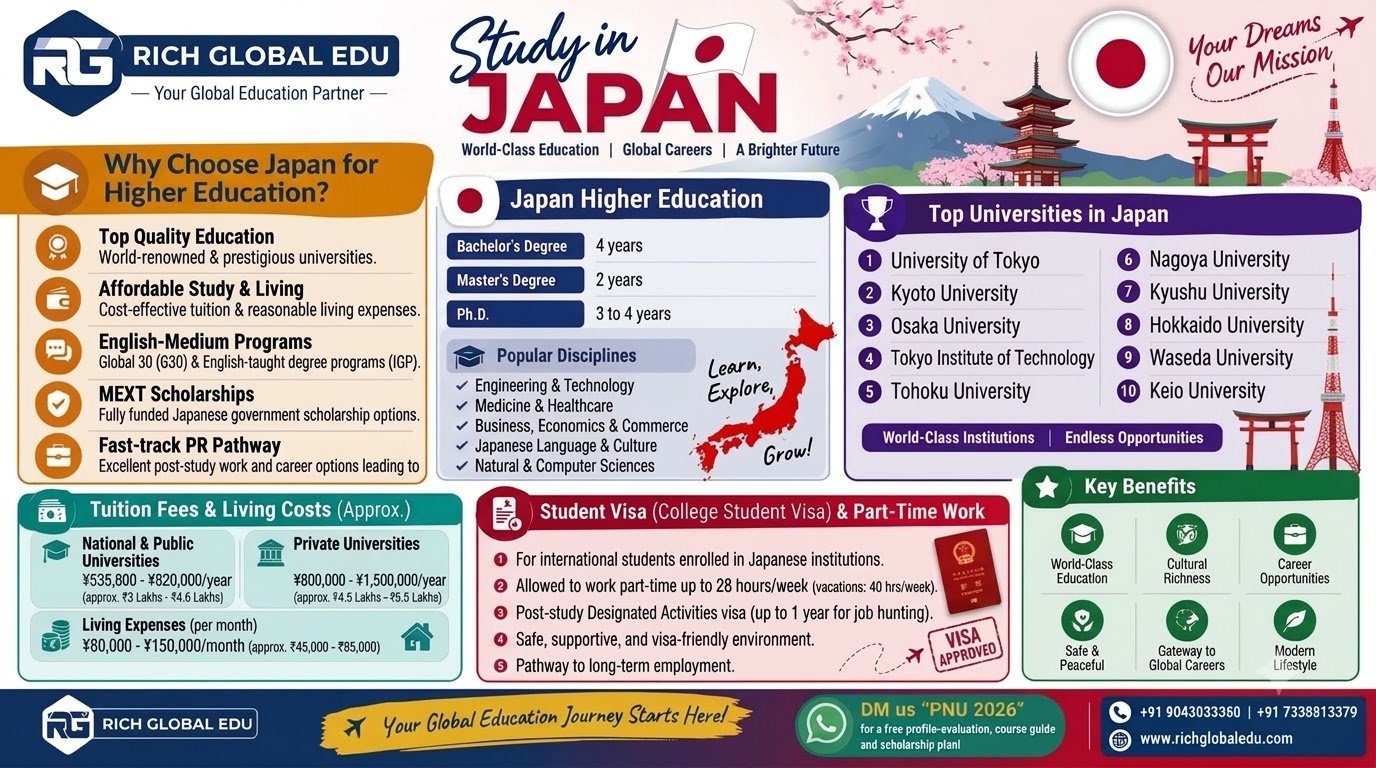
πŸš€ Why Choose Japan for Higher Education?

  • Top Global University Rankings: Japanese institutions consistently hold top-tier positions in QS and Times Higher Education (THE) World University Rankings.
  • Affordable Quality vs. Western Countries: Tuition fees at Japanese national and public universities are remarkably stable and affordable compared to institutions in the US, UK, Canada, or Australia.
  • English-Medium Degree Pathways: Extensive availability of undergraduate and postgraduate degree courses taught 100% in English under specialized international programs.
  • Generous Government & University Scholarships: Abundant MEXT scholarships, JASSO grants, and university tuition exemptions that significantly reduce financial burdens for meritorious students.
  • Exceptional Career & Immigration Openings: Japan faces a severe demographic labor shortage, creating robust post-study work visas, fast-tracked permanent residency pathways, and high-demand corporate hiring for skilled global graduates.

πŸ“š Japan’s Higher Education System

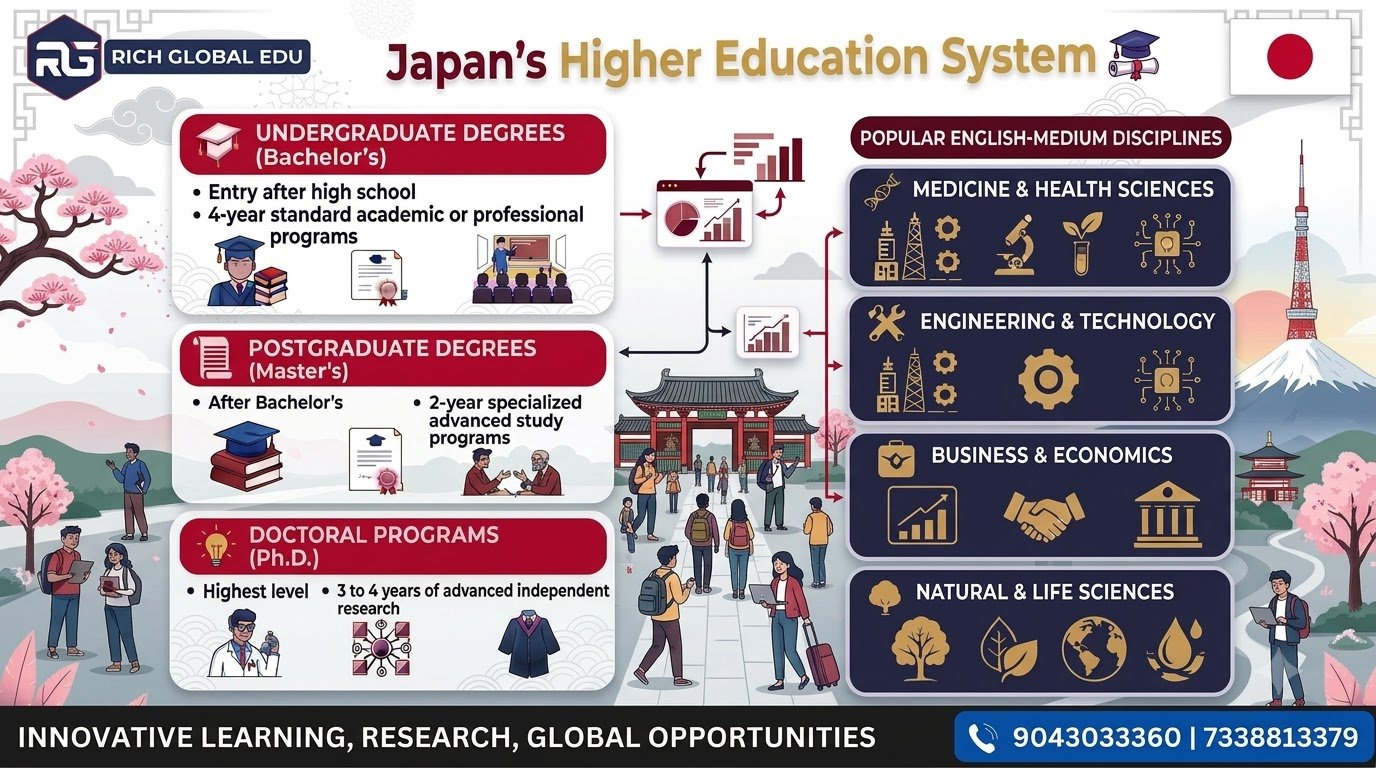
Undergraduate degree programs in Japan offering four-year bachelor's education in engineering, technology, science and humanities.
  • Undergraduate Degree Programs (Bachelor’s): Standard 4-year programs offering specialized English-medium tracks across engineering, technology, science, and humanities.
  • Postgraduate Degree Programs (Master’s): 2-year advanced coursework and high-impact research degrees.
  • Doctoral Programs (Ph.D.): 3 to 4 years of intensive research and doctoral thesis publication.
  • Popular English-Medium Disciplines for International Students:
  • Engineering & Technology: Mechanical Engineering, Computer Science, Robotics, Information Technology, Electrical & Electronic Engineering
  • Business & Economics: International Business, Global Economics, Global Studies, Management
  • Natural & Life Sciences: Biotechnology, Environmental Science, Material Science, Applied Physics

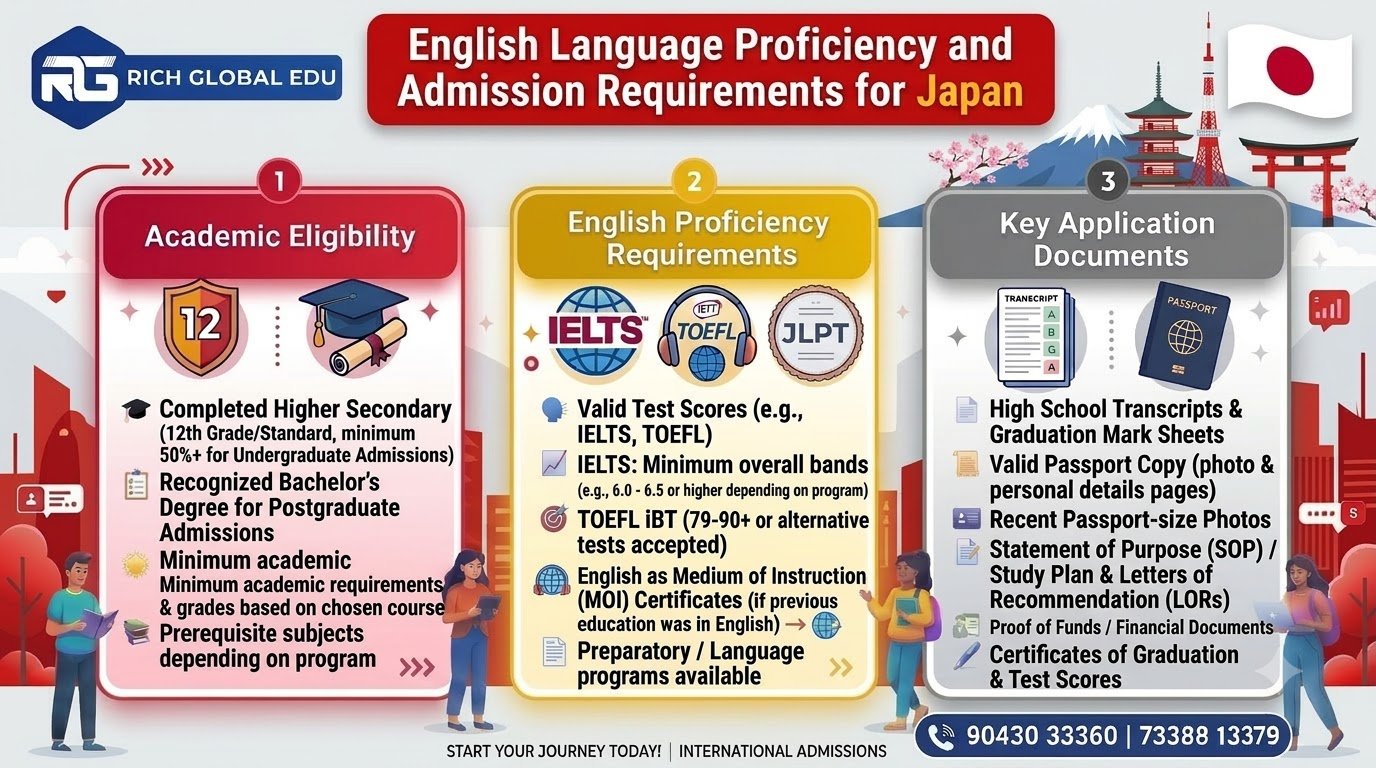
πŸ“ English Language Proficiency and Admission Requirements

Academic eligibility requirements for undergraduate and postgraduate admissions in Japanese universities for international students.
  • Applying for English-taught international programs in Japan involves a structured, merit-based admissions procedure:

Academic Eligibility:

  • For Undergraduate Admissions: Successful completion of 12th standard (Higher Secondary School Certificate) from a recognized Central or State Board (CBSE, ICSE, State Board) fulfilling the 12-year formal schooling requirement.
  • For Postgraduate Admissions: A recognized Bachelor’s degree in a relevant academic discipline.

English Proficiency Requirements:

  • Standardized English test scores such as IELTS (Academic band 6.0 to 6.5+) or TOEFL iBT (79 to 90+) are standard for English-taught international program tracks.
  • Note: Japanese language proficiency (JLPT) is not mandatory for admission into 100% English-medium degree tracks, though optional Japanese language courses are provided to aid daily life and part-time employment.
  • Key Application Documents: High school transcripts, graduation certificates, standardized test scores, Statement of Purpose (SOP), letters of recommendation, valid passport copy, and proof of financial capability.

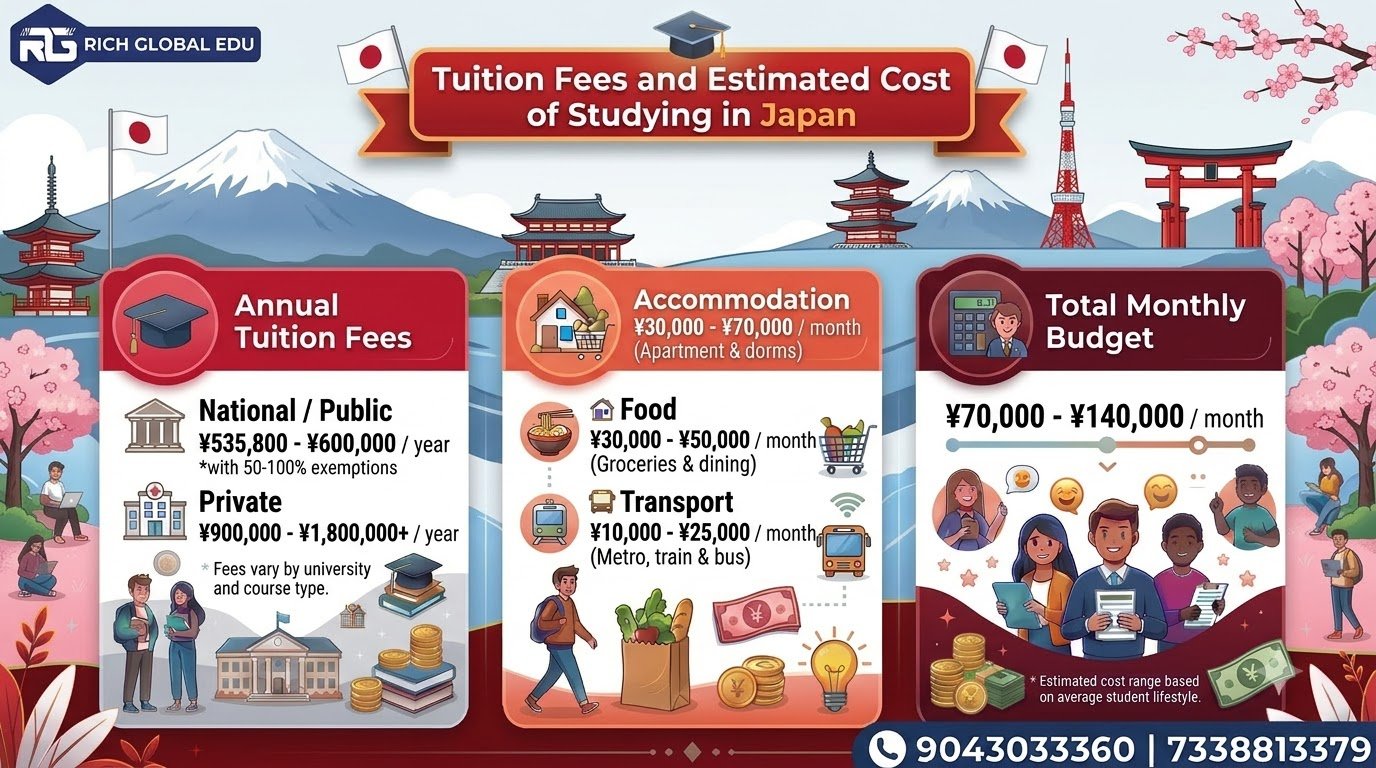
πŸ’³ Tuition Fees and Estimated Cost of Studying in Japan

Annual tuition fees at Japanese national and public universities, approximately Β₯535,800 to Β₯600,000 for international students.

Annual Tuition Fees Overview

National & Public Universities (Standardized Government Rates):

  • Approx. Β₯535,800 to Β₯600,000 per year (Approx. β‚Ή3,00,000 to β‚Ή3,36,000 / year) β€” often eligible for 50% to 100% tuition fee exemptions based on financial need or academic merit.

Private Universities:

  • Range from Β₯900,000 to Β₯1,800,000+ per year (Approx. β‚Ή5,04,000 to β‚Ή10,08,000 / year) depending on the specific faculty (arts vs. medicine/engineering).

Monthly Living Expenses (Regional vs. Tokyo Hubs)

Accommodation (University International Dormitories / Student Housing):

  • Β₯30,000 to Β₯70,000 per month (Approx. β‚Ή16,800 to β‚Ή39,200 β€” lower in regional cities like Hokkaido, Fukuoka, or Sendai)

Food & Groceries (Student Canteens & Self-Cooking):

  • Β₯30,000 to Β₯50,000 per month (Approx. β‚Ή16,800 to β‚Ή28,000)

Transportation, Utilities & Mobile Internet:

  • Β₯10,000 to Β₯25,000 per month (Approx. β‚Ή5,600 to β‚Ή14,000)

Total Estimated Monthly Living Budget:

  • Β₯70,000 to Β₯140,000 per month (Approx. β‚Ή39,200 to β‚Ή78,400 depending on city and lifestyle)

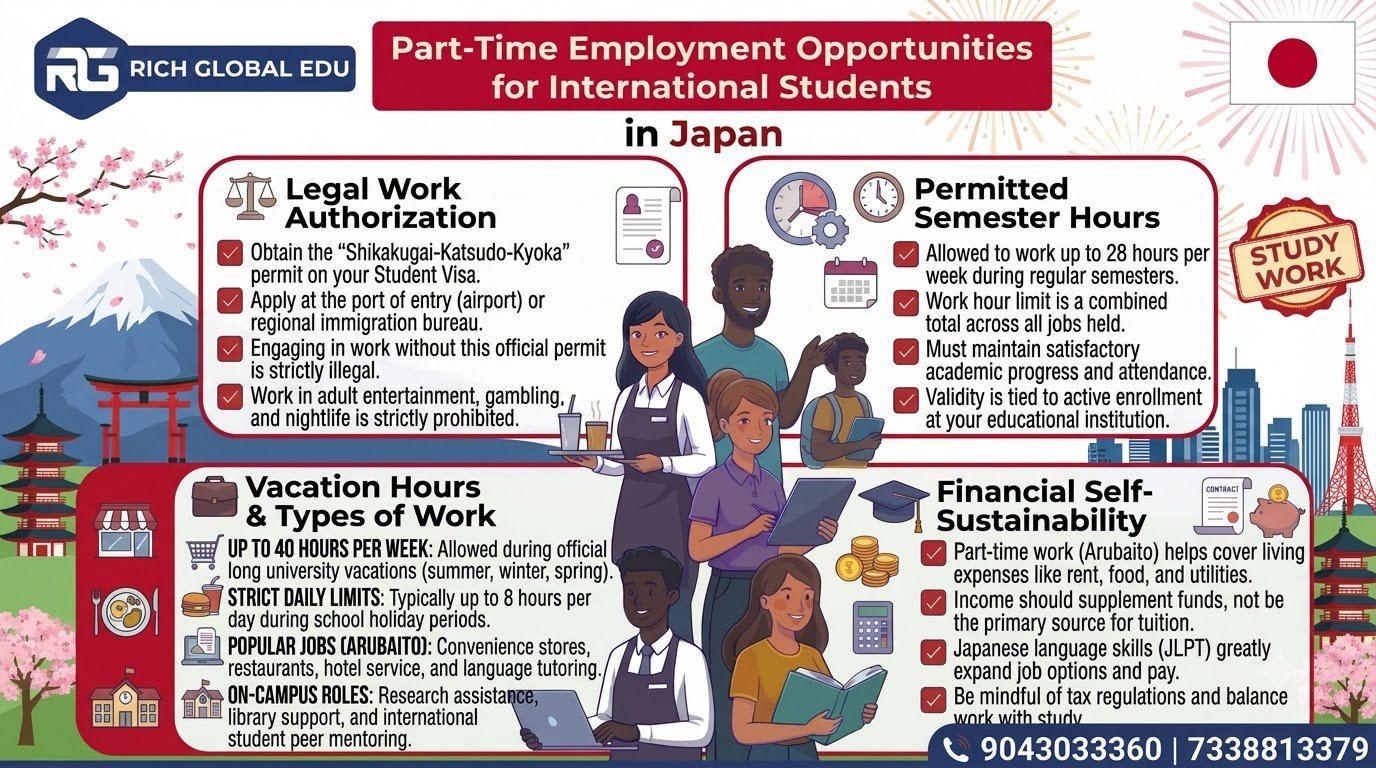
πŸ’Ό Part-Time Employment Opportunities for International Students

Legal part-time employment permission for international students holding valid student visas in Japan.
  • Legal Work Authorization (Shikakugai-Katsudo-Kyoka): International students holding a valid Student Visa are legally permitted to work part-time upon obtaining a “Permission to Engage in Activity Other Than That Permitted under the Status of Residence Previously Granted” stamp.
  • Permitted Semester Hours: Up to 28 hours per week during active academic semesters.
  • Vacation Working Privileges: Up to 8 hours per day (40 hours per week) during official university summer, winter, and spring breaks.
  • Financial Self-Sustainability: Part-time employment (Arubaito) in retail, tutoring, hospitality, or corporate offices helps students cover monthly living and food expenses, fostering independence while easing financial pressure on families.

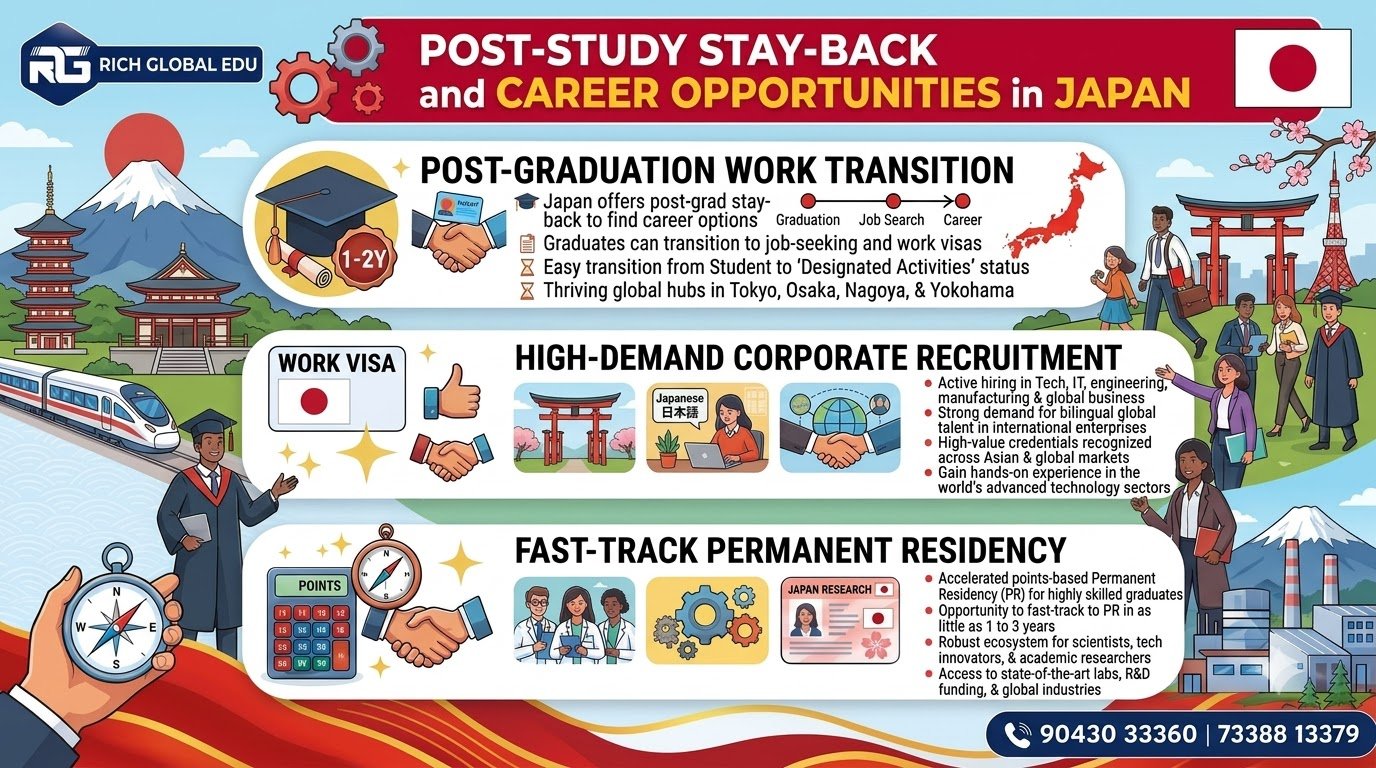
πŸ“ˆ Post-Study Stay-Back and Career Opportunities

Post-graduation work visa transition opportunities for international students securing employment with Japanese companies.
  • Post-Graduation Job-Seeker / Working Visa Transition: Upon graduation, international students can easily transition from a student visa to a standard work visa (e.g., Engineer / Specialist in Humanities / International Services) upon securing corporate employment.
  • High-Demand Corporate Recruitment: Japanese corporations actively hire international graduates fluent in English and skilled in tech, engineering, and global business, backed by government initiatives to welcome thousands of global professionals.
  • Fast-Track Permanent Residency: Japan offers one of the world’s most accelerated points-based permanent residency systems for highly skilled foreign professionals, opening long-term stability and career security.

πŸ—“οΈ University Intakes and Admission Periods

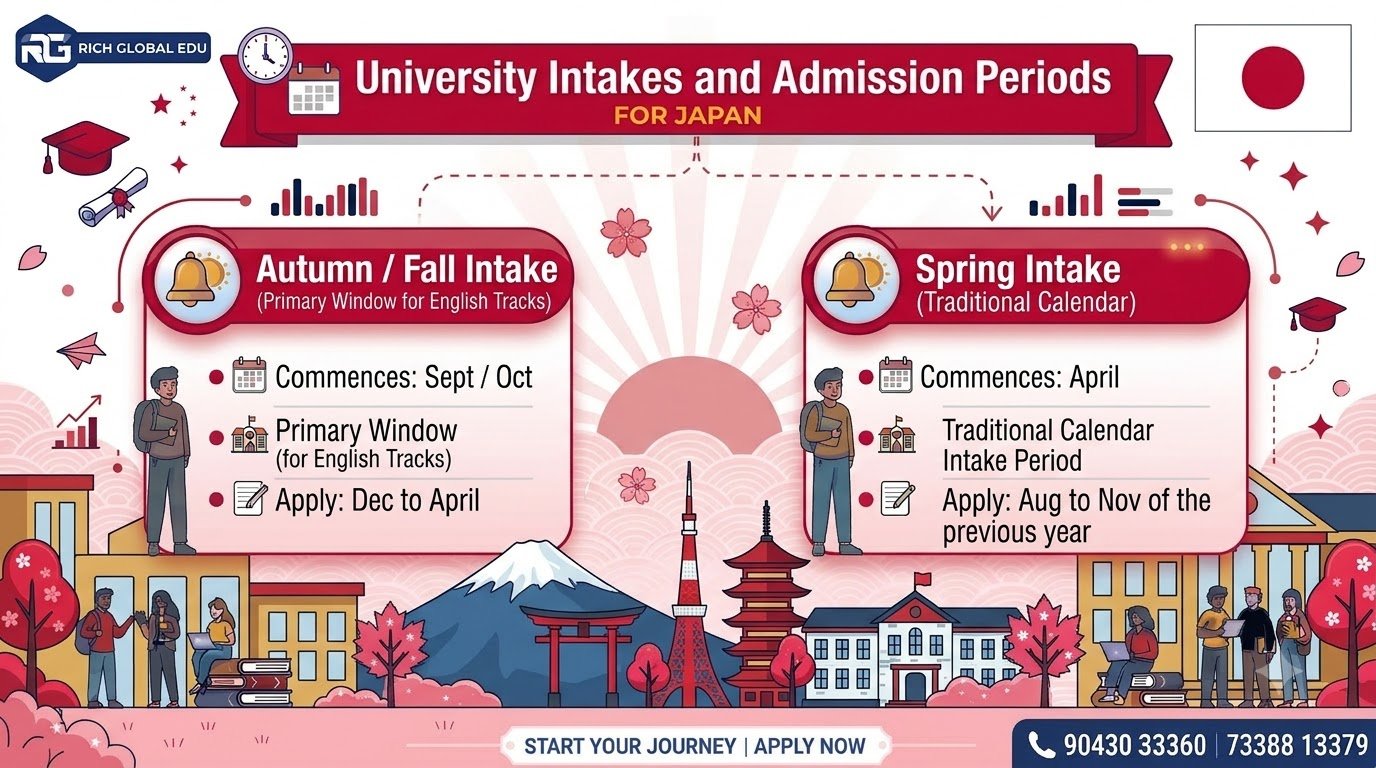
Autumn and fall university intake in Japan for international students applying to English-taught degree programs.
  • Japanese universities operate primarily on a two-semester academic calendar:

Autumn / Fall Intake (Primary Window for English-Taught Programs):

  • Semester Commences: September or October
  • Application Window: Generally opens between December and April of the same year.

Spring Intake (Traditional Japanese Academic Calendar):

  • Semester Commences: April
  • Application Window: August to November of the previous year.

⭐ LIST OF POPULAR UNIVERSITIES IN JAPAN

  1. Hokkaido University
  2. Tohoku University
  3. University of Tsukuba
  4. University of Aizu
  5. Nagoya University
  6. Nagoya Institute of Technology
  7. Osaka University
  8. Kyushu University
  9. Hiroshima University
  10. Okayama University
  11. Yamaguchi University
  12. Tokushima University
  13. Ehime University
  14. Tokyo University of Foreign Studies (TUFS)
  15. Tokyo University of Agriculture and Technology (TUAT)
  16. Yokohama National University
  17. Kobe University
  18. Kyushu Institute of Technology
  19. Akita International University (AIU)
  20. Shizuoka University
  21. Tokyo Metropolitan University
  22. Ochanomizu University
  23. Chiba University
  24. Kanazawa University
  25. Niigata University
  26. Kumamoto University
  27. Nagasaki University
  28. University of Miyazaki
  29. Kagoshima University
  30. University of the Ryukyus

πŸ‘₯ Study Abroad Counselling and Student Support Services

Navigating Japanese university admissions portals, scholarship applications (MEXT/JASSO), and consular student visa documentation requires meticulous planning. Professional study-abroad counselors support students and parents through every step:

  • Comprehensive profile assessment and strategic English-taught university program matching.
  • Complete scholarship application assistance (MEXT scholarship guidance and university fee exemption filings).
  • Document preparation, translation coordination, and application submission tracking.
  • Certificate of Eligibility (COE) processing and student visa consular documentation support.
  • Pre-departure orientation, housing bookings, and ongoing student support.

❓ Frequently Asked Questions About Studying in Japan

1. Is Japan safe for international students living abroad for the first time?

  • Yes. Japan is universally recognized as one of the safest countries globally, featuring extremely low crime rates, safe public transportation systems, secure student dormitories, and extremely welcoming local communities.

2. Can I complete my degree entirely in English in Japan?

  • Yes. Numerous top-tier Japanese national and private universities offer structured undergraduate and postgraduate degree tracks taught 100% in English.

3. Are scholarships accessible for international applicants in Japan?

  • Yes. Japan offers robust financial aid options, including prestigious MEXT government scholarships, JASSO grants, and automatic 50% to 100% tuition fee reductions at national universities based on academic performance.

4. Can part-time jobs cover living expenses in Japan?

  • Yes. With a legal part-time work permit allowing up to 28 hours per week during semesters, students can comfortably earn enough to manage their monthly food, utility, and personal living expenses independently.

πŸ“ž Connect With Our Global Admissions Team

πŸ“© DM us “PNU 2026” on WhatsApp for a free profile evaluation, course guide, and scholarship plan!

πŸ“± Call / WhatsApp: 9043033360 | 7338813379

🌐 Website: www.richglobaledu.com

Rich Global Edu β€” PIONEER in making global education affordable to all. 🌍✨

Study Abroad. Get Licensed. Go Global.

Book your Free Counselling

About Us

Business Legal Name

RICH GLOBAL

Quick Links

Countries for MBBS Abroad

Top Universities for MBBS

FAQs

Best Countries for Studying MBBS Abroad

MBBS in Moldova

MBBS in Nepal

MBBS in USA

Β© 2024Β Rich Global Edu

error: Content is protected !!