"Every learner who places their trust in Rich Global becomes our responsibility."

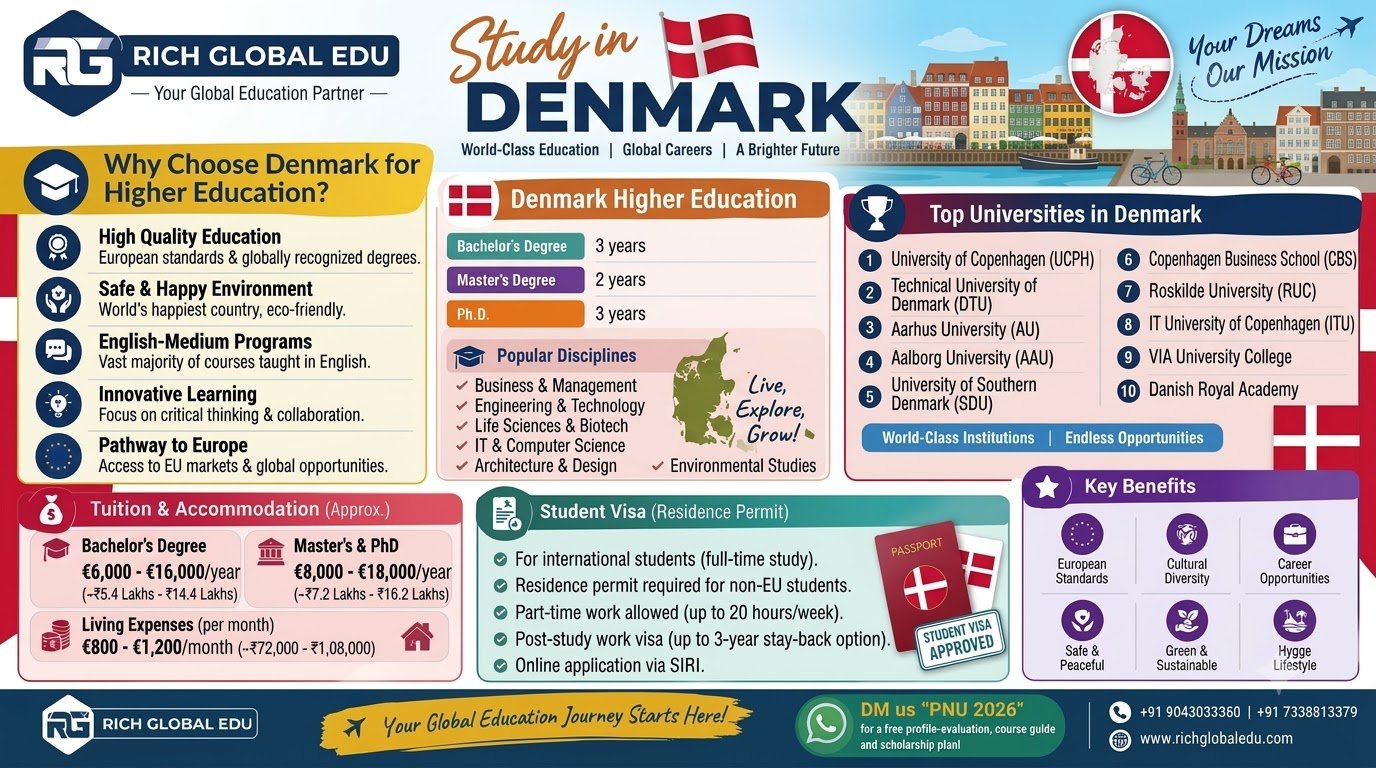
Study in Denmark guide highlighting world-class universities, innovative education, English-taught degree programs, student safety, sustainability, and study opportunities for international students.

🎓 Study in Denmark: A Comprehensive Guide for International Students

  • Denmark has firmly established itself as one of Europe’s most progressive, innovative, and intellectually vibrant study-abroad destinations. Fusing world-renowned academic excellence rooted in problem-based learning and independent thinking, absolute personal safety, cutting-edge sustainability, and a society where English is spoken fluently by nearly everyone, Denmark offers an exceptional, high-value educational pathway for Indian 12th-grade students and postgraduate applicants.
  • With a comprehensive portfolio of fully English-taught Bachelor’s and Master’s degree programs—spanning engineering, life sciences, green technology, design, and global business—international students can pursue elite European qualifications without language barriers inside or outside the classroom.

🏛️ Overview of Higher Education in Denmark

  • Supervised by the Danish Ministry of Higher Education and Science, higher education in Denmark complies fully with the European Bologna Process (Bachelor’s, Master’s, and Ph.D. cycles).

Higher education institutions in Denmark are primarily categorized into:

  1. Universities (Universiteter): Comprehensive institutions conducting both high-level scientific research and research-based undergraduate and postgraduate degree programs.
  2. University Colleges (Professionshøjskoler): Institutions focusing on professionally oriented undergraduate programs, combining theoretical learning with mandatory practical internships.
  • All study programs utilize the European Credit Transfer and Accumulation System (ECTS), ensuring seamless academic credit recognition across the European Union and globally.

🌏 Denmark: Country Profile and Key Facts

  • Official Name: Kingdom of Denmark (Kongeriket Danmark)
  • Capital City: Copenhagen
  • Major Educational Hubs: Copenhagen, Aarhus, Odense, Aalborg, Esbjerg, Roskilde
  • Official Language: Danish; English is spoken fluently by over 86% of the population, making daily academic and social integration entirely seamless.
  • Currency: Danish Krone (DKK / kr) | 1 DKK ≈ ₹12–₹12.50 INR (exchange rates fluctuate naturally)
  • Global Innovation & Green Tech Leader: Home to world-leading companies and pioneers in renewable energy, shipping, pharmaceuticals, design, and biotechnology (including Novo Nordisk, Vestas, Maersk, and LEGO).
  • Safety & Quality of Life: Consistently ranked among the happiest, safest, and most transparent societies in the world, featuring high living standards and welcoming student communities.

🚀 Why Choose Denmark for Higher Education?

  • World-Class Global University Rankings: Danish research universities consistently hold top positions in global QS and Times Higher Education rankings.
  • Unmatched English Proficiency: Extensive availability of accredited degree programs taught entirely in English, ensuring a smooth transition for international students.
  • Problem-Based Learning (PBL): A distinctive, collaborative teaching methodology that emphasizes critical thinking, teamwork, creativity, and real-world industry application over rote memorization.
  • Strong Industry Collaboration: Close cooperation between academic faculties and global Danish enterprises, providing valuable thesis projects, internships, and networking opportunities.
  • 6-Month Post-Study Job-Seeker Period: Generous post-graduation stay-back rights that allow international graduates time to secure skilled professional employment in Denmark.

📚 Denmark’s Higher Education System

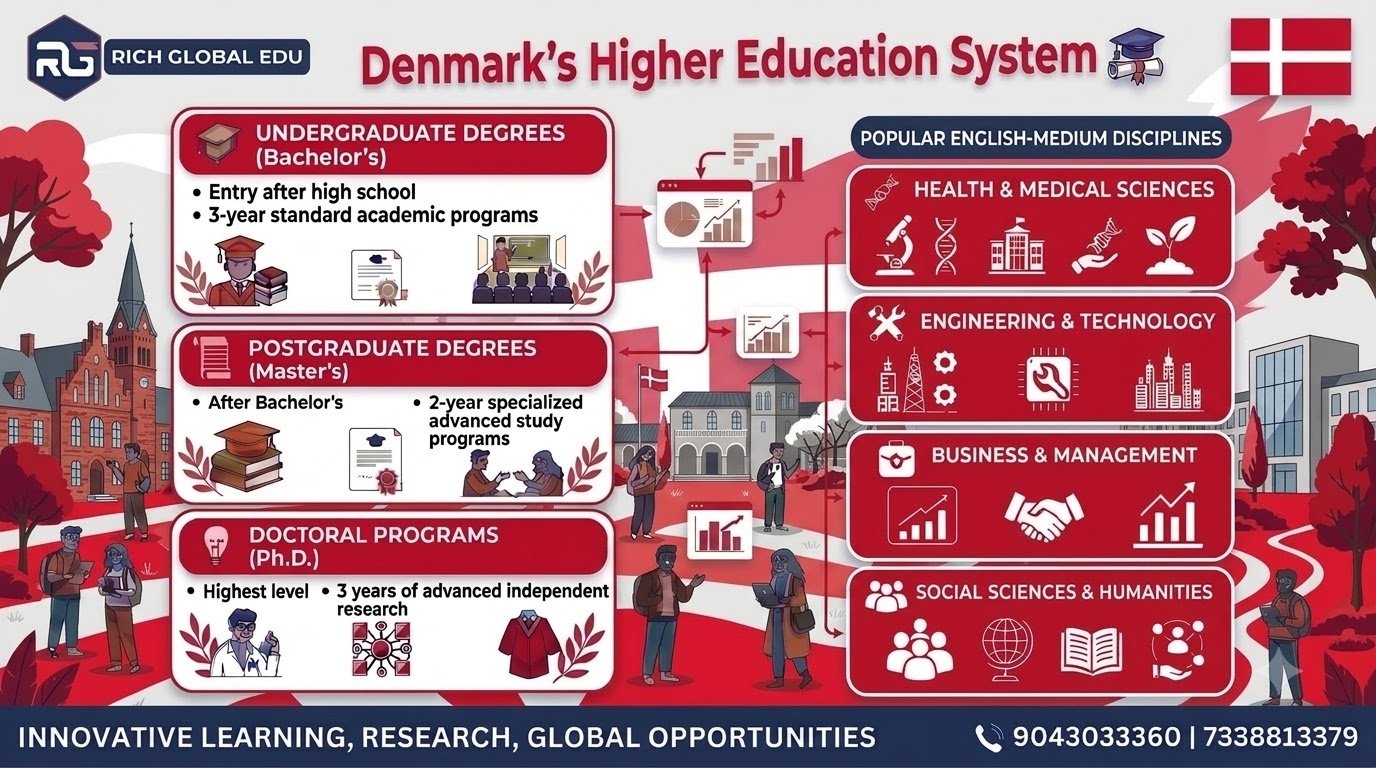
Denmark’s higher education system featuring Bachelor’s, professional Bachelor’s, Master’s, and PhD programs, with English-taught courses in engineering, business, life sciences, technology, design, and architecture.
  • Undergraduate Degree Programs (Bachelor’s / Professionsbachelor / Bachelorgrad): Typically 3-year academic university programs (180 ECTS) or 3.5- to 4-year professional bachelor programs (210–240 ECTS) at university colleges.
  • Postgraduate Degree Programs (Master’s / Kandidatuddannelse): 2-year specialized advanced study degrees (120 ECTS credits) with a vast portfolio taught entirely in English.
  • Doctoral Programs (Ph.D.): 3 years of salaried researcher positions embedded within university faculties.
  • Popular English-Medium Disciplines for International Students:
  • Engineering & Technology: Software Engineering, Computer Science, Sustainable Energy Engineering, Biotechnology, Robotics, Civil Engineering
  • Business, Economics & Innovation: International Business, Corporate Finance, Global Marketing, Entrepreneurship, Supply Chain Management
  • Life & Environmental Sciences: Environmental Science, Biomedical Engineering, Pharmaceutical Sciences, Marine Biology
  • Design & Architecture: Industrial Design, Interaction Design, Architecture, Urban Planning

📝 English Language Proficiency and Admission Requirements

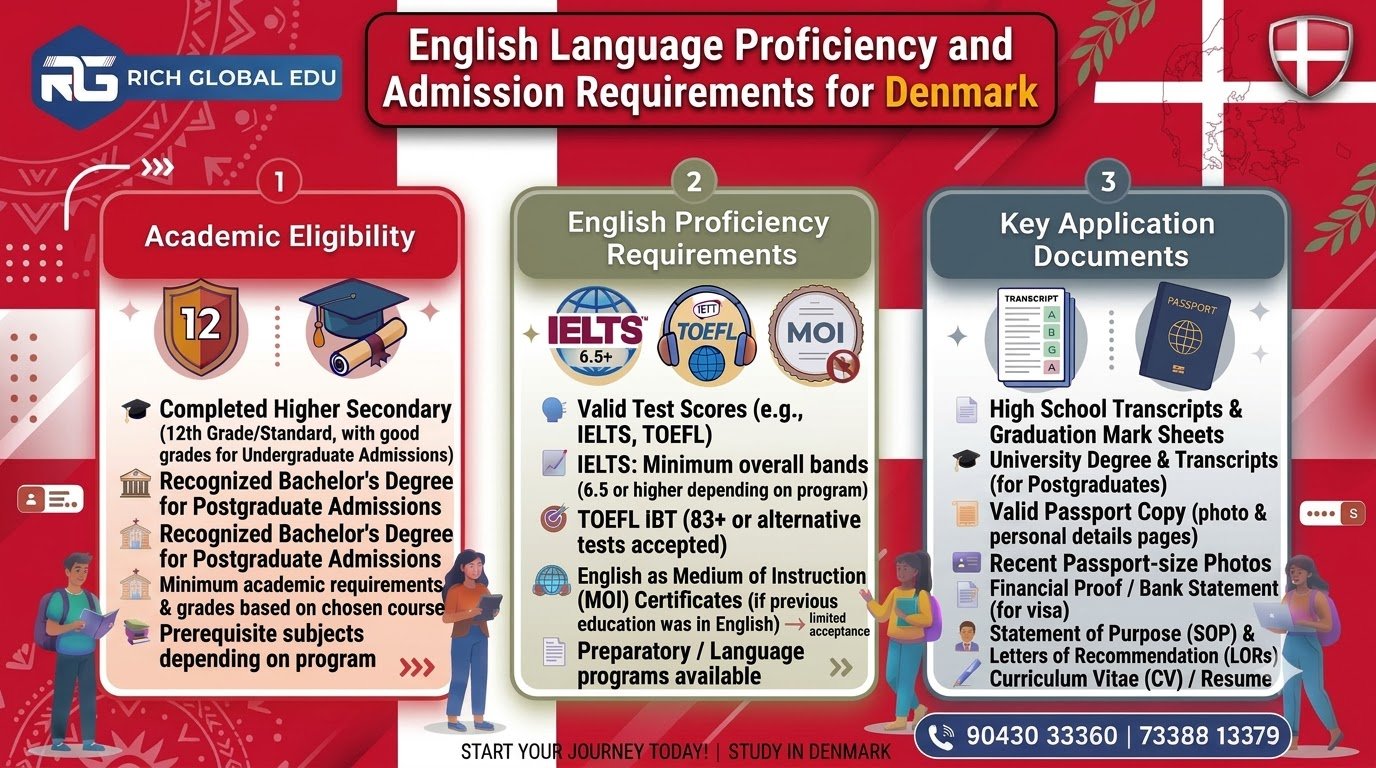
Denmark university admission requirements for international students, including academic qualifications, English proficiency tests such as IELTS and TOEFL, academic transcripts, passports, CVs, and motivation letters.
  • Admission procedures for international students are centralized, structured, and transparent via the Optagelse.dk portal or direct university admissions portals:

Academic Eligibility:

  • For Bachelor’s Programs: Successful completion of 12th standard (CBSE, ICSE, or State Board) with strong aggregate grades and meeting specific subject prerequisites.
  • For Master’s Programs: A recognized Bachelor’s degree in a relevant academic discipline matching specific ECTS credit requirements.

English Proficiency Requirements:

  • Standardized English test scores such as IELTS (Academic band 6.5+) or TOEFL iBT (83+ with writing score requirements) are mandatory for English-taught tracks.
  • Key Application Documents: Academic transcripts, higher school completion mark sheets, valid passport copy, Curriculum Vitae (CV), Statement of Purpose / Motivation Letter, and letters of recommendation.

💳 Tuition Fees and Estimated Cost of Studying in Denmark

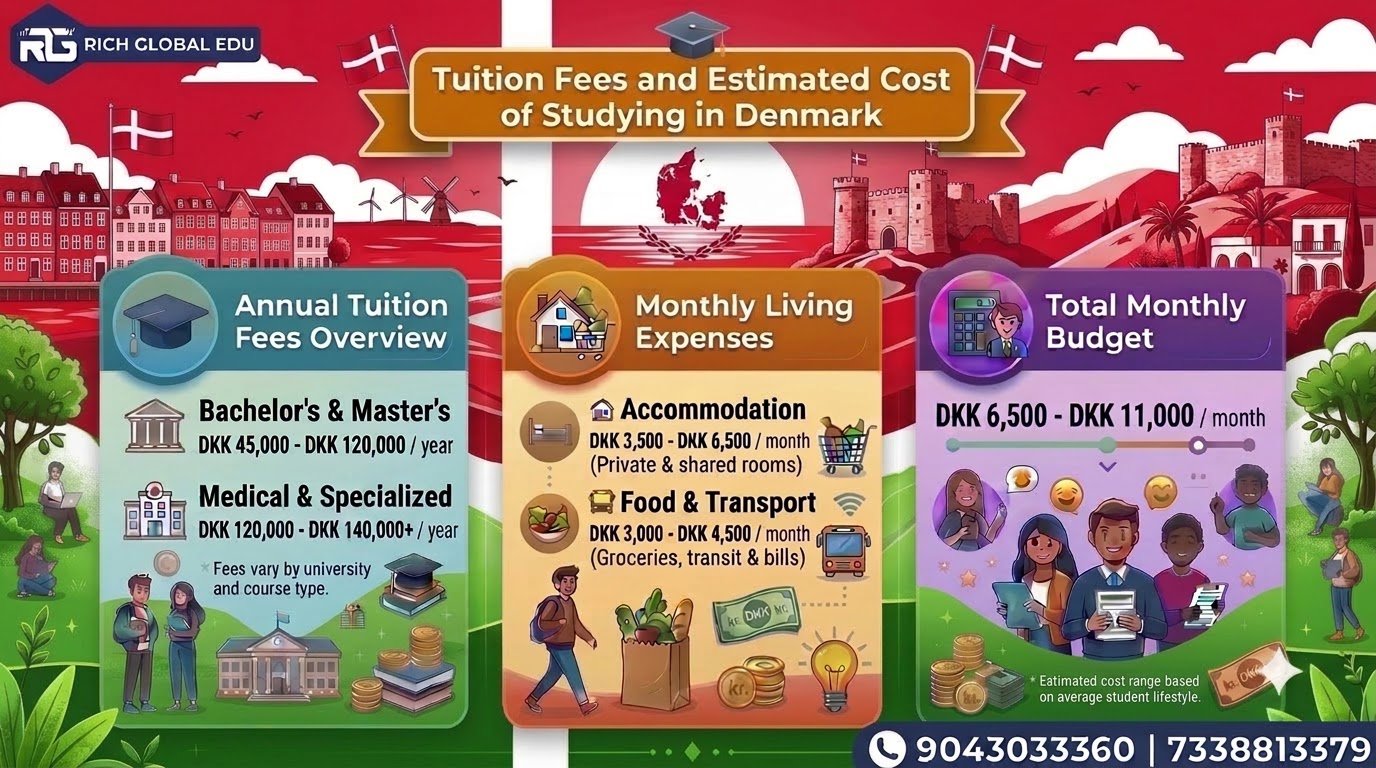
Denmark study cost guide showing estimated annual tuition fees, monthly accommodation expenses, groceries, transportation, utilities, and living budgets for international students in Danish cities.

Annual Tuition Fees Overview

Public Universities (Non-EU International Students):

  • Tuition fees for full-degree English-taught programs vary by institution and faculty, typically ranging from DKK 45,000 to DKK 140,000+ per year (Approx. ₹5,50,000 to ₹17,00,000 / year) depending on the program.

Monthly Living Expenses (Copenhagen/Aarhus vs. Regional University Hubs like Odense or Aalborg)

Accommodation (Student Housing / Kollegier / Rented Apartments):

  • DKK 3,500 to DKK 6,500 per month (Approx. ₹42,700 to ₹79,300 — student housing cooperatives offer high-quality subsidized rooms)

Food & Groceries:

  • DKK 2,000 to DKK 3,500 per month (Approx. ₹24,400 to ₹42,700)

Local Public Transport & Utilities:

  • DKK 350 to DKK 700 per month (Student discounts apply on regional transport passes)

Total Estimated Monthly Living Budget:

  • DKK 6,500 to DKK 11,000 per month (Approx. ₹79,300 to ₹1,34,200 depending on the city and lifestyle)

💼 Part-Time Employment Opportunities for International Students

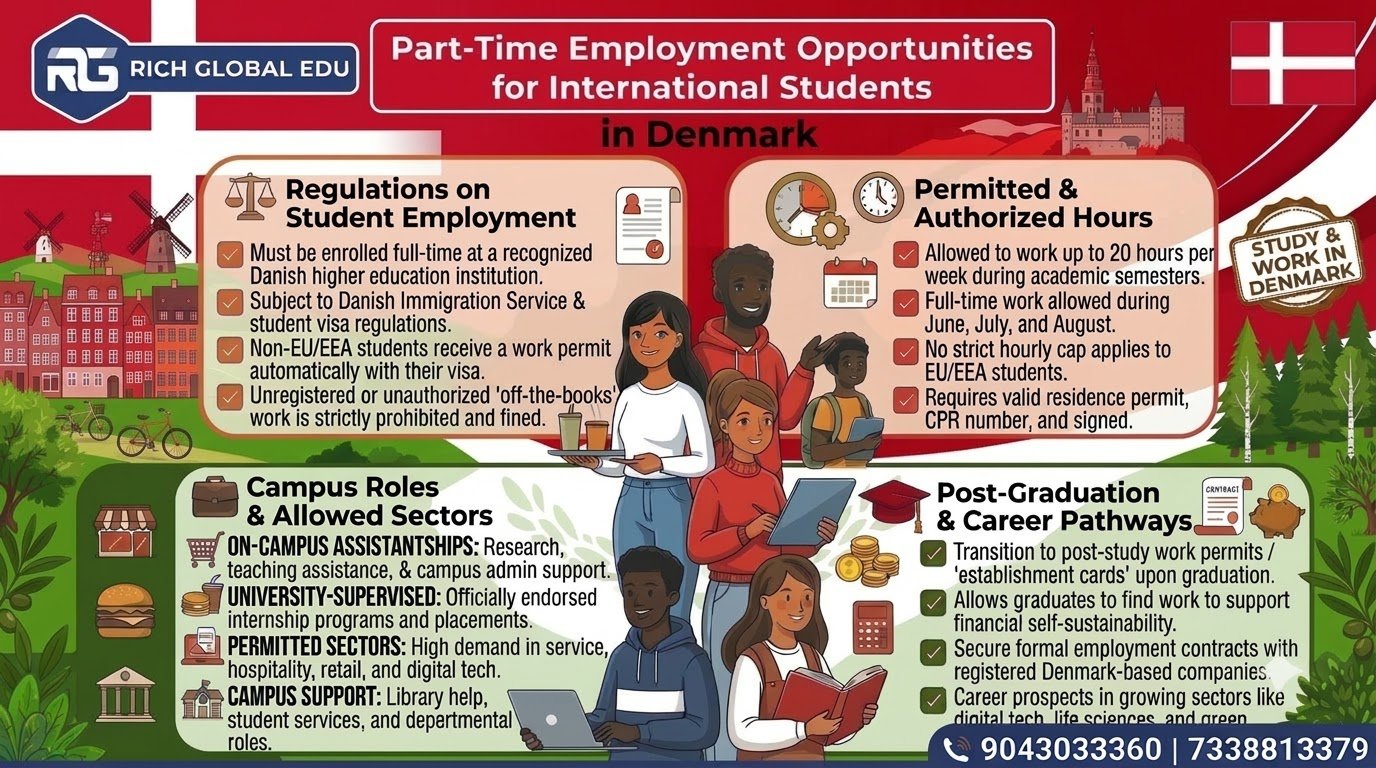
International students in Denmark exploring part-time employment opportunities in hospitality, retail, technology companies, university assistant positions, and other student-friendly workplaces.
  • Legal Work Regulations: International students holding a valid residence permit for studies are legally permitted to take up part-time employment alongside their academic schedule.
  • Permitted Hours: Unlike many other European nations, Denmark enforces no strict hourly caps on student work, allowing flexible employment as long as satisfactory academic progress is maintained.
  • Employment Sectors: Opportunities in Denmark’s service sectors, hospitality, retail, digital tech enterprises, and university student assistant roles.
  • Financial Self-Sustainability: Part-time earnings help students offset daily living costs while gaining valuable Scandinavian professional work experience.

📈 Post-Study Stay-Back and Career Opportunities

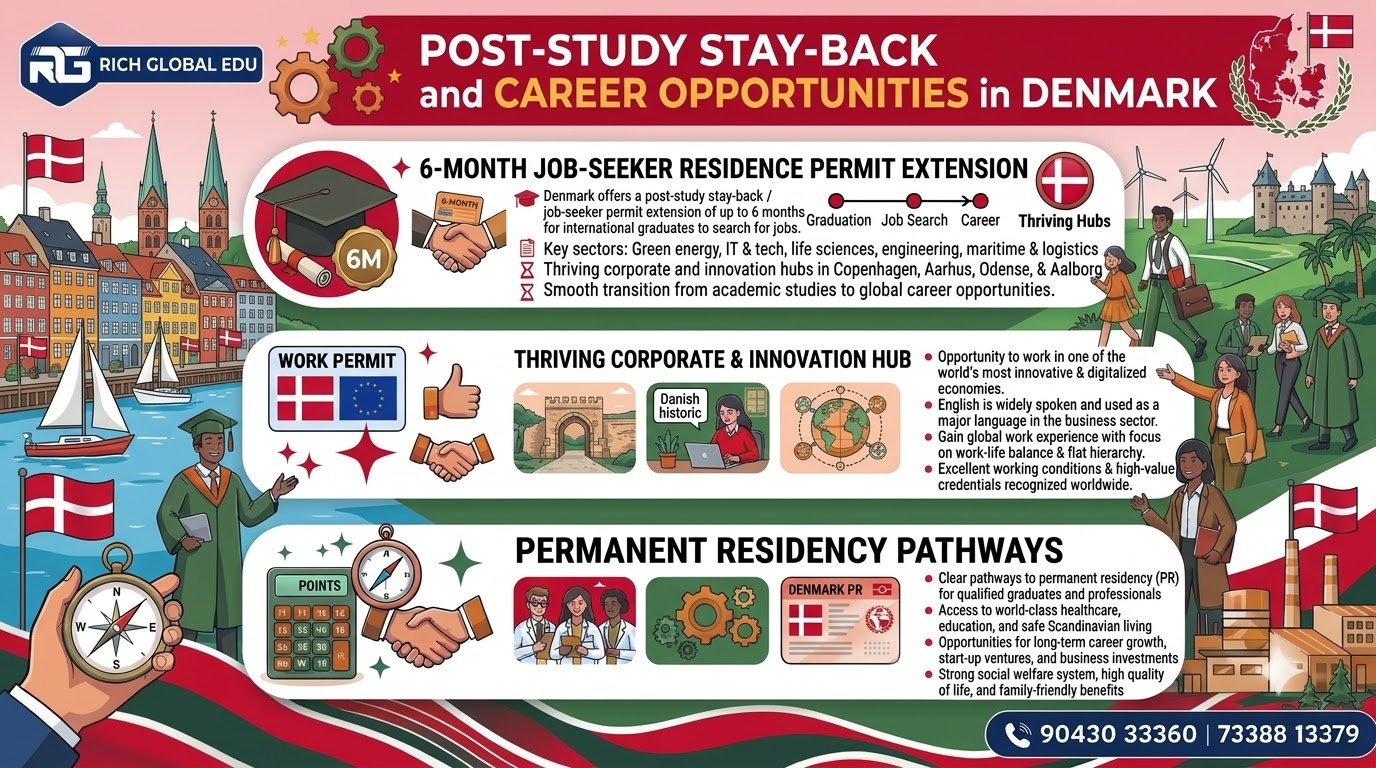
Denmark post-study career opportunities for international graduates in technology, renewable energy, engineering, research, business, and multinational companies.
  • 6-Month Job-Seeker Residence Permit Extension: Non-EU graduates from Danish higher education institutions automatically receive a 6-month post-study residence permit extension after graduation to search for skilled professional employment in Denmark.
  • Thriving Corporate & Innovation Hub: Denmark’s booming tech sectors, green energy firms, engineering enterprises, and multinational corporations actively recruit skilled global graduates.
  • Work Permit & Permanent Residency Pathways: Securing permanent full-time employment facilitates a smooth transition into a Danish work permit, paving the way toward permanent residency.

🗓️ University Intakes and Admission Periods

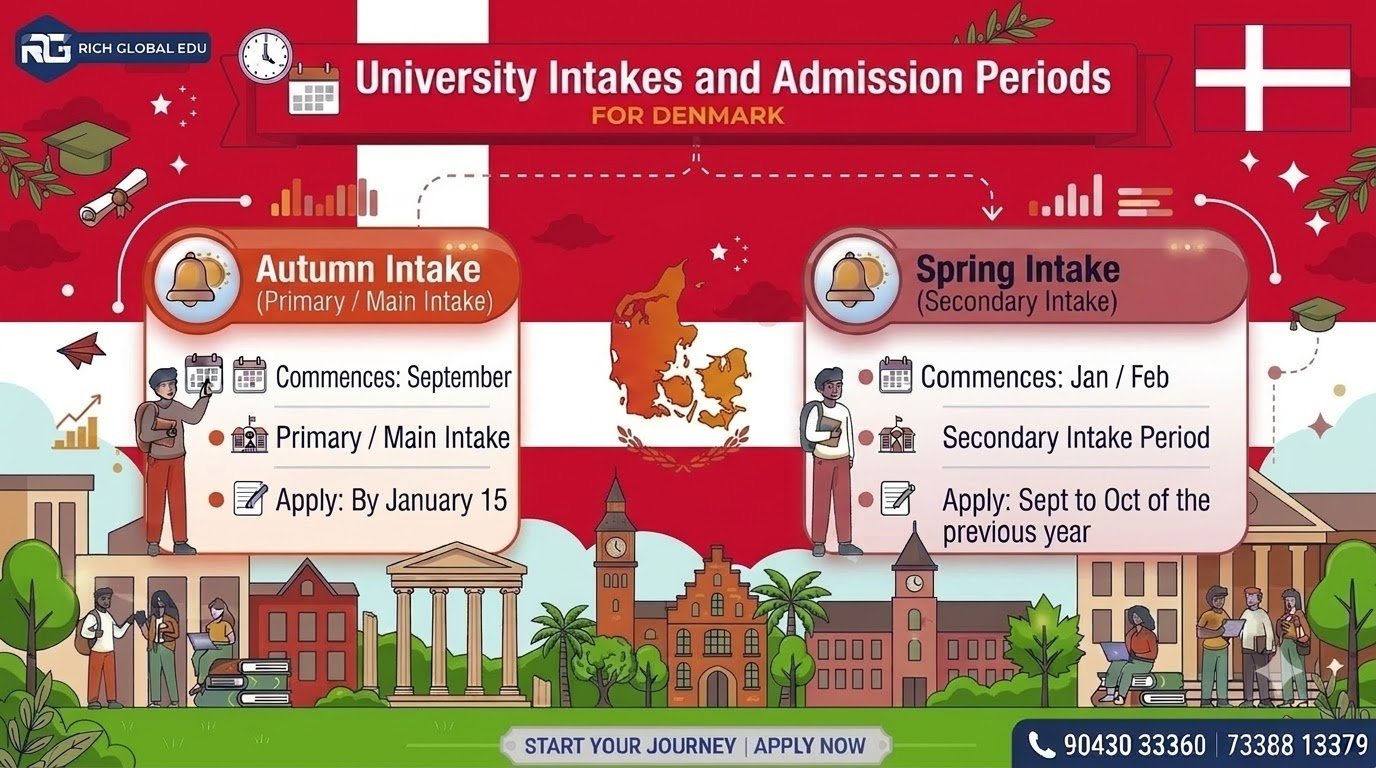
Denmark university admission calendar highlighting the main autumn intake, September semester commencement, application preparation, document submission, and university admission deadlines for international students.
  • Danish higher education institutions operate primarily on a single annual admissions cycle:

Autumn / Fall Intake (Main / Primary Intake):

  • Semester Commences: September
  • Application Window: International student application portals typically open in November or December and close on January 15th (for Bachelor’s and Master’s programs starting the following autumn).

⭐ LIST OF POPULAR UNIVERSITIES IN DENMARK

  1. University of Copenhagen
  2. Technical University of Denmark (DTU)
  3. Aarhus University
  4. Aalborg University
  5. University of Southern Denmark (SDU)
  6. Roskilde University (RUC)
  7. IT University of Copenhagen (ITU)
  8. Copenhagen Business School (CBS)
  9. Architectural School of Aarhus (Arkitektskolen Aarhus)
  10. Royal Danish Academy – Architecture, Design, Conservation
  11. Via University College
  12. Metropolitan University College (KP)
  13. University College Absalon
  14. University College Lillebaelt
  15. University College Nordjylland (UCN)
  16. University College South Denmark
  17. Zealand Academy of Technologies and Business
  18. Business Academy Aarhus
  19. Copenhagen Business Academy (Kuben)
  20. International Business Academy (IBA Kolding)
  21. Dania Academy (University of Applied Sciences)
  22. University College Copenhagen (KP)
  23. Royal Academy of Music, Aarhus/Aalborg
  24. Carl Nielsen Academy of Music
  25. Royal Danish Academy of Music
  26. Design School Kolding
  27. The Animation Workshop
  28. SDU Odense University Hospital Campus
  29. Aarhus School of Marine and Technical Engineering
  30. SIMAC (Svendborg International Maritime Academy)

👥 Study Abroad Counselling and Student Support Services

Navigating institutional application portals, residence permit documentation via SIRI (Danish Agency for International Recruitment and Integration), financial guarantees, and student housing queues requires expert guidance. Professional study-abroad counselors support students and parents through:

  • Tailored academic program matching across universities and university colleges.
  • Application document verification, translation coordination, and submission tracking.
  • SIRI student residence permit documentation support and financial proof guidance.
  • Pre-departure briefings, student housing applications (Kollegier), and arrival orientations.

❓ Frequently Asked Questions About Studying in Denmark

1. Is Denmark safe for international students moving abroad for the first time?

  • Yes. Denmark is consistently ranked among the safest, most stable, and peaceful societies in the world, featuring secure student housing, extremely low crime rates, and welcoming communities.

2. Do I need to speak Danish to study or live in Denmark?

  • No. English is spoken fluently by over 85% of people in Denmark, and international degree programs are conducted 100% in English, making daily academic and social integration effortless.

3. Can international students work while studying in Denmark?

  • Yes. International students holding a valid study residence permit enjoy legal part-time work rights in Denmark with no official caps on working hours, allowing them to balance part-time work alongside their studies.

4. What are the post-graduation work rights in Denmark?

  • Graduates automatically receive a 6-month post-study job-seeker residence permit extension to search for skilled employment in Denmark, offering excellent long-term career flexibility in Europe.

📞 Connect With Our Global Admissions Team

📩 DM us “PNU 2026” on WhatsApp for a free profile evaluation, course guide, and scholarship plan!

📱 Call / WhatsApp: 9043033360 | 7338813379

🌐 Website: www.richglobaledu.com

Rich Global Edu — PIONEER in making global education affordable to all. 🌍✨

Study Abroad. Get Licensed. Go Global.

Book your Free Counselling

About Us

Business Legal Name

RICH GLOBAL

Quick Links

Countries for MBBS Abroad

Top Universities for MBBS

FAQs

Best Countries for Studying MBBS Abroad

MBBS in Moldova

MBBS in Nepal

MBBS in USA

© 2024 Rich Global Edu

error: Content is protected !!