"Every learner who places their trust in Rich Global becomes our responsibility."

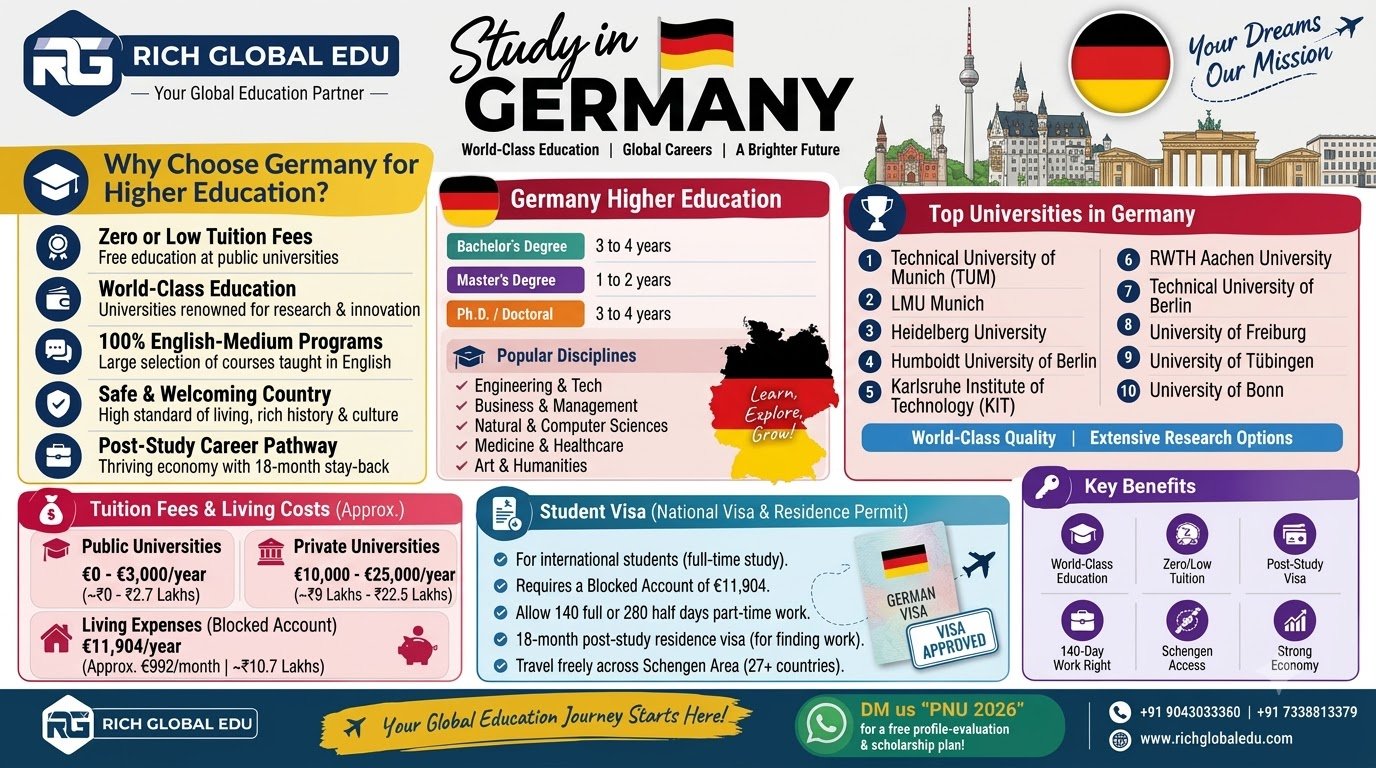
Germany as a leading European study-abroad destination offering world-class education, research excellence and affordable higher education for international students.

🎓 Study in Germany: A Comprehensive Guide for International Students

  • Germany has firmly established itself as Europe’s industrial powerhouse and premier educational destination. Combining tuition-free (or low-cost) public higher education, world-leading research institutions, absolute personal safety, and robust economic pathways, Germany offers an incredible, high-value study-abroad destination for Indian 12th-grade students and postgraduate applicants.
  • With an expansive range of fully English-taught Bachelor’s and Master’s degree programs across public and private universities, international students can gain globally recognized qualifications without encountering language barriers in the classroom.

🏛️ Overview of Higher Education in Germany

  • Supervised by the Standing Conference of the Ministers of Education and Cultural Affairs (KMK) and the German Academic Exchange Service (DAAD), higher education in Germany follows strict quality standards under the Bologna Process (Bachelor’s, Master’s, and Ph.D. cycles).
  • German higher education institutions are primarily categorized into Technical Universities (TU) focusing on advanced theoretical research, Universities of Applied Sciences (Fachhochschulen / Hochschule) emphasizing practical, industry-integrated training, and specialized business or private institutions. Public universities across most German federal states charge zero tuition fees for both domestic and international students, making it an unmatched global destination.

🌏 Germany: Country Profile and Key Facts

  • Official Name: Federal Republic of Germany (Bundesrepublik Deutschland)
  • Capital City: Berlin
  • Major Educational Hubs: Munich, Berlin, Frankfurt, Hamburg, Aachen, Stuttgart, Heidelberg, Cologne
  • Official Language: German; English is widely utilized across all international university degree tracks, corporate business environments, and urban areas
  • Currency: Euro (€ / EUR) | 1 EUR ≈ ₹90–₹92 INR (exchange rates fluctuate naturally)
  • Europe’s Economic Leader: Home to global industrial and tech leaders including BMW, Mercedes-Benz, Siemens, SAP, Bosch, BASF, and Allianz
  • Safety & Security: Consistently ranked among the safest and most stable countries in the world, featuring efficient public transit and secure, cosmopolitan communities

🚀 Why Choose Germany for Higher Education?

  • Tuition-Free Public Higher Education: Public universities in 15 out of 16 German federal states charge zero tuition fees for undergraduate and master’s degree programs.
  • Globally Recognized Degrees: Degrees earned in Germany carry universal academic prestige and open doors across global industries.
  • 100% English-Medium Programs: Thousands of accredited Bachelor’s and Master’s programs delivered entirely in English across STEM, business, and social sciences.
  • Strong Practical Exposure & Industry Ties: Mandatory university internships, working student roles (Werkstudent), and research projects directly tied with Fortune 500 companies.
  • 18-Month Post-Study Job-Seeker Visa: Generous stay-back rights that allow international graduates ample time to secure full-time professional employment.

📚 Germany’s Higher Education System

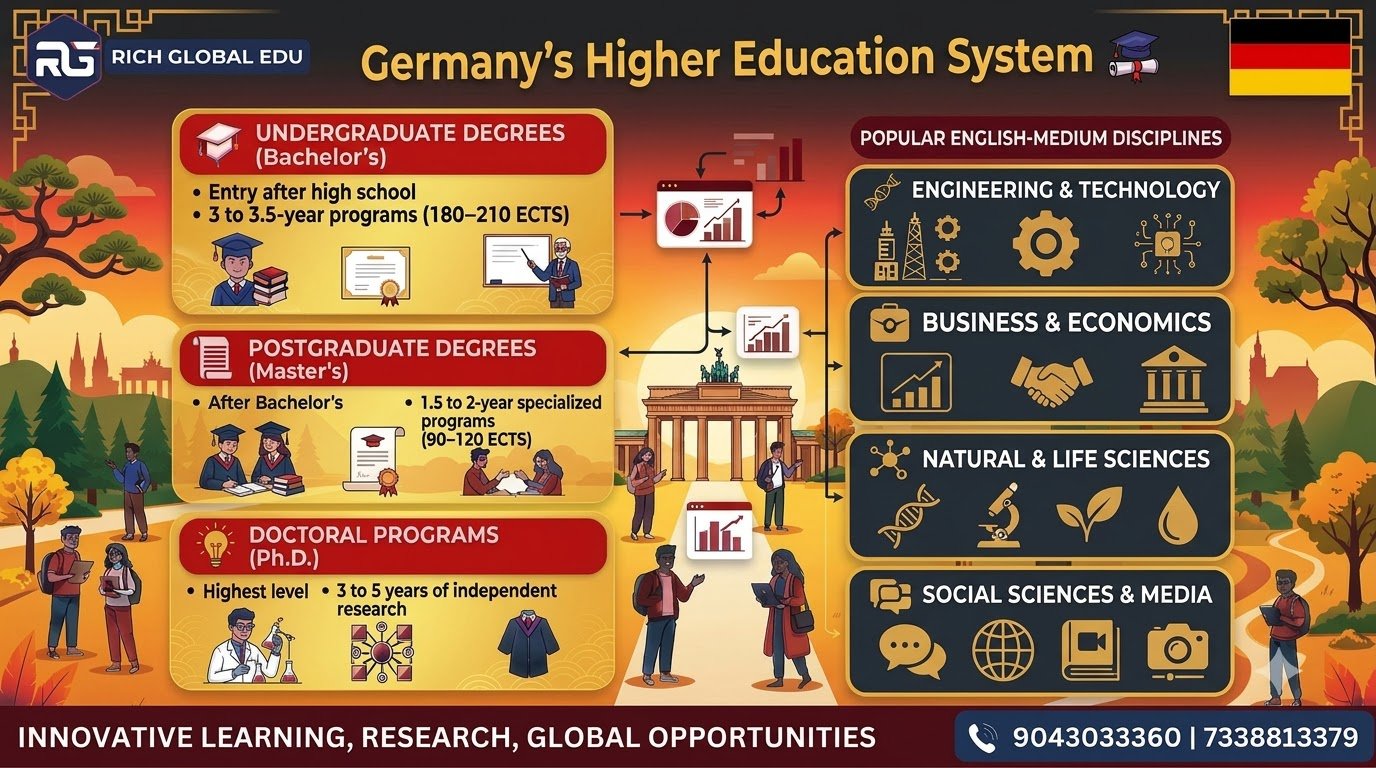
Germany's higher education system offering bachelor's, master's and doctoral degree programs across engineering, business, science and social science disciplines.
  • Undergraduate Degree Programs (Bachelor’s): Typically 3 to 3.5 years of structured study (180 to 210 ECTS credits).
  • Postgraduate Degree Programs (Master’s): 1.5 to 2 years of specialized advanced study (90 to 120 ECTS credits).
  • Doctoral Programs (Ph.D.): 3 to 5 years of independent, high-impact research.
  • Popular English-Medium Disciplines for International Students:
  • Engineering & Technology: Mechanical Engineering, Automotive Engineering, Computer Science, Artificial Intelligence, Robotics, Data Science, Electrical Engineering
  • Business & Economics: International Management, Finance, Business Analytics, Supply Chain & Logistics, E-Commerce
  • Natural & Life Sciences: Biotechnology, Environmental Engineering, Renewable Energy, Physics, Chemistry
  • Social Sciences & Media: International Relations, Digital Media, Global Communications

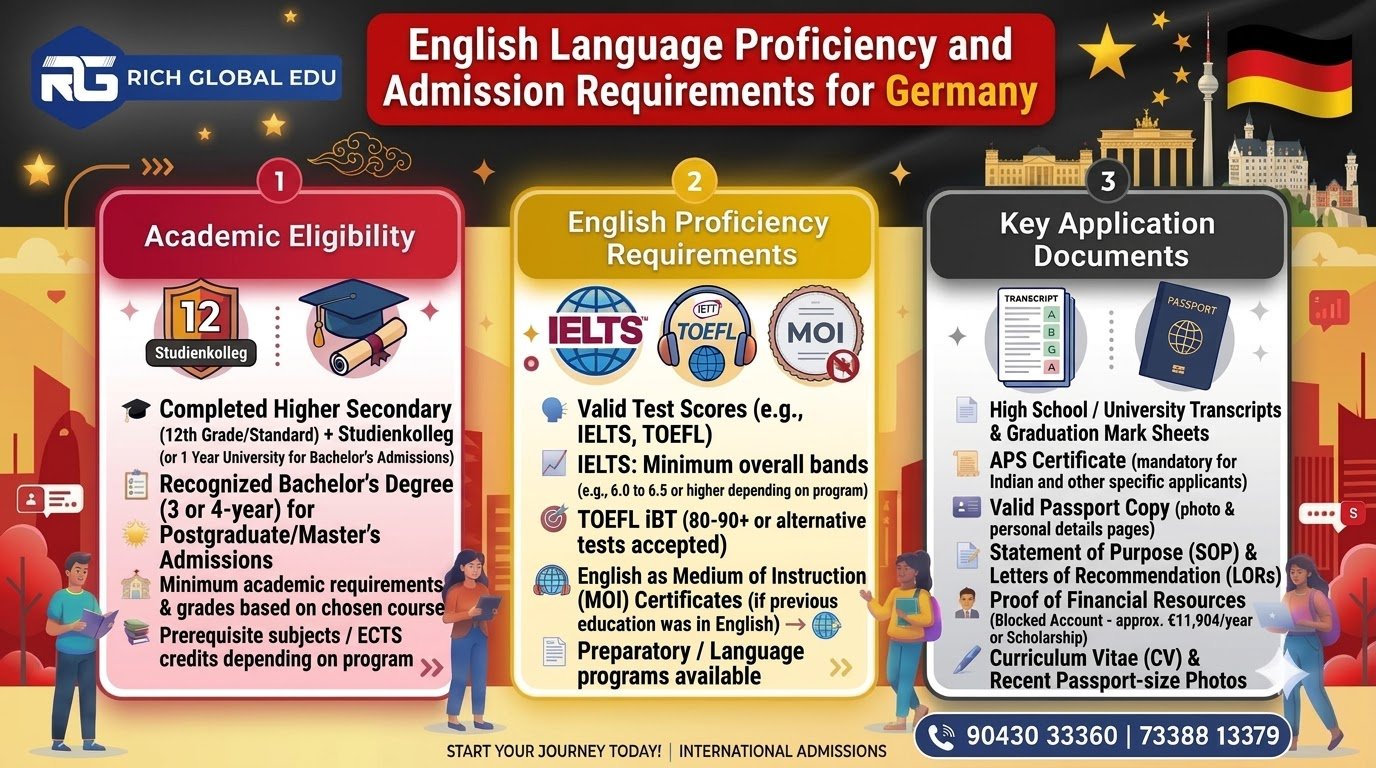
📝 English Language Proficiency and Admission Requirements

Germany university admission requirements for international students, including academic qualifications, IELTS, TOEFL, APS certificates and application documents.
  • Admission procedures for international students are structured and merit-based:

Academic Eligibility:

  • For Undergraduate / Bachelor’s Programs: Completion of 12th standard (CBSE, ICSE, or State Board). Direct entry into 3-year German Bachelor’s programs often requires 1 year of completed university education in India or completion of a 1-year preparatory course (Studienkolleg) unless specific board eligibility rules apply.
  • For Postgraduate / Master’s Programs: A recognized 3- or 4-year Bachelor’s degree in a relevant academic discipline.

English Proficiency:

  • Standardized English test scores such as IELTS (typically band 6.0 to 6.5+) or TOEFL iBT (80 to 90+) are required for English-taught tracks.
  • Key Application Documents: Academic transcripts, APS Certificate (Academic Evaluation Centre verification for Indian applicants), Statement of Purpose (SOP), letters of recommendation, valid passport copy, and proof of financial capability (Blocked Account).

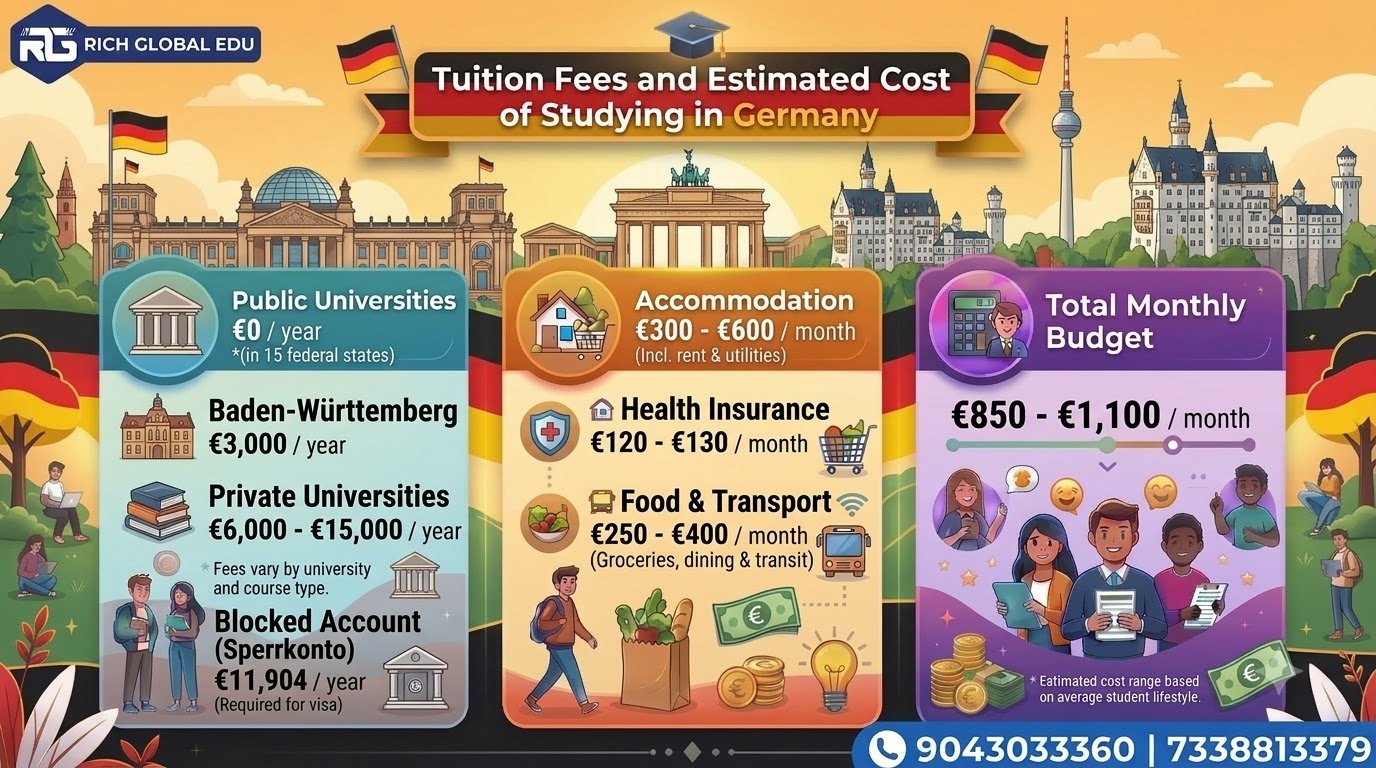
💳 Tuition Fees and Estimated Cost of Studying in Germany

Germany study costs for international students covering public and private university tuition fees, accommodation, health insurance and monthly living expenses in euros and Indian rupees.

Annual Tuition Fees Overview

Public Universities (15 Federal States):

  • €0 Tuition Fees (Only nominal semester contributions / Semesterbeitrag of approx. €150 to €400 per semester, which includes a regional public transit pass).

Public Universities in Baden-Württemberg:

  • Approx. €1,500 per semester (Approx. €3,000 / ₹2,70,000 per year) for non-EU students.

Private Universities:

  • Range from €6,000 to €15,000 per year (Approx. ₹5,40,000 to ₹13,500,000 / year) depending on the program.

Monthly Living Expenses & Blocked Account Requirement

Official Blocked Account Requirement (Sperrkonto):

  • Approx. €11,904 per year (Approx. €992 per month / ₹89,280 per month) deposited to guarantee living funds for visa issuance.

Accommodation (Student Dormitories / Shared Flat – WG):

  • €300 to €600 per month (Approx. ₹27,000 to ₹54,000)

Health Insurance (Mandatory Public Coverage):

  • Approx. €120 to €130 per month (Approx. ₹10,800 to ₹11,700)

Food, Transport & Personal Expenses:

  • €250 to €400 per month (Approx. ₹22,500 to ₹36,000)

Total Estimated Monthly Living Budget:

  • €850 to €1,100 per month (Approx. ₹76,500 to ₹99,000 depending on the city)

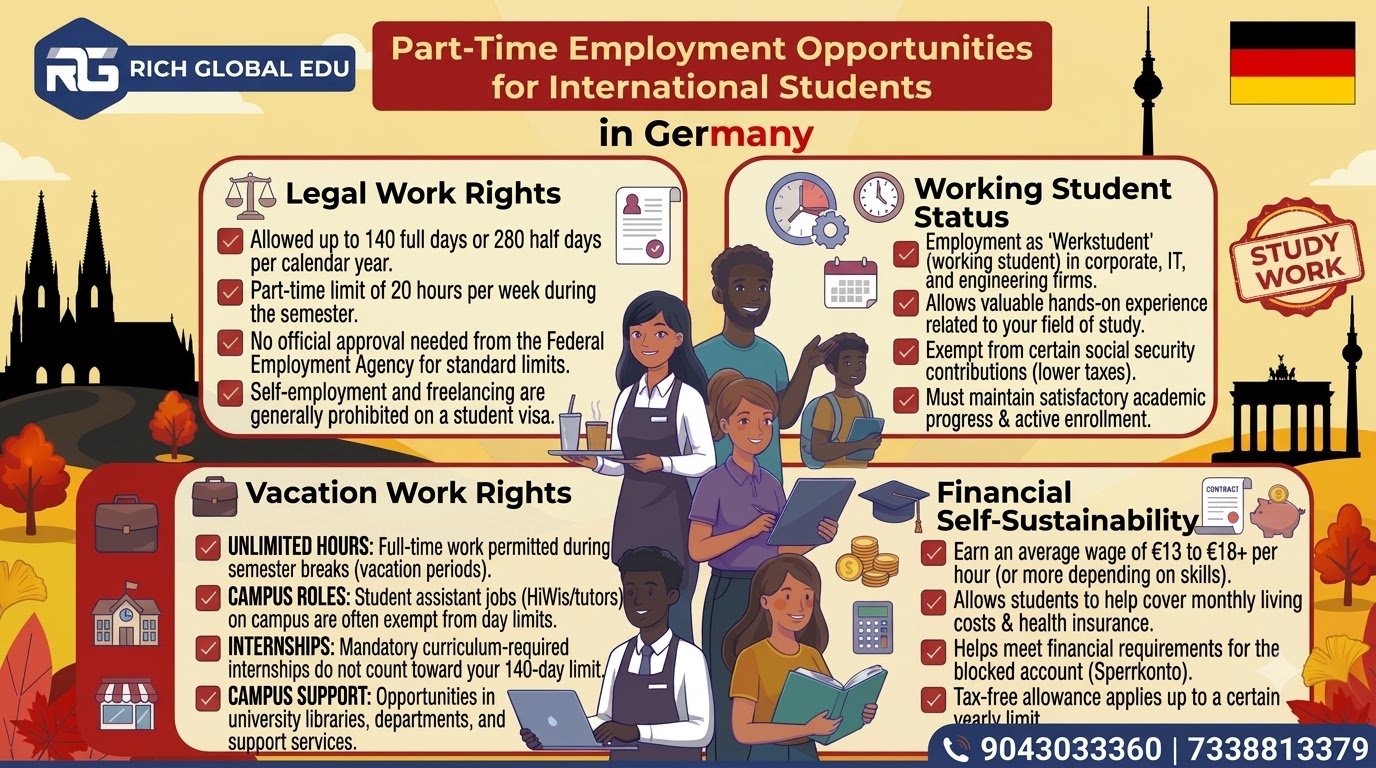
💼 Part-Time Employment Opportunities for International Students

Part-time employment opportunities for international students in Germany, including working student positions, internships and student jobs in technology, engineering and business sectors.
  • Legal Work Rights: Non-EU international students are legally allowed to work 140 full days or 280 half days per calendar year (or up to 20 hours per week during active semesters).
  • Working Student Status (Werkstudent): High-paying student roles in corporate offices, IT firms, and engineering companies that offer relevant career experience alongside study.
  • Vacation Work Rights: Unlimited full-time working hours permitted during official university summer and winter breaks.
  • Financial Self-Sustainability: Part-time student earnings (average €13 to €18+ per hour) easily cover monthly food, housing, and personal living costs, significantly easing financial pressure on parents.

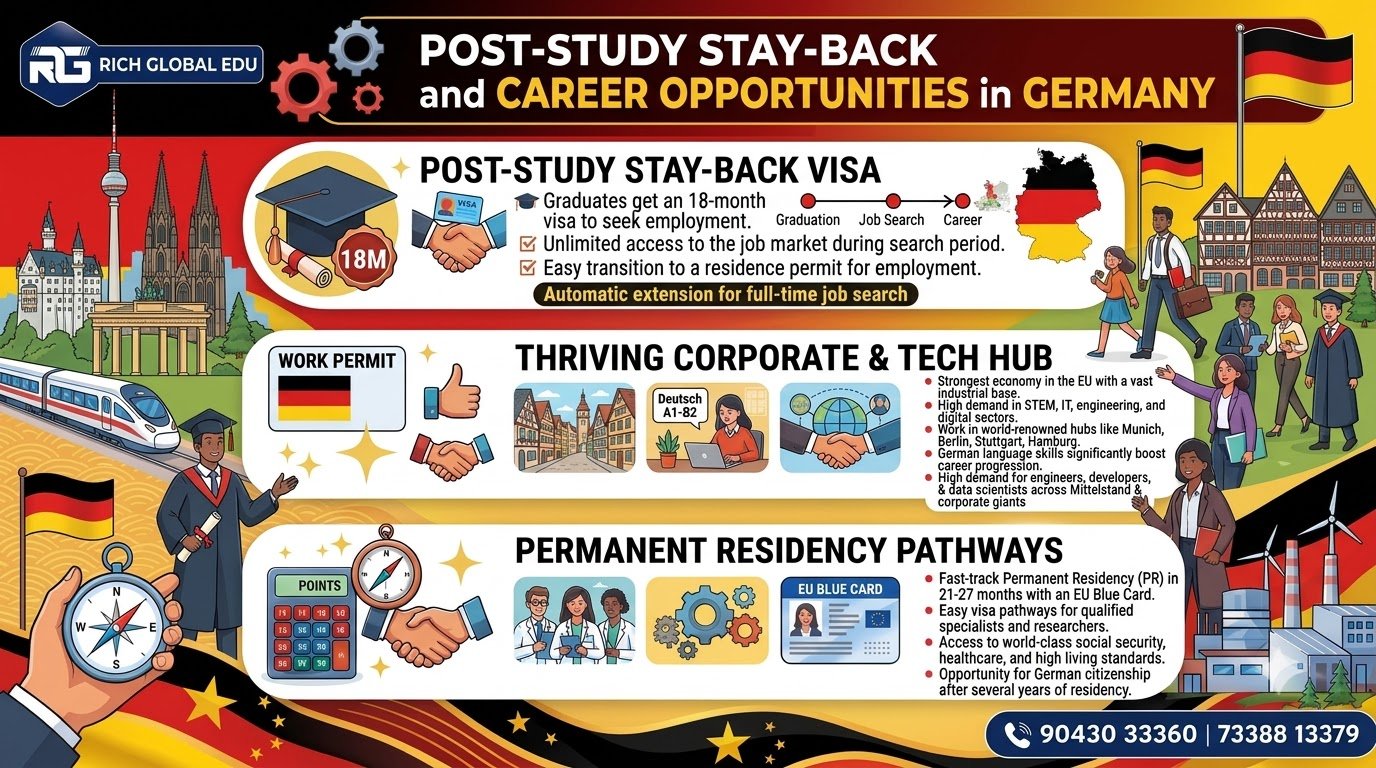
📈 Post-Study Stay-Back and Career Opportunities

Post-study career opportunities in Germany for international graduates, including the 18-month job-seeker residence permit, skilled employment and EU Blue Card pathways.
  • 18-Month Post-Study Job-Seeker Visa: Upon graduation, international students automatically qualify for an 18-month post-study residence permit extension to search for full-time professional employment in Germany.
  • Thriving Corporate & Tech Hub: High demand for qualified engineers, software developers, data scientists, healthcare professionals, and business analysts across German corporate giants and innovative Mittelstand companies.
  • Permanent Residency (PR) Pathways: Fast-tracked permanent residence options available after holding a German work permit (EU Blue Card) for as little as 21 to 27 months (with basic German proficiency).

🗓️ University Intakes and Admission Periods

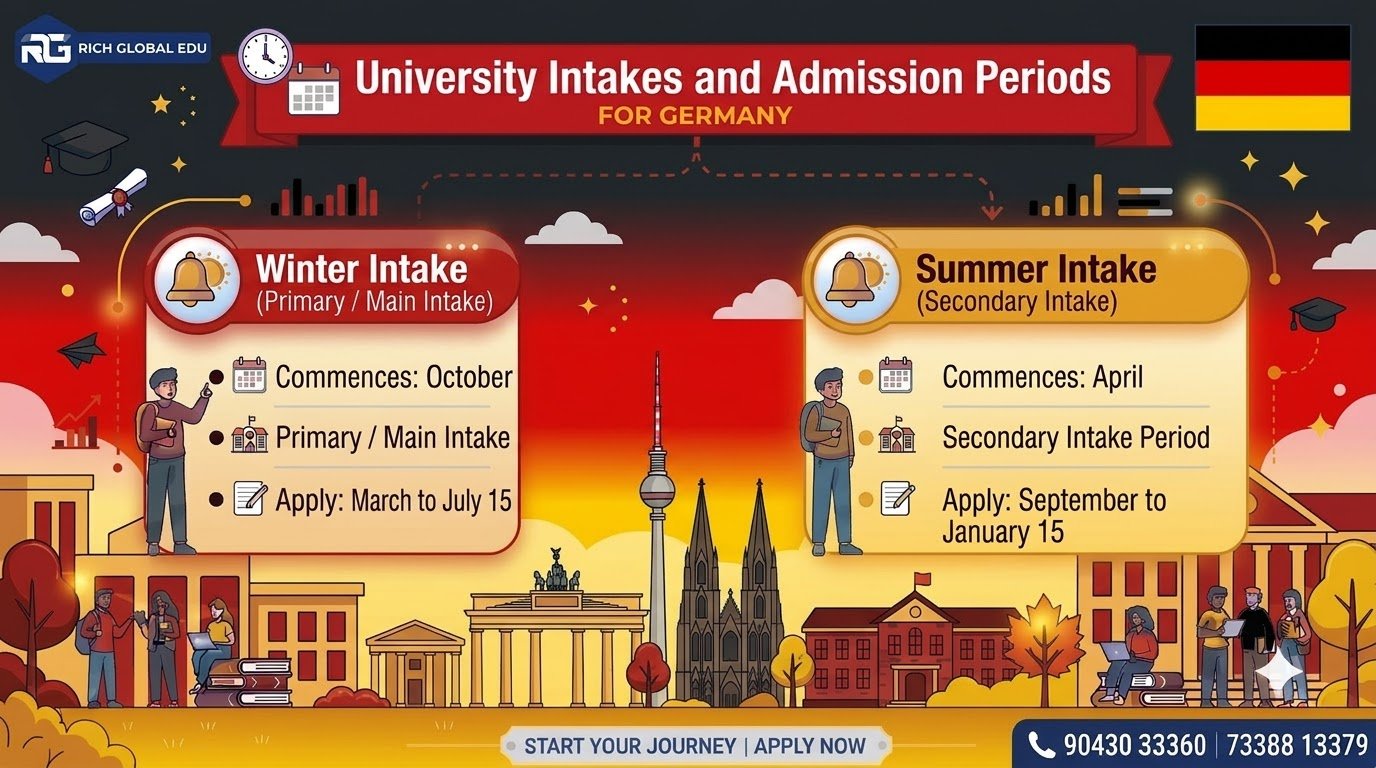
Germany university admission intakes showing winter and summer semester application periods, October and April commencement dates for international students.
  • German universities operate on a two-semester academic calendar:

Winter Intake (Primary / Main Intake):

  • Semester Commences: October
  • Application Window: Opens between March and July 15th of the same year.

Summer Intake (Secondary Intake):

  • Semester Commences: April
  • Application Window: Opens between September and January 15th of the previous year.

⭐ LIST OF POPULAR UNIVERSITIES IN GERMANY

  1. Technical University of Munich (TUM)
  2. Ludwig Maximilian University of Munich (LMU)
  3. Heidelberg University
  4. RWTH Aachen University
  5. Humboldt University of Berlin
  6. Free University of Berlin
  7. KIT – Karlsruhe Institute of Technology
  8. Technical University of Berlin (TU Berlin)
  9. TU Dresden (Technical University of Dresden)
  10. University of Stuttgart
  11. University of Hamburg
  12. University of Frankfurt (Goethe University)
  13. University of Bonn
  14. University of Cologne
  15. University of Freiburg
  16. University of Erlangen-Nuremberg (FAU)
  17. TU Darmstadt (Technical University of Darmstadt)
  18. University of Mannheim
  19. University of Göttingen
  20. University of Münster
  21. TU Dortmund University
  22. Leibniz University Hannover
  23. University of Bremen
  24. University of Bayreuth
  25. University of Jena (Friedrich Schiller University)
  26. Frankfurt School of Finance & Management
  27. IU International University of Applied Sciences
  28. SRH Hochschule Berlin / Heidelberg
  29. GISMA Business School
  30. Kühne Logistics University (KLU)

👥 Study Abroad Counselling and Student Support Services

Navigating German university applications via Uni-Assist, APS Certificate verification, Blocked Account setup, and consular visa appointments requires meticulous handling. Professional study-abroad counselors assist families through:

  • Profile evaluation and strategic university matching across public tuition-free and private universities.
  • APS document processing guidance and Uni-Assist application tracking.
  • Blocked Account (Sperrkonto) and mandatory health insurance setup assistance.
  • Student visa documentation, financial proof review, and consular interview preparation.
  • Pre-departure orientation, housing application support, and arrival guidance.

❓ Frequently Asked Questions About Studying in Germany

1. Is Germany safe for international students moving abroad for the first time?

  • Yes. Germany is universally recognized for its exceptional public safety, strict law enforcement, secure campus environments, and welcoming, diverse student communities.

2. Can I study in Germany for free?

  • Yes. Public universities across 15 of Germany’s 16 federal states do not charge tuition fees for international students, requiring only a nominal semester contribution that includes a regional transit pass.

3. Do I need to speak German to take an English-taught degree?

  • No. For 100% English-medium degree programs, German language proficiency is not required for admission. However, learning basic everyday German is highly recommended for daily life and part-time jobs.

4. What is the APS Certificate requirement for Indian students?

  • The APS Certificate is a mandatory document issued by the Academic Evaluation Centre at the German Embassy in New Delhi that verifies the authenticity of Indian academic credentials before applying for a German student visa.

📞 Connect With Our Global Admissions Team

📩 DM us “PNU 2026” on WhatsApp for a free profile evaluation, course guide, and scholarship plan!

📱 Call / WhatsApp: 9043033360 | 7338813379

🌐 Website: www.richglobaledu.com

Rich Global Edu — PIONEER in making global education affordable to all. 🌍✨

Study Abroad. Get Licensed. Go Global.

Book your Free Counselling

About Us

Business Legal Name

RICH GLOBAL

Quick Links

Countries for MBBS Abroad

Top Universities for MBBS

FAQs

Best Countries for Studying MBBS Abroad

MBBS in Moldova

MBBS in Nepal

MBBS in USA

© 2024 Rich Global Edu

error: Content is protected !!