"Every learner who places their trust in Rich Global becomes our responsibility."

Bachelor of Biomedical Sciences (Honours) – Lincoln University at Malaysia

🔬 WANT TO BECOME A BIOMEDICAL SCIENTIST AFTER 12TH?

Bachelor of Biomedical Sciences (Honours) in Malaysia for Indian Students

Are you interested in medical diagnostics, pathology, biotechnology, pharmaceutical research or clinical research after 12th?

Then Biomedical Sciences could be the right degree to build your foundation in modern healthcare and scientific research.

Malaysia is developing as an important healthcare, medical research and biotechnology destination in Southeast Asia, creating opportunities for students looking for an international Biomedical Sciences degree with practical laboratory exposure.

But before choosing your university, ask yourself:

Study Biomedical Science in Malaysia with hands-on laboratory research, clinical trial exposure, genetics and precision medicine, MedTech, pharmaceutical research, and global healthcare opportunities.

❓ WILL YOU GRADUATE WITH JUST A DEGREE — OR WITH THE PRACTICAL LABORATORY SKILLS TO BUILD A SCIENTIFIC CAREER?

Biomedical Science is not a course you can truly master through textbooks alone.

You need to understand biological samples, diagnostic techniques, pathology, molecular testing, laboratory equipment and scientific research.

That is why students should seriously consider:

🇲🇾 STUDYING BIOMEDICAL SCIENCES IN MALAYSIA

🌟 WHY STUDY BIOMEDICAL SCIENCES IN MALAYSIA?

A Bachelor of Biomedical Sciences in Malaysia can combine scientific theory with practical laboratory learning and research exposure, depending on the university and programme.

Students may develop knowledge and practical skills across areas such as:

🔬 Clinical pathology and disease mechanisms
🧪 Diagnostic laboratory techniques
🩸 Hematology and blood-related testing
🧫 Medical microbiology and cell culture
🧬 Molecular biology and genetic testing
💊 Pharmacology and drug development
📊 Biostatistics and biomedical research
💻 Modern diagnostic technologies
🧪 Laboratory safety and quality management
🏥 Clinical and healthcare laboratory environments

The objective is to move beyond simply understanding science and learn how scientific knowledge is applied in real healthcare and research settings.

📚 BIOMEDICAL SCIENCES: THEORY + PRACTICAL LAB TRAINING

Biomedical Science is a lab-driven and evidence-based discipline.

A strong programme should give students opportunities to connect classroom learning with practical laboratory applications.

Instead of:

TEXTBOOK THEORY → CLASSROOM LECTURES → WRITTEN EXAMS → DEGREE

The learning journey should move towards:

💡 LEARN → PRACTISE → LAB TRAINING → CLINICAL EXPOSURE → CAREER

Depending on the university, students may participate in practical laboratory sessions, clinical attachments, research projects and industry-related training.

🧪 PRACTICAL LABORATORY TRAINING IN MALAYSIA

One of the most important things to consider when choosing a Biomedical Sciences course in Malaysia is the amount and quality of practical laboratory exposure.

Students may gain hands-on experience in areas such as:

🔬 Clinical BiochemistryUnderstand how blood and body-fluid testing can support the investigation of metabolic and other health conditions.

🩸 Hematology & TransfusionStudy blood cells, blood disorders, coagulation and laboratory procedures related to blood banking.

🧫 Medical MicrobiologyLearn about microorganisms, infectious diseases, diagnostic cultures and antimicrobial testing.

🧬 Molecular DiagnosticsDevelop exposure to DNA/RNA analysis, PCR-based techniques and modern molecular testing.

🫀 Histopathology & CytologyUnderstand tissue preparation, staining and microscopic examination used in pathology.

🥼 Immunology & SerologyExplore immune responses and laboratory testing involving antibodies and immune-related conditions.

💊 Pharmacology & ToxicologyStudy how drugs interact with biological systems and understand principles related to drug safety and toxicology.

📊 Biostatistics & ResearchLearn how scientific data is analysed and how biomedical research findings are presented.

🏥 REAL-WORLD CLINICAL & DIAGNOSTIC LAB EXPOSURE

The value of a Biomedical Sciences degree increases when students can understand how professional laboratories operate.

Depending on the programme, selected Malaysian universities may provide clinical or research attachments involving:

🏥 Hospital pathology laboratories
🧪 Private diagnostic centres
🧫 Pharmaceutical research environments
🧬 Biotechnology companies
🏫 Academic research institutes

Students may gain exposure to activities such as diagnostic sample analysis, laboratory quality control, molecular testing, microbiological procedures, tissue preparation, clinical research data and laboratory safety systems.

This practical exposure can help students become more confident in professional scientific environments.

🧬 KEY AREAS OF BIOMEDICAL SCIENCES

A Biomedical Sciences degree can open exposure to multiple areas of modern healthcare science.

Clinical Diagnostics

Build knowledge of laboratory testing used in disease investigation and healthcare.

Molecular Biology & Genetics

Explore DNA, RNA, PCR and molecular diagnostic technologies.

Microbiology & Virology

Study microorganisms and their role in infectious diseases and laboratory diagnosis.

Pathology & Histopathology

Understand how tissue and cellular changes can be examined to support disease diagnosis.

Hematology

Learn about blood disorders, blood cells and laboratory testing.

Immunology

Understand immune-system responses and laboratory-based immune testing.

Pharmacology

Explore drug actions, biological responses and principles of drug development.

Biomedical Research

Develop skills in experimental design, scientific analysis and research reporting.

🌏 WHY MALAYSIA FOR BIOMEDICAL SCIENCES?

Malaysia offers Indian students an opportunity to experience a multicultural international education environment while studying in a growing Southeast Asian healthcare ecosystem.

Depending on the university, students may benefit from exposure to:

🌐 Modern diagnostic infrastructure
🏥 Clinical healthcare environments
🧪 Laboratory-based education
🔬 Research-focused learning
💬 Scientific communication in English
🤝 Multicultural healthcare environments

For students planning an international career in biomedical science, diagnostics, research, biotechnology or pharmaceuticals, this international exposure can be an important part of their educational journey.

🇮🇳 INDIA vs 🇲🇾 MALAYSIA — WHAT SHOULD STUDENTS CONSIDER?

India has a large number of medical science and life-science institutions, but the quality of laboratory infrastructure, equipment access, research opportunities and practical exposure can vary between institutions.

For students considering studying abroad, Malaysia can offer an alternative pathway to pursue a Biomedical Sciences degree with practical laboratory and clinical exposure, depending on the university selected.

Rather than choosing a destination only because of location, students should compare:

PRACTICAL LAB HOURS + EQUIPMENT ACCESS + CLINICAL ATTACHMENT + RESEARCH OPPORTUNITIES + INTERNATIONAL EXPOSURE + CAREER POTENTIAL

💰 BIOMEDICAL SCIENCES COURSE FEES IN MALAYSIA

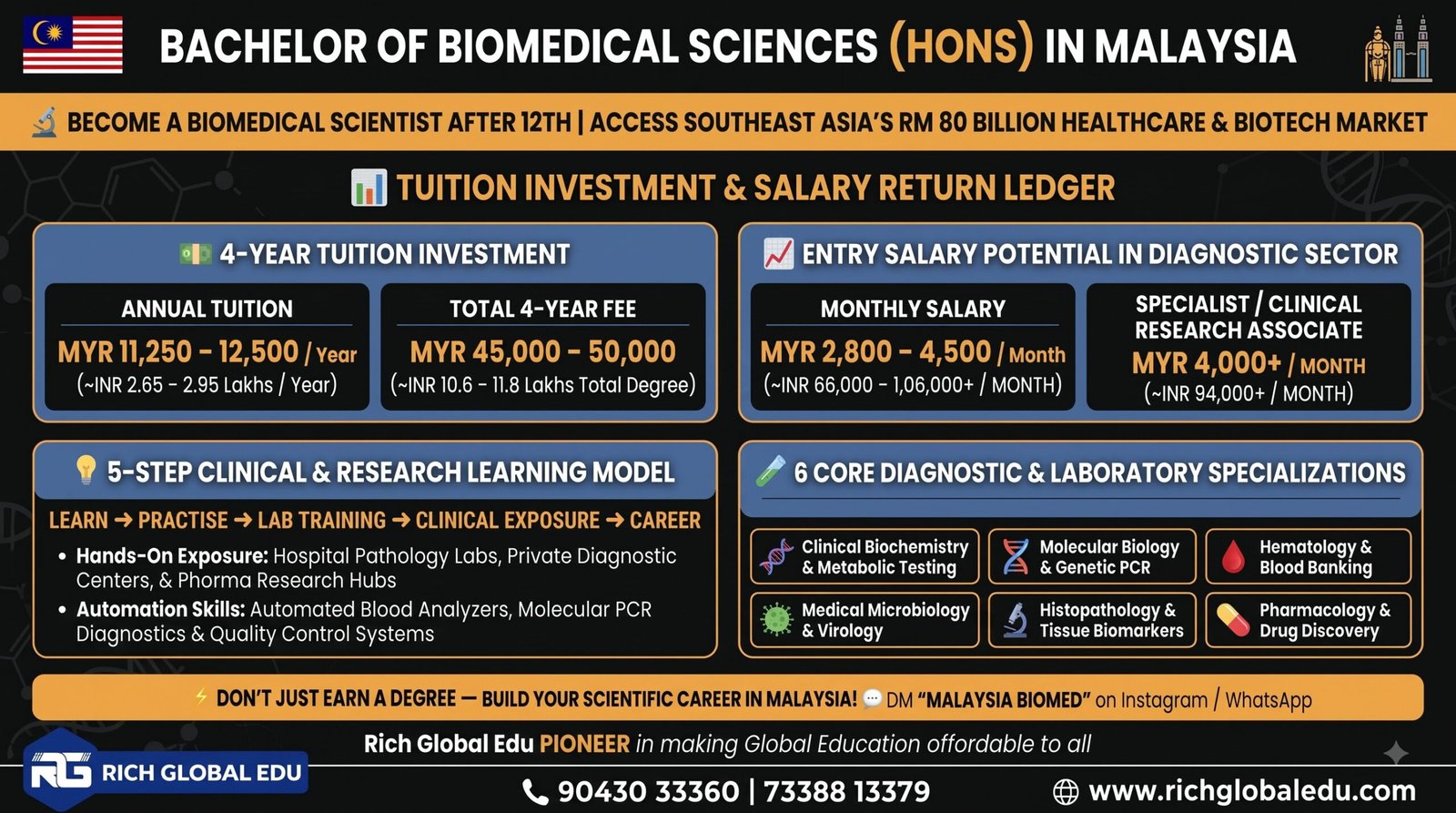
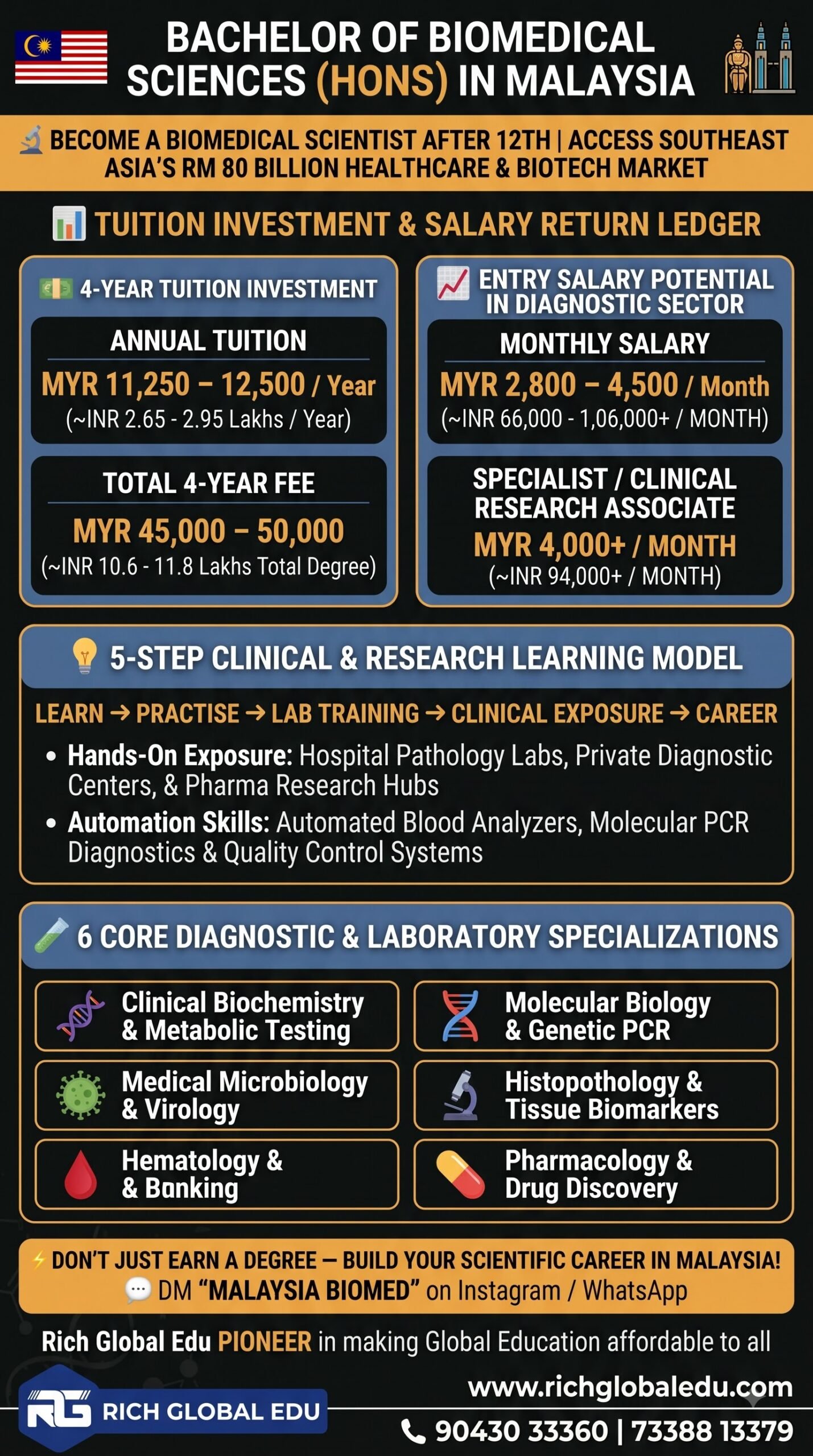
For the four-year programme highlighted in this pathway, the approximate total tuition fee is MYR 45,000–50,000, which is around ₹10.6 lakh–₹11.8 lakh for the complete degree.

The approximate annual tuition works out to around MYR 11,250–12,500, or approximately ₹2.65 lakh–₹2.95 lakh per year.

Actual fees vary by university, programme structure, intake and applicable laboratory or other charges. Students should confirm the latest official fee structure before applying.

📈 BIOMEDICAL SCIENCES SALARY IN MALAYSIA

Salary is another important consideration for students planning an international career.

Based on the figures provided, fresh Biomedical Sciences graduates entering diagnostic laboratories, healthcare facilities or clinical research-related roles may see starting salaries in the range of MYR 2,800–4,500 per month, approximately ₹66,000–₹1.06 lakh+ per month.

This corresponds to around MYR 33,600–54,000 annually, or approximately ₹7.95 lakh–₹12.77 lakh per year.

Specialised roles in areas such as clinical research, molecular diagnostics and multinational pharmaceutical environments may offer higher earning potential, with reported figures of MYR 4,000+ per month in some cases.

Actual salaries depend on the employer, location, role, technical skills, specialisation and experience. Salary figures are indicative and are not guaranteed outcomes

💼 CAREER OPPORTUNITIES AFTER BIOMEDICAL SCIENCES

A Bachelor of Biomedical Sciences can provide a foundation for careers across diagnostics, healthcare, research, biotechnology and pharmaceutical industries.

Depending on qualification, practical skills, specialisation and employer requirements, graduates may explore roles such as:

🔬 Biomedical Scientist / Technologist
🧪 Clinical Diagnostic Laboratory Analyst
🧫 Medical Microbiology roles
🧬 Molecular Diagnostics roles
📊 Clinical Research Associate
💊 Pharmaceutical Quality Control roles
🥼 Immunology Laboratory roles
🩸 Hematology and Blood Bank roles
🫀 Histopathology Laboratory roles
🔍 Medical Research Assistant
💻 Medical Equipment Application Specialist
📋 Regulatory Affairs roles

Students who continue with M.Sc., Ph.D. or other relevant qualifications can explore advanced research and academic pathways.

🛂 CAN INDIAN STUDENTS WORK IN MALAYSIA AFTER BIOMEDICAL SCIENCES?

Potentially, but graduating from a Malaysian university does not automatically guarantee the right to work in Malaysia.

International graduates must meet the applicable immigration, professional registration, work-pass and employer requirements at the time of employment.

Career opportunities can also depend on the student's technical skills, specialisation, employer demand and prevailing regulations.

That is why students should think about career planning, practical skills, relevant certifications and professional networking throughout their degree.

✨ IS BIOMEDICAL SCIENCES IN MALAYSIA WORTH IT?

If you are interested in medical diagnostics, molecular biology, pathology, microbiology, biotechnology, pharmaceuticals or biomedical research, Malaysia can be a destination worth considering for your undergraduate studies.

But don't ask only:

❓ “WHERE CAN I GET A BIOMEDICAL SCIENCES DEGREE?”

Ask:

❓ “WHERE CAN I BECOME A BETTER-PREPARED BIOMEDICAL SCIENTIST?”

When choosing your university, look beyond the degree title and consider:

🔬 Practical laboratory training
🧪 Modern laboratory equipment
🏥 Clinical exposure
🧬 Research opportunities
📊 Scientific and analytical skills
🤝 Industry and healthcare connections
🌏 International learning environment

🚀 DON'T JUST EARN A BIOMEDICAL SCIENCE DEGREE. BUILD YOUR SCIENTIFIC CAREER IN MALAYSIA.

LEARN → PRACTISE → LAB TRAINING → CLINICAL EXPOSURE → GLOBAL CAREER

📞 STUDY BIOMEDICAL SCIENCES IN MALAYSIA WITH RICH GLOBAL EDU

Planning to study Bachelor of Biomedical Sciences (Honours) in Malaysia after 12th?

Rich Global Edu can help you explore suitable Malaysian universities based on your academic profile, budget, tuition fees, practical laboratory training, clinical exposure, research opportunities and career goals.

Whether your interest is clinical diagnostics, molecular biology, microbiology, pathology, biotechnology, medical research or pharmaceuticals, choosing the right university can make a significant difference to your study experience and future career.

📲 Call / WhatsApp: 90430 33360 | 73388 13379

📩 DM Rich Global Edu with “BIOMEDICAL” to explore your study options.

🌐 Visit: richglobaledu.com to explore universities, eligibility, fees and admission options.

Rich Global Edu. PIONEER in making Global Education affordable to all..🌍🎓🚀

Bachelor (Hons) in Business Administration – Lincoln University at Malaysia

🎓 WANT TO BECOME A BUSINESS LEADER AFTER 12TH?

Bachelor (Hons) in Business Administration in Malaysia for Indian Students

Are you planning to study Business Administration after 12th but want more than classroom theory and written exams?

A Bachelor of Business Administration (BBA) in Malaysia can give you the opportunity to develop practical business skills while gaining exposure to a multicultural and internationally connected business environment.

With thousands of global companies operating in Malaysia and the country serving as an important gateway to Southeast Asian markets, students can build an international perspective from the beginning of their business education.

Study BBA in Malaysia after Class 12 with affordable tuition, international exposure, practical learning, multicultural experiences, internships, and career-oriented business education.

🎯 A BBA DEGREE IS NOT JUST ABOUT LEARNING BUSINESS THEORY

Business today is about making decisions, understanding markets, managing people, analysing data and creating growth.

That means your education should go beyond:

TEXTBOOK THEORY → CLASSROOM LECTURES → WRITTEN EXAMS → DEGREE

Instead, focus on:

LEARN → PRACTISE → INDUSTRY EXPOSURE → REAL PROJECTS → CAREER

🌏 STUDY BUSINESS ADMINISTRATION IN MALAYSIA

A Bachelor of Business Administration in Malaysia is designed to develop a broad understanding of how modern businesses operate.

Depending on the programme, students can gain exposure to areas such as:

- Business Management & Administration
- Marketing & Digital Marketing
- Finance & Accounting
- Human Resource Management
- Business Analytics
- Operations & Supply Chain
- Entrepreneurship
- International Business
- Strategic Management
- Business Communication

This combination can help students understand both the business fundamentals and the practical skills required in today's corporate environment.

💼 WHY STUDY BUSINESS ADMINISTRATION IN MALAYSIA?

Malaysia offers an attractive study environment for students looking for an international business education in Asia.

Key advantages include:

🌍 International Business Exposure
Study in a country connected to regional and global businesses.

📊 Practical Business Skills
Develop skills in management, marketing, finance, analytics and operations.

🤝 Multicultural Environment
Interact with people from different cultural and professional backgrounds.

🏢 Corporate Exposure
Selected programmes provide opportunities for internships and industry-based learning.

💻 Digital Business Skills
Understand modern business tools, analytics, CRM systems and digital marketing.

🚀 Career Flexibility
A BBA can lead to careers across management, marketing, HR, finance, operations, sales and business analytics.

🏢 PRACTICAL BUSINESS TRAINING

One of the most important questions before choosing a BBA programme is:

HOW MUCH WILL I ACTUALLY GET TO PRACTISE?

A good Business Administration programme should give students opportunities to apply classroom concepts to real business situations.

Depending on the university and programme structure, students may experience:

- Business case studies
- Market research projects
- Digital marketing activities
- Financial analysis
- Business presentations
- Team-based projects
- Entrepreneurship projects
- Industry internships

This practical approach helps students understand how business decisions are made beyond the classroom.

📚 KEY AREAS OF BUSINESS ADMINISTRATION

Corporate Strategy & Leadership

Learn how organisations make strategic decisions, manage teams and achieve business objectives.

Marketing & Digital Media

Understand branding, consumer behaviour, digital marketing and modern marketing strategies.

Finance & Accounting

Build knowledge of financial statements, budgeting, cost management and business finance.

Human Resource Management

Learn about recruitment, employee development, performance management and workplace practices.

Operations & Supply Chain

Understand how businesses manage production, logistics, suppliers and operational efficiency.

Business Analytics

Develop the ability to use business data to support better decision-making.

Entrepreneurship


Explore business planning, innovation, startup development and growth strategies.

International Business

Understand global markets, international trade and the challenges of managing businesses across countries.

🌏 WHY MALAYSIA FOR BUSINESS ADMINISTRATION?

Malaysia provides students with exposure to a multicultural and internationally connected business environment.

Its location in Southeast Asia can also provide valuable exposure to regional markets and industries.

For Indian students, studying Business Administration in Malaysia can mean experiencing:

- International business environments
- Multicultural corporate teams
- Southeast Asian markets
- Business communication in English
- Regional networking opportunities
- International academic exposure

The goal is not simply to earn a business degree, but to develop the confidence and skills to operate in a modern business environment.

🏢 INDUSTRY & CORPORATE EXPOSURE

Business Administration becomes more valuable when students understand how companies actually operate.

Depending on the programme, students may receive exposure to areas such as:

- Corporate management
- Marketing and advertising
- Financial services
- Technology companies
- Logistics and supply chain
- ConsultingStartups
- Sales and business development

Industry internships can also help students connect academic knowledge with real workplace experience.

🇮🇳 INDIA vs 🇲🇾 MALAYSIA FOR BUSINESS ADMINISTRATION

Business Education

When evaluating Business Education, India provides a wide range of BBA programmes, while Malaysia offers internationally oriented business programmes.

Learning Environment

Regarding the Learning Environment, it varies by institution in India, whereas Malaysia offers a multicultural and international setting.

Industry Exposure

For Industry Exposure, opportunities in India depend heavily on the college, while selected programmes in Malaysia include internships.

International Exposure

In terms of International Exposure, India varies, whereas Malaysia provides a stronger regional international environment.

Regional Business Access

Looking at Regional Business Access, India is primarily India-focused, while Malaysia grants access to the Southeast Asian business environment.

Career Perspective

Finally, for Career Perspective, India offers a primarily domestic outlook, whereas Malaysia opens up an international and regional career perspective.

The right choice depends on more than the degree.

Look at:

PRACTICAL TRAINING + INDUSTRY EXPOSURE + INTERNSHIP + INTERNATIONAL ENVIRONMENT + CAREER POTENTIAL

💰 BBA COURSE FEES IN MALAYSIA

Based on the provided programme figures, tuition is approximately:

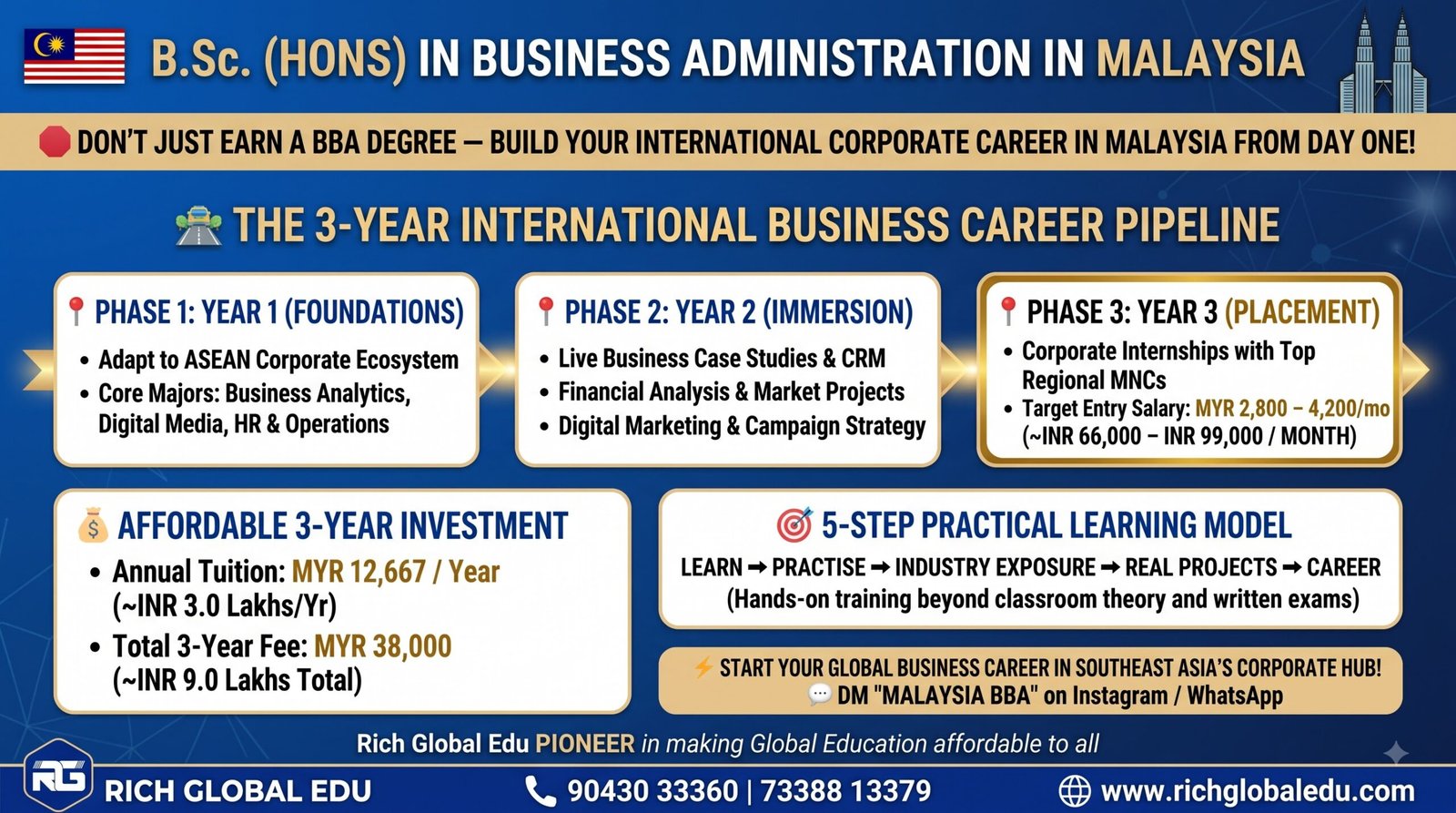
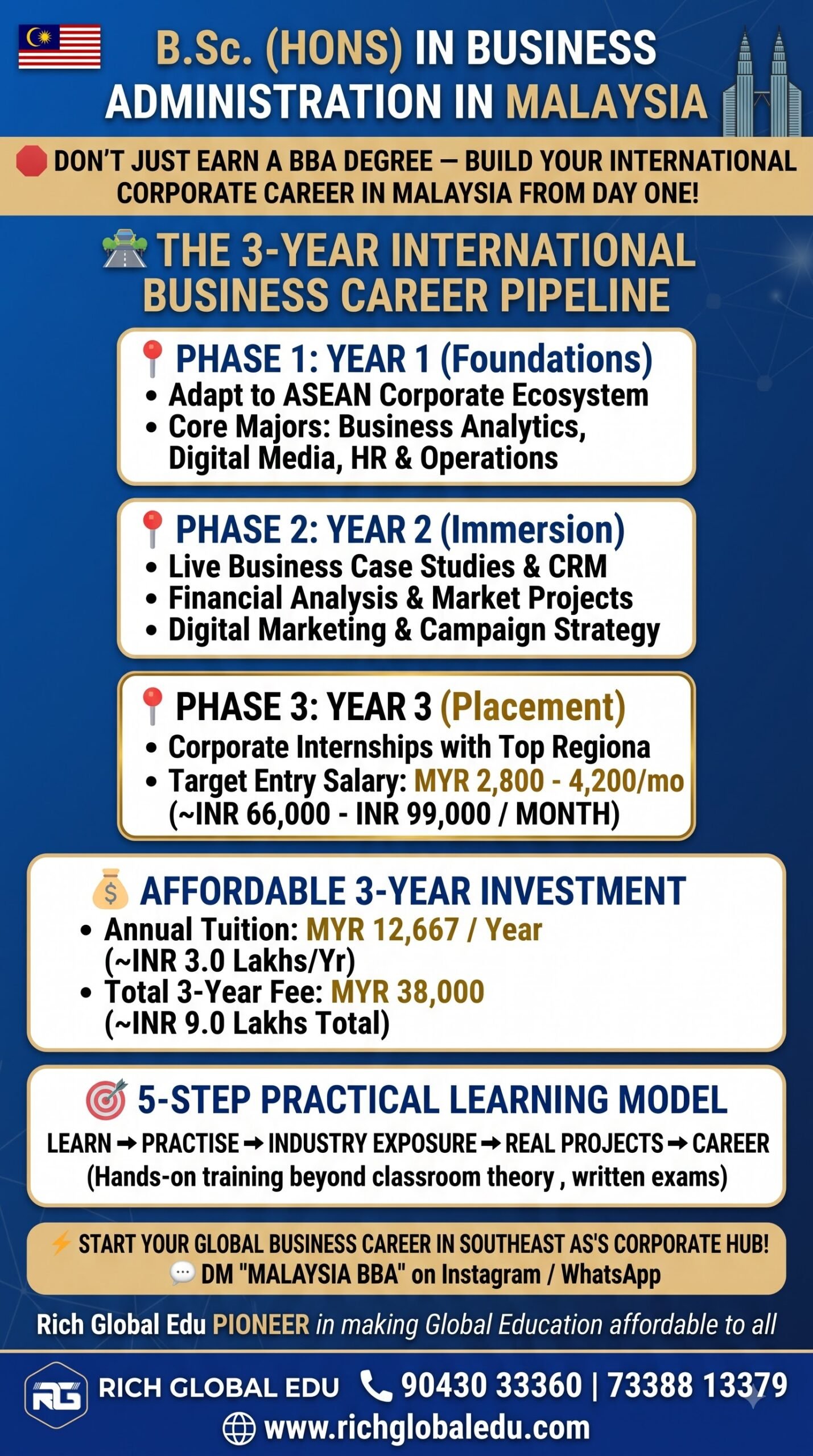
MYR 12,667 per year ₹3 lakh per year

For a 3-year programme:

Approximately MYR 38,000 total ₹9 lakh

Fees vary by university and programme. Students should always confirm the latest tuition fees and additional costs before applying.

💼 CAREER OPTIONS AFTER BBA IN MALAYSIA

A Bachelor of Business Administration can open pathways into multiple business functions.

Potential career roles include:

- Management Trainee
- Business Development Executive
- Marketing Executive
- Digital Marketing Executive
- Human Resources Executive
- Business Analyst
- Financial Analyst Assistant
- Operations Executive
- Sales Executive
- Client Relationship Executive
- Brand Executive
- Supply Chain Executive
- Startup & Growth Roles

With experience and further qualifications such as an MBA or professional certifications, graduates can progress into more specialised and managerial positions.

💰 BBA SALARY IN MALAYSIA

Based on the provided market figures, entry-level business roles in Malaysia may range around:

MYR 2,800 – 4,200 per month
₹66,000 – ₹99,000 per month

That translates to approximately:

MYR 33,600 – 50,400 per year
₹7.95 lakh – ₹11.92 lakh per year

In Kuala Lumpur and other major business centres, certain management trainee and specialised business roles may offer RM3,500+ per month.

Actual salaries vary depending on role, employer, location, skills and experience. Salary figures are indicative and should not be treated as guaranteed outcomes.

🇲🇾 CAN INDIAN STUDENTS WORK IN MALAYSIA AFTER BBA?

Yes, there can be opportunities for international graduates to pursue employment in Malaysia, but graduation does not automatically provide the right to work.

Employment is subject to applicable Malaysian immigration regulations, work-pass requirements and employer sponsorship.

Students should therefore consider career planning, internships, relevant skills and employer requirements while studying.

🎯 IS BUSINESS ADMINISTRATION IN MALAYSIA WORTH IT?

If you want to build a career in management, marketing, finance, HR, business analytics, operations, entrepreneurship or international business, studying Business Administration in Malaysia can be an option worth exploring.

The key is choosing a programme that combines:

ACADEMICS + PRACTICAL LEARNING + INDUSTRY EXPOSURE + INTERNSHIP + INTERNATIONAL EXPERIENCE

Your BBA should prepare you not only to understand business, but to participate in it.

🚀 DON’T JUST EARN A BBA DEGREE. BUILD YOUR BUSINESS CAREER IN MALAYSIA.

Planning to study Business Administration in Malaysia after 12th?

Let Rich Global Edu help you explore suitable universities, eligibility, tuition fees, intakes, scholarships and admission options.

📞 Call / WhatsApp: 90430 33360 | 73388 13379

📲 Direct Message: Send us a DM with "MALAYSIA BBA" on Instagram or WhatsApp to check your eligibility immediately!

🌐 Website: www.richglobaledu.com

Rich Global Edu. PIONEER in making Global Education affordable to all..🌍🎓🚀

1 Nursing Degree; 4 Potential Career Directions

Nursing in Kazakhstan After 12th: 1 Nursing Degree, 4 Potential Career Directions

Planning to study Nursing after 12th and build a career abroad? Studying Nursing in Kazakhstan can give students an opportunity to pursue an international education while preparing for multiple potential career pathways after graduation.

Instead of waiting until graduation to think about your career destination, students can begin preparing during their Nursing studies with relevant German language training and Prometric-based preparation, depending on their intended career pathway

Study Nursing in Kazakhstan after Class 12 and prepare for multiple potential career pathways in Germany, Gulf countries, Kazakhstan, or India through international education and career planning.

🌍 Study Nursing in Kazakhstan and Plan Your International Career

A Nursing degree can open different professional directions depending on your qualifications, destination, language skills, licensing requirements, and professional registration. With a Nursing degree from Kazakhstan, students can explore four potential directions:

Germany
Gulf Countries
Kazakhstan
India

🛤️ 4 Potential Nursing Career Pathways

1. Nursing Career Pathway in GermanyStudents planning to explore nursing opportunities in Germany can begin developing their German language skills while studying Nursing. After graduation, they can work toward the applicable qualification recognition, language requirements, and professional registration requirements before exploring nursing employment opportunities in Germany. Starting German language preparation during the degree can help students build a foundation before beginning the post-graduation recognition and registration process.

2. Nursing Career Pathway in Gulf CountriesStudents interested in working in Gulf countries can prepare for the relevant nursing licensing examinations and professional requirements during their education. This may include Prometric-based examination preparation, where applicable to the selected destination and licensing authority. After graduation, candidates must satisfy the applicable eligibility, examination, licensing, registration, and experience requirements for their chosen country before pursuing employment opportunities.

3. Build a Nursing Career in KazakhstanStudying Nursing in Kazakhstan can also provide an opportunity to explore a potential career pathway within Kazakhstan. After completing the Nursing degree, graduates can understand and meet the applicable local language, qualification recognition, professional registration, immigration, and employment requirements before exploring eligible opportunities. Living and studying in Kazakhstan can also provide students with exposure to the country's healthcare environment, culture, and professional expectations.

4. Return to India After Nursing AbroadStudying Nursing abroad does not necessarily mean that students must build their entire career overseas. Graduates can also consider returning to India after completing their Nursing education. Before practising as a nurse in India, graduates would need to satisfy the applicable Indian recognition and nursing registration requirements. Once eligible, they can explore nursing career opportunities in India using their international education and exposure.

💡 Why Start Career Preparation During Your Nursing Degree?

One of the biggest advantages of planning early is that students can use their study period to develop skills relevant to their intended career pathway. Depending on their goals, students may begin working on:

- Language & Exam Prep: German language preparation for potential Germany pathways, alongside Prometric-based preparation for applicable Gulf licensing pathways.

- Process Understanding: Understanding qualification recognition requirements and learning about professional registration processes.

- Requirements & Global Context: Understanding destination-specific employment requirements while developing awareness of international healthcare environments.

Your Nursing degree is not just about completing your education. It can also be the starting point for planning your future career.

📊 Overview of Career Directions & Requirements

When evaluating your potential pathways after studying Nursing in Kazakhstan, each destination involves distinct preparation components:

- Germany Pathway: Requires German language preparation alongside qualification recognition, target language proficiency, and professional nursing registration in Germany.

- Gulf Countries Pathway: Focuses on Prometric-based examination preparation, alongside satisfying destination eligibility, licensing, registration, and required work experience.

- Kazakhstan Pathway: Involves local language proficiency, local qualification recognition, immigration compliance, and meeting Kazakh healthcare employment requirements.

- India Pathway: Requires meeting Indian Nursing Council / state nursing council recognition, passing applicable registration processes, and local licensing compliance.

🎯 Nursing in Kazakhstan: Plan Your Career From Day One

After 12th, the question doesn't have to be only "Where can I study Nursing?" A better question can be: "How can I use my Nursing education to prepare for my future career?"

With the right planning, one Nursing degree can potentially lead to multiple directions: Germany | Gulf Countries | Kazakhstan | India.

Your final career pathway will depend on the destination-specific qualification, language, licensing, registration, immigration, and employment requirements applicable at the time you graduate

📞 Study Nursing Abroad with Rich Global Edu

RICH GLOBAL EDU – PIONEER in making Global Education affordable to all

Planning to study Nursing in Kazakhstan after 12th?

- Rich Global Edu can assist students with Nursing admissions, university selection, and international career-pathway guidance.

Call / WhatsApp: 90430 33360 | 73388 13379

Website: www.richglobal.com

Study. Prepare. Graduate. Explore the World.

Bachelor of Science (Hons) in Hospitality Management – Lincoln University at Malaysia

Study Hospitality Management in Malaysia After 12th

Bachelor of Science (Hons) in Hospitality Management in Malaysia for Indian Students.

Did you know that Malaysia's tourism and hospitality industry contributes over 14% TO THE NATION'S GDP and welcomes more than 20 MILLION INTERNATIONAL TOURISTS ANNUALLY?

If you're planning to build a global career in resort management, luxury hotel operations, tourism, food & beverage management or event planning after 12th, there is a degree you should seriously consider: BACHELOR OF SCIENCE (HONS) IN HOSPITALITY MANAGEMENT IN MALAYSIA.

Before deciding where to pursue your Hospitality Management degree, think about where you want to be three years from now and ask yourself two important questions:

- Will I graduate with just a degree, or will I have the practical hospitality skills, industry exposure and international experience needed to build a successful career?

- Will I start my career with a modest salary, or can I prepare myself for better-paying opportunities in the international hospitality industry?

Hospitality Management is not simply a classroom-based degree. It is a people-focused, service-driven and highly practical profession. You cannot learn hospitality management only through textbooks and written examinations. You need to understand hotel operations, guest relations, food & beverage management, revenue management, event planning, customer experience and real-world hospitality operations.

That's why students should seriously consider STUDYING HOSPITALITY MANAGEMENT IN MALAYSIA. Malaysia offers an attractive combination of affordable international education, practical hospitality training, multicultural exposure, tourism opportunities and access to established hotel and resort environments.

Study Hospitality Management in Malaysia after Class 12 with affordable tuition, practical hotel training, internships, and exposure to front-office operations, food and beverage management, hotel analytics, and luxury hospitality.

🌟 Why Study Hospitality Management in Malaysia?

Hospitality is a hands-on service industry, and a successful hospitality professional needs more than academic knowledge. Students need daily opportunities to:

Understand Operations: Master hotel, resort, front-office, housekeeping, and food & beverage operations.

Develop Core Services: Build strong guest-relations, customer-service, and professional communication skills.

Master Strategy: Study hospitality revenue management, hotel sales, and digital marketing.

Gain Experience: Understand event management, work in multicultural environments, explore hospitality tech, and gain real-world industry experience.

This is one of the major reasons students should consider a Hospitality Management degree in Malaysia.

Instead of following only "TEXTBOOK THEORY → CLASSROOM LECTURES → WRITTEN EXAMS → DEGREE", hospitality education focuses on:

LEARN → PRACTISE → INDUSTRY EXPOSURE → GUEST EXPERIENCE → CAREER

🏨 Practical Hospitality Training & Key Focus Areas

One of the biggest factors to consider when choosing a course abroad is practical exposure. A graduate should understand what actually happens inside a hotel, resort, restaurant, event venue or tourism business. Selected Malaysian programmes incorporate practical learning across several key departments:

Front Office Operations: Learn how hotels manage reservations, check-ins, check-outs, guest communication, and day-to-day operations to shape the guest experience.

Food & Beverage Management: Understand restaurant, catering, and food-service operations, including cost control and service management.

Hotel Operations: Explore how front office, housekeeping, F&B, administration, and sales work together seamlessly.

Revenue Management: Learn how hospitality businesses manage room rates, occupancy, demand, and revenue optimization.

Event Management: Develop knowledge in planning, organizing, and managing corporate events, conferences, exhibitions, weddings, and functions.

Resort Management: Understand operational requirements for resorts and destination hospitality, including recreation and overall guest experience.

Hospitality Sales & Marketing: Learn how businesses attract guests, build their brands, and utilize modern digital communication.

Guest Relations & Customer Experience: Master customer expectation management and service delivery in a multicultural setting.

🏬 Real-World Hotel & Hospitality Exposure

Hospitality education becomes far more valuable when students experience the industry before graduation. Selected Malaysian universities provide industrial training and internship placements in 4-Star Hotels, 5-Star Hotels, Resorts, Restaurants, Event Venues, Tourism Businesses, and Hospitality Companies.

This allows students to gain practical exposure to front-office, F&B, housekeeping, revenue management, guest relations, sales, and resort operations.

The learning journey moves beyond "THEORY → EXAM → DEGREE" and towards LEARN → PRACTISE → INTERNSHIP → INDUSTRY EXPERIENCE → CAREER.

📊 Hospitality Management: India vs. Malaysia Comparison

While India has many hospitality institutions, the quality of practical facilities, industry exposure, internship opportunities, international environment, and hotel partnerships can vary considerably between institutions. When comparing factors, Malaysia offers distinct advantages:

Practical Learning: Malaysian programs feature integrated hospitality-focused practical training connected directly to local resort ecosystems.

Industrial Training: Offers structured internship and industrial placement opportunities built into the degree curriculum.

Hotel Exposure & Front Office: Provides direct access to professional hotel environments for hands-on guest and front-office operations.

Food & Beverage & Events: Hands-on restaurant service experience paired with real-world event planning and execution.

Revenue & Resort Management: Comprehensive understanding of hotel business performance and destination hospitality management.

International Environment & Career Perspective: Exposure to multicultural learning, international guest interactions, and Malaysia's thriving tourism ecosystem.

Don't choose between India and Malaysia simply based on location.

Choose based on: PRACTICAL TRAINING + HOTEL EXPOSURE + INDUSTRY INTERNSHIP + INTERNATIONAL EXPERIENCE + CAREER POTENTIAL.

💰 Course Fees & Expected Salary Range

Tuition fees and career earnings are key considerations for Indian students and parents planning an international education path:

Tuition Fees:

For the highlighted pathway, the tuition fee is approximately MYR 12,667 per year (approx. ₹2,95,000 per year). The total tuition fee for the complete 3-year degree is approximately MYR 38,000 (approx. ₹8,87,000 for the full degree). (Note: Fees vary based on university, intake, and structure).

Entry-Level Salaries in Malaysia:

Fresh graduates can expect starting salaries between MYR 2,800 – MYR 4,200 per month (approx. ₹65,000 – ₹98,000 per month). This equals an annual earning range of MYR 33,600 – MYR 50,400 per year (approx. ₹7,84,000 – ₹11,76,000 per year).

Note: Conversion rates are based on current nominal estimates. Salary ranges depend on employer, hotel category, location, and individual skills.

🎯 Career Opportunities After Graduation

A Hospitality Management degree opens doors across multiple dynamic sectors. Depending on your specialization and career progression, roles include:

- Hotel / Resort / Housekeeping / Tourism Operations Executive

- Front Office Executive & Guest Relations / Guest Experience Executive

- Food & Beverage Executive & Restaurant Manager

- Hospitality Sales, Marketing & Revenue Management Executive

- Event Management, Conference & Banquet Executive

- Hospitality Management Trainee

With experience, professionals steadily progress into supervisory and general management positions.

🌐 Work Rights & Post-Graduation Planning

Graduating in Malaysia does not automatically guarantee employment or a work visa. International students wishing to work post-graduation must fulfill local immigration, work-pass, and employer requirements.

This is why career planning should begin before selecting a university. At Rich Global Edu, students are guided to evaluate programs based on Curriculum, Practical Training, Hotel Exposure, Internship Opportunities, Facilities, and long-term Career Goals.

🚀 Build Your Hospitality Career with Rich Global Edu

For a student seeking international education, practical training, multicultural exposure, and access to a massive tourism hub, Malaysia is an ideal choice.

Instead of asking "Where can I get a Hospitality Management degree?", ask "Where can I become a better-prepared hospitality professional?"

Invest your three years where you gain: Practical Training | Hotel & Resort Exposure | Industry Internships | Front-Office Experience | F&B Management | Revenue Knowledge | Event Skills | International Guest Exposure | Global Perspective.

Don't Just Study Hospitality Management. Build Your Hospitality Career in Malaysia.

Study Hospitality Management in Malaysia with Rich Global Edu

Planning to study Bachelor of Science (Hons) in Hospitality Management after 12th? Rich Global Edu helps you shortlist suitable Malaysian universities based on Academic Profile, Budget, Tuition Fees, Hotel Exposure, and Career Goals.

Call / WhatsApp: 90430 33360 | 73388 13379

Website: www.richglobaledu.com

Rich Global Edu – Making Global Education Affordable for All 🌍🎓🚀


Artificial Intelligence – Lincoln University at Malaysia

Study Computer Science (AI) in Malaysia After 12th


Bachelor of Computer Science (Artificial Intelligence) in Malaysia for Indian Students.

Want to become an Artificial Intelligence Specialist after 12th? Before deciding where to pursue your B.Sc. Computer Science with Artificial Intelligence, think about where you want to be three years from now.

Ask Yourself Two Important Questions:

- Will I graduate with just a degree, or will I have the coding skills, AI model-building experience and practical exposure needed to build a successful technology career?

- Will I begin my career with a modest starting salary, or can I prepare myself for better-paying opportunities in the rapidly growing AI and technology industry?

For students looking beyond conventional classroom learning, studying Computer Science (AI) in Malaysia can offer an attractive combination of practical coding, AI project experience, modern computing infrastructure, industry exposure, international experience and access to a growing digital technology ecosystem.

Study Computer Science with Artificial Intelligence in Malaysia after Class 12 with practical coding, AI projects, industry internships, advanced computing labs, and exposure to machine learning, deep learning, NLP, computer vision, and generative AI.

🤖 Why Study Computer Science (AI) in Malaysia?

Computer Science with Artificial Intelligence is a fast-paced, hands-on technology profession. Becoming an AI specialist requires much more than studying programming concepts, attending theoretical lectures and passing examinations. Students need opportunities to:

Develop Coding Skills: Develop strong programming and coding skills.

Master Algorithms: Understand algorithms and computational problem-solving.

Train ML Models: Build and train machine learning models.

Work with Neural Networks: Work with neural networks and deep learning.

Explore NLP: Explore Natural Language Processing (NLP).

Computer Vision Applications: Develop computer vision applications.

Work with LLMs: Work with large language models (LLMs).

Big Data Processing: Analyse and process large datasets.

AI App Development: Develop AI-powered applications.

Cloud Technologies: Work with cloud computing technologies.

AI Ethics: Understand AI ethics and responsible AI.

Practical AI Projects: Build practical software and AI projects.

Real-World Exposure: Gain exposure to real-world software development environments

Malaysia's Computer Science education environment combines Theory + Practical Coding + Industry Placement + AI Projects. Instead of following only "STUDY → EXAMINATION → DEGREE", it focuses on a practical learning journey:

LEARN → CODE → BUILD → DEPLOY → INDUSTRY EXPOSURE → AI CAREER

💻 Practical Coding Training for Computer Science (AI) Students

One of the biggest factors to consider when choosing a Computer Science course abroad is practical exposure. Artificial Intelligence is not a subject that can be mastered simply by reading textbooks. Students need to write code, experiment with models, analyse results, identify errors and build working applications. Selected Malaysian Computer Science programmes provide extensive hands-on laboratory training, algorithmic problem-solving and industry internships, depending on the university and programme.

Practical Exposure Environments

Students may gain exposure to environments such as:

- Computer Laboratories
- Software Development Centres ,
- Technology Hubs
- Fintech Companies
- AI Development Environments
- Multinational Technology Companies

🧠 Core Areas of Artificial Intelligence & Computer Science

Depending on the Malaysian university and programme selected, students can study and gain exposure across key areas including:

Machine Learning: Learn how computers can identify patterns in data and make predictions or decisions using machine learning algorithms. Students develop practical knowledge of model development, training, testing and evaluation.

Deep Learning & Neural Networks: Understand neural-network architectures and deep-learning approaches used in modern AI applications. This provides a foundation for working with complex data such as images, text and speech.

Natural Language Processing (NLP): Explore how computers process, understand and generate human language. NLP is increasingly important for chatbots, language models, translation systems, search technologies and intelligent assistants.

Large Language Models & Generative AI: Learn about modern AI systems capable of generating text, code and other forms of content. The growth of Generative AI and LLM technologies is creating new applications across software, business, education, finance and other industries.

Computer Vision: Understand how AI systems analyse and interpret visual information. Computer vision can be applied in areas such as image recognition, automated inspection, healthcare technology, security systems and autonomous technologies.

Big Data Analytics: Learn how large volumes of data can be processed, analysed and transformed into useful insights. AI and data analytics increasingly work together across modern technology businesses.

Autonomous Systems & Robotics: Explore intelligent systems that can perceive their environment, make decisions and perform tasks with varying degrees of autonomy. This connects AI with robotics, automation, mobility and smart systems.

AI Ethics: Understand the importance of responsible development and deployment of artificial intelligence. Students can explore topics such as fairness, privacy, transparency, accountability and responsible AI use.

🖥️ Modern AI & Computing Laboratories

Modern Artificial Intelligence is no longer limited to theoretical algorithms and programming exercises. Depending on the Malaysian university selected, students may gain access to advanced computing laboratories, AI development environments, cloud platforms and GPU-powered systems including:

- AI & Machine Learning Laboratories
- Advanced Computer Laboratories
- GPU Computing Infrastructure
- Cloud Computing Environments
- Deep Learning Platforms
- Data Analytics Tools
- IoT & Smart Computing Platforms
- Robotics & Autonomous Systems
- Computer Vision Systems
- Software Development Environments
- AI Simulation Tools
- Neural Network Development Platforms
- Big Data Processing Environments

Evaluating Computing Infrastructure:

These technologies are not exclusive to Malaysia and can also be available in Indian institutions.

Therefore, students should ask a more important question when comparing universities:

“HOW MUCH WILL I ACTUALLY GET TO BUILD AND CODE?”

A technology appearing in a brochure or syllabus is not enough. Students and parents should evaluate the actual computing infrastructure, AI laboratories, software tools, project opportunities, industry partnerships and opportunities to develop real-world applications before choosing a Computer Science university.

🏬 Extensive Industry Training for AI & Computer Science Students

Technology careers are built through more than academic knowledge. Students need to understand how software and AI are developed, tested and deployed in professional environments. Selected Malaysian Computer Science programmes provide opportunities for industrial training and internships in Software Development, Artificial Intelligence, Data Analytics, Fintech, Cloud Computing, Cybersecurity, Technology Services, and Digital Businesses.

This type of industry experience can help students understand:

- How professional software teams work
- How production code is developed
- How AI models are tested
- How data is prepared and analysed
- How software applications are deployed
- How technical problems are solved
- How projects are managed in industry
- How AI can be applied to real business problems

The goal is to move beyond THEORY → EXAM → DEGREE and towards THEORY → CODE → BUILD → INDUSTRY → EXPERIENCE → CAREER

📊 Computer Science (AI) in India vs. Malaysia

India has many established institutions offering Computer Science and Artificial Intelligence-related programmes. However, the quality of computing infrastructure, practical exposure, industry interaction, project opportunities and access to specialised technologies can vary considerably between institutions. For students willing to study abroad, Malaysia provides an opportunity to specifically choose programmes offering a combination of key factors:

Practical Coding: Hands-on programming and coding components integrated into the coursework.

AI Training: Comprehensive learning in machine learning, deep learning and AI applications.

Industry Training: Structured internships or industrial training in tech companies.

Computing Infrastructure: Access to modern computer and AI laboratories.

GPU & Cloud Exposure: Access to advanced computing environments at selected universities.

AI Specialisations: In-depth knowledge of NLP, computer vision, robotics, analytics and more.

Software Development: Focus on real-world programming and application development.

Practical Projects: Opportunities to work on practical AI and software development projects.

Research Opportunities: Applied AI and computing research opportunities.

International Environment: International and multicultural learning experience.

Career Perspective: Direct exposure to Malaysia's growing digital technology ecosystem.

Don't choose between India and Malaysia simply based on where the college is located.

Choose based on: CODING + AI PROJECTS + COMPUTING INFRASTRUCTURE + INDUSTRY EXPOSURE + CAREER POTENTIAL

🌐 Why Malaysia's Digital & AI Ecosystem Matters

Studying Computer Science with Artificial Intelligence is not only about the next three years; students should also understand where future technology demand is developing. Malaysia is rapidly strengthening its position as a digital technology and data-centre hub in Southeast Asia, attracting major technology and infrastructure investments. This growing digital ecosystem is creating demand for professionals across areas such as software development, cloud computing, data, artificial intelligence and digital technology.

As technology advances, industry requirements are increasing in areas such as:

- Generative AI & LLMs
- Predictive Analytics
- Autonomous Robotics
- AI Cybersecurity
- Smart Healthcare
- Automated Financial Systems

Computer scientists specialising in Artificial Intelligence can play an important role across many of these emerging technology areas.

🎯 Career Opportunities After Computer Science (AI)

A Computer Science degree with Artificial Intelligence can provide a foundation for careers across multiple technology sectors. Depending on their qualification, skills, specialisation and employer requirements, graduates may explore roles such as:

- AI Engineer / Machine Learning Engineer
- AI Software Engineer / Software Engineer
- Data Scientist / Data Analyst
- Deep Learning Engineer / MLOps Engineer
- NLP Engineer / Computer Vision Engineer
- AI Research Assistant / AI Solutions Developer
- Full-Stack Developer / Generative AI Developer
- Cloud Engineer / Automation Engineer / Robotics Engineer

💵 AI / Computer Science Salary: India vs. Malaysia

Career earnings are another factor students and parents naturally consider when choosing an international education destination:

Computer Science / AI Salary in India: Fresh CS / AI graduates in India may encounter starting salaries in the region of ₹20,000 – ₹35,000 per month. Actual salaries can vary substantially depending on employer, location, technical skills, specialisation, experience, qualification, and industry.

AI / Computer Science Salary in Malaysia: Reported AI / Computer Science specialist salaries in Malaysia can be around RM 4,000 – RM 6,000 per month (approximately ₹94,000 – ₹1,42,000+ per month at nominal conversion). In major technology hubs such as Kuala Lumpur and Cyberjaya, reported averages can be around RM 4,500+ per month.

🛂 Can Indian Students Work in Malaysia After Graduation?

Graduating in Malaysia does not automatically guarantee employment or the right to remain and work in Malaysia. International students who wish to work in Malaysia after graduation must satisfy the applicable immigration, work-pass and employer requirements at that time.

This is why career planning should begin before selecting the university, rather than after graduation.

At Rich Global Edu, students can be guided to evaluate Computer Science and AI programmes based not only on tuition fees, but also on Curriculum, Coding Training, AI Infrastructure, Industry Exposure, and Career Goals.

🌟 Is Studying Computer Science (AI) in Malaysia Worth It?

If you're going to invest approximately three years studying Computer Science, choose your university based on what those three years can give you: Practical Coding | Industry-Relevant AI Projects | Advanced Computing Laboratories | Machine Learning Experience | Generative AI & LLM Exposure | Cloud & GPU Computing Exposure | International Technology Ecosystem | Industry Internship Experience | Global Career Perspective.

Don't Just Study Computer Science. Build Your AI Career in Malaysia.

Study Computer Science (AI) in Malaysia with Rich Global Edu

- Call / WhatsApp: 90430 33360 | 73388 13379

- Website: www.richglobaledu.com

Rich Global Edu – Making Global Education Affordable for All

Electrical & Electronics Engineering Technology – Lincoln University at Malaysia

Study Electrical & Electronics Engineering Technology in Malaysia After Class 12: Bachelor’s Degree Guide for Indian Students

Want to become an Electrical & Electronics Engineer after 12th? Before deciding where to pursue your B.E. / B.Tech in Electrical & Electronics Engineering, take a moment to look four years into your future.

Ask yourself two fundamental questions:

- Will I graduate with just an engineering degree, or will I possess the practical skills, laboratory experience, and industry exposure needed to build a successful engineering career?

- Will I begin my career with a modest starting salary, or can I prepare myself for better-paying opportunities in the growing global technology and engineering industry?

For students looking beyond conventional classroom learning, studying Electrical & Electronics Engineering Technology in Malaysia offers a powerful combination of practical education, modern engineering laboratories, industry exposure, applied learning, international experience, and access to a growing electronics and technology ecosystem.

Study Electrical and Electronics Engineering in Malaysia and gain exposure to the country’s established semiconductor and E&E ecosystem, with practical learning, laboratories, industry projects, internships, and industry collaboration.

⚡ Why Choose Malaysia for Electrical & Electronics Engineering Technology?

Electrical and Electronics Engineering Technology is an inherently hands-on technical profession. Becoming a successful engineer requires far more than studying formulas, attending lectures, and passing written examinations. To excel, students require daily opportunities to:

Analyse Circuits: Master complex electrical and electronic circuit analysis.

Understand Power Systems: Study electrical grid infrastructure and high-voltage power technologies.

Work with Embedded Systems: Code microcontrollers and design smart, integrated hardware systems.

Develop Power Electronics Knowledge: Master conversion systems for electric vehicles, industrial machines, and renewables.

Learn Automation & Robotics: Work directly with industrial control systems, PLCs, and manufacturing automation.

Utilize Modern Lab Equipment: Gain practical experience with advanced measurement, testing, and diagnostic instruments.

Explore IoT & Renewable Energy: Master connected smart devices, solar technologies, and smart-grid infrastructure.

Master Engineering Standards: Build practical troubleshooting skills, apply industrial standards, and solve real-world problems.

Malaysia’s engineering education environment places heavy emphasis on combining Theory + Practical Laboratory Training + Industry Placement + Applied Research. The curriculum moves away from a basic "Study $\longrightarrow$ Examination $\longrightarrow$ Degree" model and focuses instead on LEARN PRACTISE APPLY INDUSTRY EXPOSURE ENGINEERING CAREER.

🔬 Practical Training & Real-World Laboratory Exposure

Engineering is an applied profession. While a student may understand circuit theory academically, real engineering demands the ability to design, test, analyze, troubleshoot, and optimize operational systems. Selected Malaysian Engineering Technology programs deliver extensive practical laboratory work and mandatory industrial placements, connecting classroom theory with real-world engineering environments.

Diversity of Training Environments

Students gain practical exposure across a broad spectrum of high-tech technical facilities:

- Advanced Engineering Laboratories
- High-Tech Manufacturing Facilities
- National Technology Parks
- Power Generation & Utility Companies
- Electronics & Semiconductor Production Industries
- Industrial Automation Facilities

🧩 Key Specializations & Focus Areas

Depending on the university and chosen program track, Indian students gain hands-on training across eight core engineering domains:

Electrical Power Systems: Fundamentals of power generation, transmission, distribution, and modern industrial electrical infrastructure.

Power Electronics: Electronic systems that convert and control electrical power, powering everything from industrial machinery to electric vehicles and renewable energy grids.

Embedded Systems & Microcontrollers: Programming intelligent microcontrollers to control electronic devices, serving as the foundation for IoT, robotics, and smart tech.

Renewable Energy & Smart Grids: Technologies behind solar power, energy management, smart-grid infrastructure, and sustainable power grids.

Industrial Automation & Robotics: Control systems, sensors, programmable logic controllers (PLCs), and industrial robotics transforming modern smart factories.

Circuit Design & Electronics: Comprehensive component testing, PCB layout, circuit design, and performance optimization for real-world devices.

Control Engineering: Systems used to monitor, regulate, and automate complex industrial processes and machine operations.

Telecommunications & Communication Systems: Principles behind high-speed digital communications, network infrastructure, and electronic data transfer.

⚙️ Modern Engineering Laboratories & Facilities

Modern engineering education requires state-of-the-art facilities. Depending on the university selected, students gain hands-on lab access to:

Electrical Machines & Power Systems Labs: Power system training equipment, machines, and high-voltage grid simulators.

Power Electronics & Circuit Labs: Specialized benches for testing power conversion, electronic components, and circuit design.

Embedded Systems & Microcontroller Platforms: Development platforms for microcontrollers, microprocessors, and hardware debugging.

Automation, Robotics & Control Systems: Industrial automation setups, PLC racks, robotic arms, and sensor networks.

IoT & Telecommunications Labs: Development platforms for connected IoT devices, RF testing, and modern telecommunication suites.

Renewable Energy Training Systems: Solar array, energy storage, and green power integration simulators.

Advanced Engineering Software: Industry-standard simulation, CAD, and circuit modelling software.

The Defining Question: Infrastructure Over Brochure Claims

While advanced equipment exists in select Indian institutions, prospective students and parents must ask: “HOW MUCH WILL I ACTUALLY GET TO PRACTISE?”

A lab listed in a brochure is meaningless without guaranteed, regular access. Always evaluate the actual laboratory infrastructure, equipment availability, industry partnerships, project opportunities, and practical lab hours before selecting an engineering university.

🏬 Industry Placements & Industrial Training

Engineering education reaches its full potential when students experience real-world technical operations. Selected Malaysian Engineering Technology programs integrate structured industrial training within key economic sectors including Manufacturing, Electronics, Semiconductors, Industrial Automation, Power & Energy, Telecommunications, and Engineering Services.

Through these placements, students learn how engineering teams operate, how industrial equipment is tested, how electronic products are developed, how automated assembly lines function, and how complex engineering projects are managed.This transitions your journey from "Theory Exam Degree" to THEORY PRACTICAL INDUSTRY EXPERIENCE CAREER.

📊 Comprehensive Comparison: Engineering in India vs. Malaysia

While India features many established engineering colleges, the quality of laboratory infrastructure, actual machine time, industry placements, and global perspective varies significantly across institutions.

Practical Learning Integration: Indian curricula feature lab components, but Malaysian Engineering Technology programs seamlessly weave applied practical modules into every semester.

Structured Industrial Training: Malaysian programs offer guaranteed, structured industry placements built directly into the degree framework.

Laboratory Facilities & Equipment: Direct student access to modern electrical machines, power electronics units, automation equipment, and control systems.

Embedded Technology & IoT: Extensive practical exposure to microcontrollers, embedded hardware development, and IoT sensor platforms.

Automation & Renewable Integration: Hands-on experience with industrial robotics, PLC programming, smart grid systems, and solar power training units.

Industry & Applied Research: Direct training opportunities inside Malaysia's thriving manufacturing and semiconductor hubs, combined with applied engineering projects.

International Environment & Perspective: Experience an international, multicultural campus life while connecting directly with Malaysia's global technology supply chain.

Rather than choosing a destination based purely on geography, evaluate programs based on: PRACTICAL TRAINING + LABORATORY EXPOSURE + INDUSTRY TRAINING + INFRASTRUCTURE + CAREER POTENTIAL.

🏭 Why Malaysia's Semiconductor & Electronics Industry Matters

Studying engineering is about preparing for future technological demand. Malaysia is an essential global hub within the global semiconductor and electronics supply chain. The country holds a major worldwide presence in Semiconductor Assembly & Testing, Electronics Manufacturing, Electrical Components, Industrial Automation, and Engineering Services.

Malaysia’s booming ecosystem creates high demand for skilled engineers across booming technical sectors:

Electric Vehicles & Battery Tech: High demand for engineers skilled in power electronics, battery management, and electric drivetrains.

Smart Grid Infrastructure: Need for professionals who understand automated power distribution, intelligent monitoring, and renewable integration.

Automation & Industrial Robotics: Automated assembly, robotic manufacturing lines, and intelligent factory control systems.

Semiconductor Manufacturing: Precise electrical, electronic, testing, and cleanroom automation environments.

Renewable Energy Systems: Solar power integration, energy storage systems, and power conversion.

IoT & Embedded Solutions: Smart hardware, sensor integration, microcontroller programming, and hardware-software communication.

💼 Diverse Career Pathways for Graduates

An Electrical & Electronics Engineering Technology degree provides a versatile foundation across high-tech sectors. Depending on specialisation, skills, and employer requirements, graduates can pursue career roles such as:

- Electrical Engineer / Electronics Engineer
- Electrical Design Engineer / Electronics Design Engineer
- Power Systems Engineer / Renewable Energy Engineer
- Automation Engineer / Control Systems Engineer / Robotics Engineer
- Embedded Systems Engineer / IoT Engineer
- Electronics Testing Engineer / Instrumentation Engineer
- Maintenance Engineer / Manufacturing Engineer
- Semiconductor Engineer / Telecommunications Engineer

💰 Salary Expectations: India vs. Malaysia

Career earning potential is an important factor for prospective students and their families:

Fresh Engineer Salary in India: Entry-level electrical and electronics engineering graduates in India typically start with earnings between ₹18,000 to ₹30,000 per month. Actual salaries vary based on employer type, geographic location, technical specialization, individual skills, and institution tier.

Fresh Engineer Salary in Malaysia: Reported starting salaries for Electrical & Electronics Engineers in Malaysia range between RM 2,800 to RM 4,500 per month. In major industrial hubs like Kuala Lumpur and Penang, starting salaries average RM 3,500+ per month.

Note: Salary figures depend on local living costs, individual employer terms, industry sector, work permit policies, and economic conditions at graduation

🌐 Post-Graduation Work Opportunities & Planning

Graduating from a Malaysian university builds a strong foundation for an international engineering career, though foreign work rights require fulfilling local immigration, employer, and professional engineering registration rules. Because work passes and foreign employer hires require strategic foresight, career planning must begin before choosing a university—not after graduation.

🚀 Build Your Engineering Career with Rich Global Edu

If you are going to invest four years studying Electrical & Electronics Engineering Technology, choose a university based on what those four years will give you: Practical Learning | Extensive Lab Exposure | Industry Placements | Modern Automation & Electronics Tech | Global Ecosystem Exposure | High Industry Demand.

Don't just study engineering. Build a high-impact global career.

Take the First Step Today with Rich Global Edu

Rich Global Edu helps Indian students shortlist top Malaysian engineering universities based on your academic profile, budget, technical specialization (power, electronics, embedded systems, robotics, IoT, semiconductors), lab facilities, and long-term career goals.

📞 Call / WhatsApp: 90430 33360 | 73388 13379
🌐 Website: www.richglobaledu.com
📲 Direct Message: Send us a DM with "MALAYSIA EEE" on Instagram or WhatsApp to check your eligibility immediately!

Rich Global Edu – Making Global Education Affordable for All🌍🎓🚀

Physiotherapy – Lincoln University at Malaysia

Study Physiotherapy in Malaysia After Class 12: Bachelor of Physiotherapy (BPT) for Indian Students

Want to become a Physiotherapist after Class 12? Before deciding where to pursue your Bachelor of Physiotherapy (BPT), take a moment to look four years into your future.

Ask yourself two fundamental questions:

- Will I graduate with just a degree, or will I possess the practical skills and clinical exposure needed to build a successful Physiotherapy career?

- Will I begin my career with a modest starting salary, or can I prepare myself for better-paying international opportunities?

For students looking beyond conventional, exam-centric classroom environments, studying Physiotherapy in Malaysia offers a powerful combination of practical education, extensive clinical exposure, state-of-the-art rehabilitation facilities, international experience, and direct access to a rapidly expanding healthcare sector.

Study Physiotherapy in Malaysia after Class 12 with practical training, extensive clinical exposure, modern rehabilitation technology, and international healthcare experience.

🩺 Why Choose Malaysia for Your Physiotherapy Degree?

Physiotherapy is an inherently hands-on healthcare profession. Becoming a skilled practitioner requires far more than studying textbook theory and passing written examinations. To excel, students require daily opportunities to:

Assess Patients: Evaluate real clinical conditions and patient histories under expert supervision.

Master Biomechanics: Study human movement dynamics and functional anatomy in real time.

Develop Practical Skills: Practice advanced rehabilitation, therapeutic techniques, and manual therapies.

Utilize Advanced Equipment: Work with modern physiotherapy, diagnostic, and therapeutic technologies.

Gain Real-World Experience: Observe and manage patient care directly within active hospitals and dedicated rehabilitation centers.

Malaysia’s national academic standards for Physiotherapy explicitly integrate Theory + Practical Learning + Clinical Placement + Research as core components of professional education.

The curriculum moves away from a basic "Study Examination Degree Examination ⟶  Degree" model and focuses instead on LEARN PRACTISE CLINICAL EXPOSURE PATIENT CARE CAREER

🏥 Extensive Clinical Training & Real-World Exposure

One of the most critical factors when evaluating a BPT degree abroad is the depth of clinical training. Malaysian national benchmarks mandate 1,000 hours (or 25 weeks) of clinical placement. Selected universities provide 1,000+ hours of structured clinical experience, allowing students to apply classroom concepts in supervised, real-world clinical settings.

Diversity of Clinical Training Environments

Students undergo hands-on clinical rotations across diverse healthcare settings, including:

- Full-Scale Hospitals
- Specialized Physiotherapy Clinics
- Dedicated Rehabilitation Centers
- Outpatient Healthcare Centers
- Community Healthcare Settings

🔬 Specializations & Clinical Exposure Domains

Depending on the chosen university and program track, Indian students gain clinical exposure across seven core domains of modern healthcare:

Musculoskeletal Physiotherapy: Assessment and rehabilitation techniques for muscle, joint, structural movement problems, and traumatic injuries.

Neurological Rehabilitation: Restoring mobility, motor control, and functional independence for patients suffering from neurological conditions or stroke.

Cardiorespiratory Physiotherapy: Diagnostic and therapeutic care for chronic respiratory conditions, cardiovascular health, and post-cardiac recovery.

Sports Physiotherapy & Rehabilitation: Prevention, acute management, exercise prescription, and return-to-play protocols for athletic injuries.

Surgical & Acute Care: Pre-operative and post-operative physical therapy support within hospital wards and intensive care units.

Paediatric Physiotherapy: Specialized developmental, motor, and physical support tailored to neonates, infants, and growing children.

Geriatric Physiotherapy: Enhancing mobility, balance, muscle strength, fall prevention, and functional independence among aging adults.

⚡ Modern Rehabilitation Technology & Infrastructure

Modern Physiotherapy extends far beyond basic exercise routines and manual therapy. Depending on the university, Malaysian institutions equip students with access to cutting-edge rehabilitation technologies, including:

Gait Analysis Systems: Computerized systems for analyzing walking mechanics and biomechanics.

Force Platforms: Specialized equipment for evaluating ground reaction forces, balance, and weight distribution.

Electromyography (EMG): Measuring and evaluating muscular electrical activity during movement.

Real-Time Ultrasound: Visualizing real-time muscle structure, dynamic function, and deep core engagement.

Isokinetic Equipment: Dynamometers used for objective muscle strength assessment and isolation training.

Therapeutic Modalities: Advanced Electrotherapy, Therapeutic Ultrasound, and Hydrotherapy suites.

Clinical Skills Laboratories: Simulation facilities and modern rehabilitation gyms designed for real-time practice.

The Core Question: Infrastructure Over Syllabus

While similar equipment can be found in top Indian institutions, prospective students and parents must ask the defining question: “HOW MUCH WILL I ACTUALLY GET TO PRACTISE?”

A technology listed in a brochure is meaningless if students do not get regular, hands-on time with it. Always evaluate the actual infrastructure, hospital partnerships, patient volume, and guaranteed lab access before selecting a university.

📊 Comprehensive Comparison: BPT in India vs. Physiotherapy in Malaysia

While India features many reputable BPT institutions, the quality of infrastructure, technological access, and hospital rotations varies significantly across colleges.

Practical & Academic Integration: Indian curricula include clinical components, but Malaysian programs feature structured practical modules seamlessly woven into every semester.

Guaranteed Clinical Hours: Malaysian degrees build 1,000+ clinical placement hours directly into the degree framework.

Hospital & Patient Placements: Students in Malaysia complete rotations across diverse public and private hospitals, specialized clinics, and community care centers.

Technological Exposure: Access to advanced biomechanical labs, simulation labs, and real-time diagnostic tools at selected campuses.

Curriculum Breadth: Dedicated coursework across Neurological, Musculoskeletal, Sports, Cardiorespiratory, Paediatric, and Geriatric fields.

Research & Global Perspective: Integrated research dissertations coupled with direct experience within an international, multicultural healthcare ecosystem.

👵 The Demographics Factor: Malaysia's Rapidly Ageing Population

When selecting a healthcare career path, understanding future market demand is essential. Malaysia is experiencing a significant demographic shift toward an aging society:

- In 2025, approximately 4.1 million Malaysians were aged 60 and above.

- Senior citizens account for roughly 12% of Malaysia's total population, a statistic projected to climb steadily.

What This Means for Physiotherapists

An aging population creates an exponential, long-term demand for specialized physical therapy and rehabilitation in:

- Fall prevention and balance restoration

- Joint replacement and musculoskeletal rehabilitation

- Post-stroke recovery and neurological care

- Post-surgical mobilization

- Strength maintenance and long-term geriatric independence

This growing demographic reality ensures sustained demand for skilled rehabilitation professionals across the region.

💰 Salary Expectations: India vs. Malaysia

Career earning potential is a crucial consideration for students and families:

Physiotherapist Starting Salary in India: Fresh BPT graduates in India typically start with earnings between ₹15,000 to ₹25,000 per month. Actual figures vary based on employer type, city, and individual skill sets.

Physiotherapist Starting Salary in Malaysia: Reported average starting salaries for physiotherapists in Malaysia hover around RM 2,800 per month (which converts nominally to approximately ₹60,000+ per month). In major urban healthcare hubs like Kuala Lumpur, reported averages reach RM 3,000+ per month.

Note: Earning figures depend on regional living costs, individual employer terms, local work permit guidelines, and professional registration rules at the time of graduation.

🌐 Post-Graduation Work Opportunities & Career Planning

Graduating from a Malaysian university provides a strong foundation for an international healthcare career, though employment and residence rights require meeting local professional registration and immigration criteria.

Because navigating foreign healthcare registrations and work visas requires foresight, career planning must begin before choosing a university—not after graduation.

🚀 Build Your Global Physiotherapy Career with Rich Global Edu

If you are going to invest four years into earning your BPT degree, choose an institution based on what those four years will give you: Practical Learning | 1,000+ Clinical Hours | Modern Rehabilitation Tech | International Healthcare Exposure | Patient-Centered Training | Sustained Industry Demand.

Don't just study Physiotherapy. Build a high-impact global career.

Take the First Step Today with Rich Global Edu

Rich Global Edu helps Indian students navigate Malaysian university admissions based on your academic profile, budget, clinical preferences, and long-term career goals.

📞 Call / WhatsApp: 90430 33360 | 73388 13379

🌐 Website: www.richglobaledu.com

📲 Direct Message: Send us a DM with "MALAYSIA BPT" on Instagram or WhatsApp to check your eligibility immediately!

Rich Global Edu – Making Global Education Affordable for All🌍🎓🚀

Study Mechatronics in China After Class 12

Study Mechatronics in China After Class 12

Don’t Just Earn an Engineering Degree. Become an Industry-Ready Engineer.

The engineering landscape is evolving rapidly. Tomorrow's successful engineers will no longer operate within isolated, traditional disciplines. Instead, they will thrive at the intersection where Mechanical Engineering + Electronics + Robotics + Automation + AI + Computer Programming converge.

That multi-disciplinary core is Mechatronics—and China serves as the world's largest real-world environment for these advancing technologies.

Study Mechatronics in China after Class 12 with affordable tuition and industry-oriented engineering education focused on robotics, automation, artificial intelligence, programming, and advanced manufacturing technologies.

🤖Why Study Mechatronics in China?

Instead of learning automation purely out of textbooks, study robotics in the global hub of industrial manufacturing and deployment:

- Massive Industrial Deployment: In 2024, China installed 295,000 industrial robots—accounting for 54% of all industrial robot installations worldwide and surpassing India's 9,100 installations by more than 32 times.

- Unmatched Operational Scale: China's operational industrial-robot stock has exceeded 2 million units, making it the largest operational robot base in the world.

- Rapid Multi-Sector Growth: In 2025, China produced approximately 773,000 industrial robots (a 28% increase year-on-year), while service-robot production reached 18.58 million units (growing by 16.1%).

China is not simply preparing for the future of industrial automation—it is actively engineering and building it.

🔬Don’t Just Learn Mechatronics. Experience It.

Traditional university curricula often focus strictly on isolated theoretical concepts:

PLC → Sensors → Motors → Actuators → CAD → Embedded Systems → Control → Robotics

However, becoming a true engineer requires practical mastery. You need to gain hands-on expertise to answer critical operational questions:

- Design: Can you engineer and assemble an operational robotic system?
- Control: Can you program controllers and execute real-time automation?
- Integration: Can you seamlessly connect sensors, motors, and microcontrollers?
- Automation: Can you optimize and automate a full-scale manufacturing process?
- AI & Vision: Can you implement machine vision and AI algorithms to build smarter systems?
- Troubleshooting: Can you diagnose, isolate, and repair complex system failures?

That practical competency marks the exact difference between studying theory and becoming a field-ready engineer. Your daily classroom directly connects to a massive, world-class manufacturing ecosystem.

🎓International Engineering Education at an Affordable Cost

Pursuing an international degree in Mechatronics provides global exposure without prohibitive financial burdens:

- Program: UG (Undergraduate) Mechatronics Engineering in China
- Eligibility: Admission directly after Class 12
- Tuition Fee: Starting from approximately ₹2,00,000 per year*
- Core Advantages: Affordable Tuition | International Degree Recognition | Practice-Oriented Learning | Industry-Aligned Skillset

🚀Start Your Global Engineering Journey Today with Rich Global Edu!

Don't just earn a degree—become an industry-ready engineer in the world’s leading hub for robotics and automation!

DM 'CHINA MECHATRONICS' to check your eligibility now!

📞 Call / WhatsApp: 90430 33360 | 73388 13379

🌐 Website: www.richglobaledu.com

📲 Direct Message: Send us a DM with "CHINA MECHATRONICS" on Instagram or WhatsApp to check your eligibility immediately!Rich Global Edu – Making Global Education Affordable for All 🌍🎓🚀

WHY STUDY UG IN HUNGARY?

Why Study UG in HUNGARY Rather Than India? Here is Your Exact Step-by-Step Blueprint!

Choosing where to pursue your undergraduate or master’s degree is one of the most critical decisions of your academic life. While private universities in India often demand heavy tuition fees alongside intense competition and uncertain job placements, European destinations offer a globally recognized alternative.

Among European nations, Hungary has emerged as a preferred destination for international students. Offering affordable tuition, strong visa success rates, and direct access to the Schengen Zone, Hungary delivers exceptional value without the heavy financial burden.

Students can study undergraduate and postgraduate programs in Hungary with affordable tuition, part-time work opportunities, and European career prospects. The post highlights courses, fees, visa benefits, stay-back options, and universities represented by Rich Global Edu.

Why Choose Hungary? Key Benefits for Indian Students

Hungary provides a smooth transition into European higher education with student-friendly policies:

No IELTS Required: Many Hungarian universities offer admission pathways without mandatory IELTS test scores.

High Visa Success Ratio: Enjoy straightforward document processing and high visa approval rates for qualified applicants.

Schengen Mobility: Situated in Central Europe’s Schengen Zone, allowing you to travel freely across 25+ European countries during your studies.

Low Cost of Living: Experience high European living standards at a fraction of Western Europe's cost of living.

No Language Barrier: All major degree programs are taught 100% in English across international university campuses.

Part-Time Earning & Post-Study Career Security

Studying in Hungary enables you to gain international work experience while helping cover your daily living expenses:

Earn While You Study: Work legally up to 20 hours per week during academic semesters and full-time during breaks.

Part-Time Earning Potential: Students typically earn around 232,000 HUF per month (approx. ₹62,000 INR), helping fund living costs.

9-Month Stay-Back Permit: After completing your Bachelor’s or Master’s degree, you can apply for a 9-month "study-to-work" residence permit to secure job offers or start a business in Europe.

Popular Programs, Duration & Fee Structure

Hungary’s top institutions offer industry-focused degrees spanning engineering, business, and technology.

Bachelor's Degree Programs in Hungary

For undergraduate students, Hungarian universities offer 3 to 4-year Bachelor’s degrees with annual tuition fees ranging from approx. ₹5.25 Lakhs to ₹17.82 Lakhs per year.

Popular undergraduate fields include Business Administration & Management, Computer Science, Computer Science Engineering, Mechanical Engineering, Civil Engineering, Tourism & Commerce, and Film & Media Studies.

Master's Degree Programs in Hungary

For postgraduate students, Hungary provides 1 to 2-year Master’s degrees with annual tuition fees ranging between approx. ₹5.59 Lakhs and ₹10.06 Lakhs per year.

Key specialized courses include International Economy & Business, Structural Engineering, Electrical Engineering, and Tourism Management.

Part-Time Work & Earning Potential

While pursuing either a Bachelor's or Master's degree, international students are allowed to work up to 20 hours per week during classes and full-time during breaks. This offers a typical part-time income of 232,000 HUF per month (approx. ₹62,000 INR) to cover daily living costs.

Top Represented Universities:

- University of Pécs .
- University of Debrecen
- Budapest Metropolitan University of Applied Sciences
- Budapest University of Economics and Business
- Corvinus University of Budapest & International Business School (IBS)

Your Step-by-Step Hungary Admission Blueprint

Here is how you can transition from Tamil Nadu to a European campus in 5 simple steps:

Step 1: Profile Assessment & Course Selection — Choose your preferred Bachelor's or Master's program aligned with your career goals.
Step 2: Document Legalization & Application — Prepare academic transcripts, statement of purpose (SOP), and recommendation letters without IELTS requirements.
Step 3: Offer Letter & Tuition Deposit — Secure your admission offer letter from a top Hungarian university and complete the initial fee deposit.
Step 4: Schengen Student Visa Filing — File your student visa application with financial documentation and accommodation proof.
Step 5: Pre-Departure & European Arrival — Complete pre-departure briefing, fly to Hungary, and receive your European residence permit.

Start Your European Journey with Rich Global Edu

Navigating university applications and Schengen visas doesn't have to be overwhelming. The team at Rich Global Edu guides you through every stage of your study-abroad process.

Ready to Check Your Eligibility?

Call / WhatsApp: 90430 33360 | 73388 13379
Website: www.richglobaledu.com
Direct Message: Send us a DM with "HUNGARY" on Instagram or WhatsApp to check your eligibility now!

Rich Global Edu – Your Study Abroad & Work Abroad Partner

Study Engineering in Malaysia After 12th standard completion

Planning to Study Engineering After 12th? The ₹4 Lakh Truth Every Indian Student Needs to Know

Are you currently in 12th standard and planning to pursue an Engineering degree? Before you or your parents commit to spending ₹4–6 Lakhs per year on private engineering colleges in India, pause and consider the real outcome of that investment.

India produces nearly 15 lakh engineering graduates every year. However, employability reports suggest that approximately 85% of engineering graduates finish their degree without a job or internship offer in hand.

Even more alarming, industry assessments show that only 18% to 28% of engineering graduates possess industry-ready technical skills. In contrast, the engineering unemployment rate in countries like the U.S. remains around 3%, while Malaysia's overall unemployment rate stands low at approximately 3%.

Engineering education comparison between India and Malaysia highlighting tuition fees, employability, practical skills, and career opportunities.

What Is Going Wrong with Traditional Engineering Degrees?

The gap between classroom learning and actual industry requirements comes down to a few major factors:

- Over-Reliance on Rote Learning: Heavy focus on theoretical exams rather than modern tech stack, design thinking, and practical problem-solving.
- Lack of Industrial Training: Minimal quality internship opportunities leave students unprepared for real-world engineering environments.
- Critical Skill Gaps: Employers consistently report deficits in communication, teamwork, data literacy, and practical execution.

Why Smart Students Are Choosing Malaysia for Engineering?

You don't need to spend crores in the US or UK to get a world-class, career-focused engineering education. Malaysia has emerged as a premier global education destination offering hands-on, job-ready training at nearly the same cost as private Indian colleges.

Comparison Criteria of Private Colleges in India V/S Engineering Universities in Malaysia:

Annual Tuition Fee : ₹4.0 Lakhs – ₹6.0 Lakhs / Year v/s ₹3.0 Lakhs – ₹6.0 Lakhs / Year.
Learning Methodology :  Theory & exam-centric focus v/s Hands-on, project-based & practical focus.
Industry Integration : Variable / Limited internship support v/s Built-in mandatory industry internships.
Global Exposure : Local campus environment v/s Multicultural, international environment.
Graduate Employability : High skill gap reported by recruiters v/s Job-ready technical & soft skill focus.

Bridge the Skill Gap with Rich Global Edu

Companies don't pay for degrees; they pay for skills. At Rich Global Edu, we help students from Tamil Nadu access practical, affordable global engineering programs that set them up for international career success.

Ready to Build a Job-Ready Engineering Career?

Call / WhatsApp: 90430 33360 | 73388 13379
Website: www.richglobaledu.com
Direct Message:
Send us a DM with "MALAYSIA ENG" on Instagram or WhatsApp for instant details!

Rich Global Edu – Making Global Education Affordable for All

Study Abroad. Get Licensed. Go Global.

Book your Free Counselling

About Us

Business Legal Name

RICH GLOBAL

Quick Links

Countries for MBBS Abroad

Top Universities for MBBS

FAQs

Best Countries for Studying MBBS Abroad

MBBS in Moldova

MBBS in Nepal

MBBS in USA

© 2024 Rich Global Edu

error: Content is protected !!