
Study Physiotherapy in Malaysia After Class 12: Bachelor of Physiotherapy (BPT) for Indian Students
Want to become a Physiotherapist after Class 12? Before deciding where to pursue your Bachelor of Physiotherapy (BPT), take a moment to look four years into your future.
Ask yourself two fundamental questions:
- Will I graduate with just a degree, or will I possess the practical skills and clinical exposure needed to build a successful Physiotherapy career?
- Will I begin my career with a modest starting salary, or can I prepare myself for better-paying international opportunities?
For students looking beyond conventional, exam-centric classroom environments, studying Physiotherapy in Malaysia offers a powerful combination of practical education, extensive clinical exposure, state-of-the-art rehabilitation facilities, international experience, and direct access to a rapidly expanding healthcare sector.
🩺 Why Choose Malaysia for Your Physiotherapy Degree?
Physiotherapy is an inherently hands-on healthcare profession. Becoming a skilled practitioner requires far more than studying textbook theory and passing written examinations. To excel, students require daily opportunities to:
Assess Patients: Evaluate real clinical conditions and patient histories under expert supervision.
Master Biomechanics: Study human movement dynamics and functional anatomy in real time.
Develop Practical Skills: Practice advanced rehabilitation, therapeutic techniques, and manual therapies.
Utilize Advanced Equipment: Work with modern physiotherapy, diagnostic, and therapeutic technologies.
Gain Real-World Experience: Observe and manage patient care directly within active hospitals and dedicated rehabilitation centers.
Malaysia’s national academic standards for Physiotherapy explicitly integrate Theory + Practical Learning + Clinical Placement + Research as core components of professional education.
The curriculum moves away from a basic "Study ⟶Examination ⟶ Degree⟶ Examination ⟶ Degree" model and focuses instead on LEARN⟶ PRACTISE ⟶ CLINICAL EXPOSURE ⟶ PATIENT CARE ⟶ CAREER
🏥 Extensive Clinical Training & Real-World Exposure
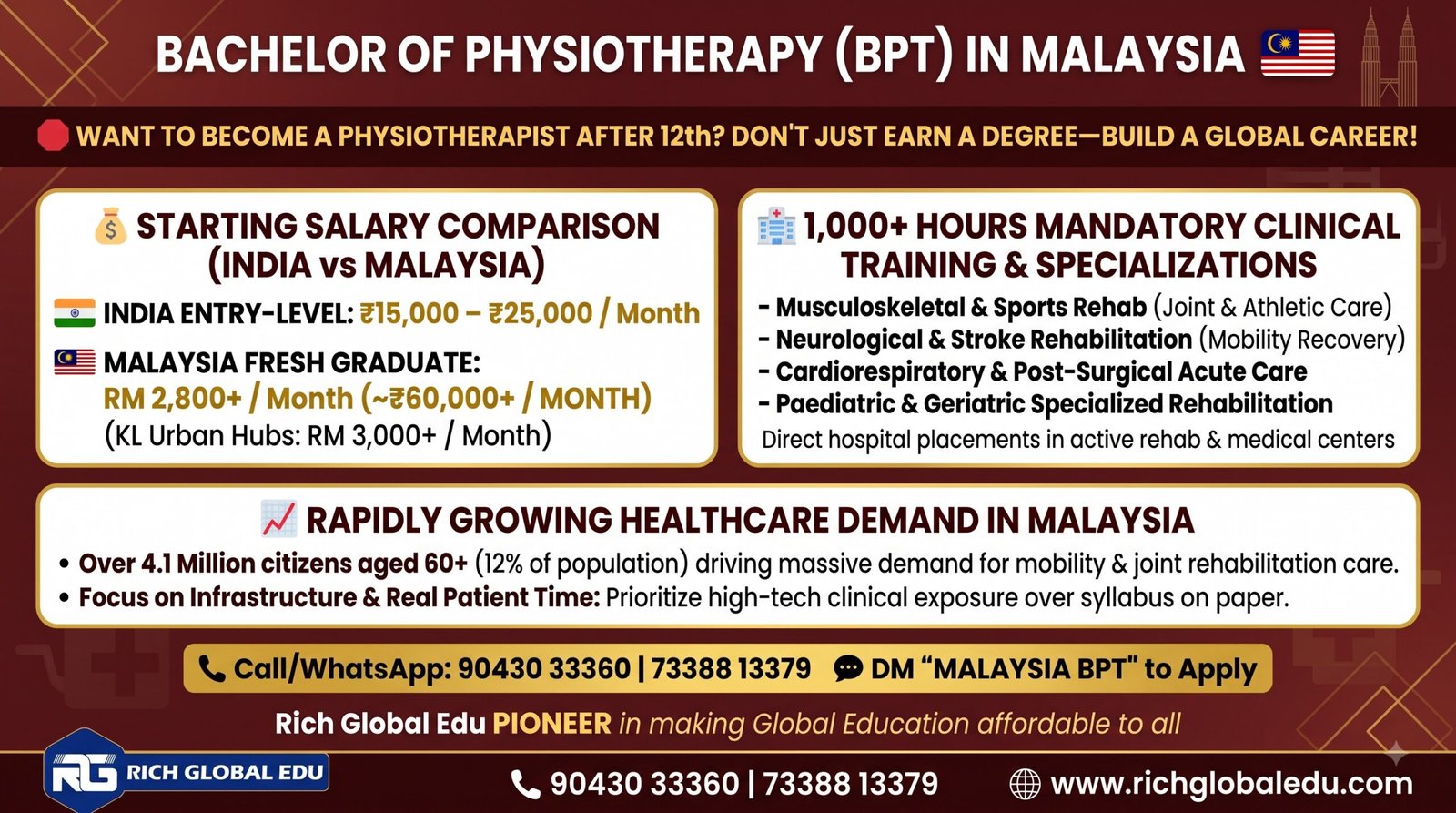
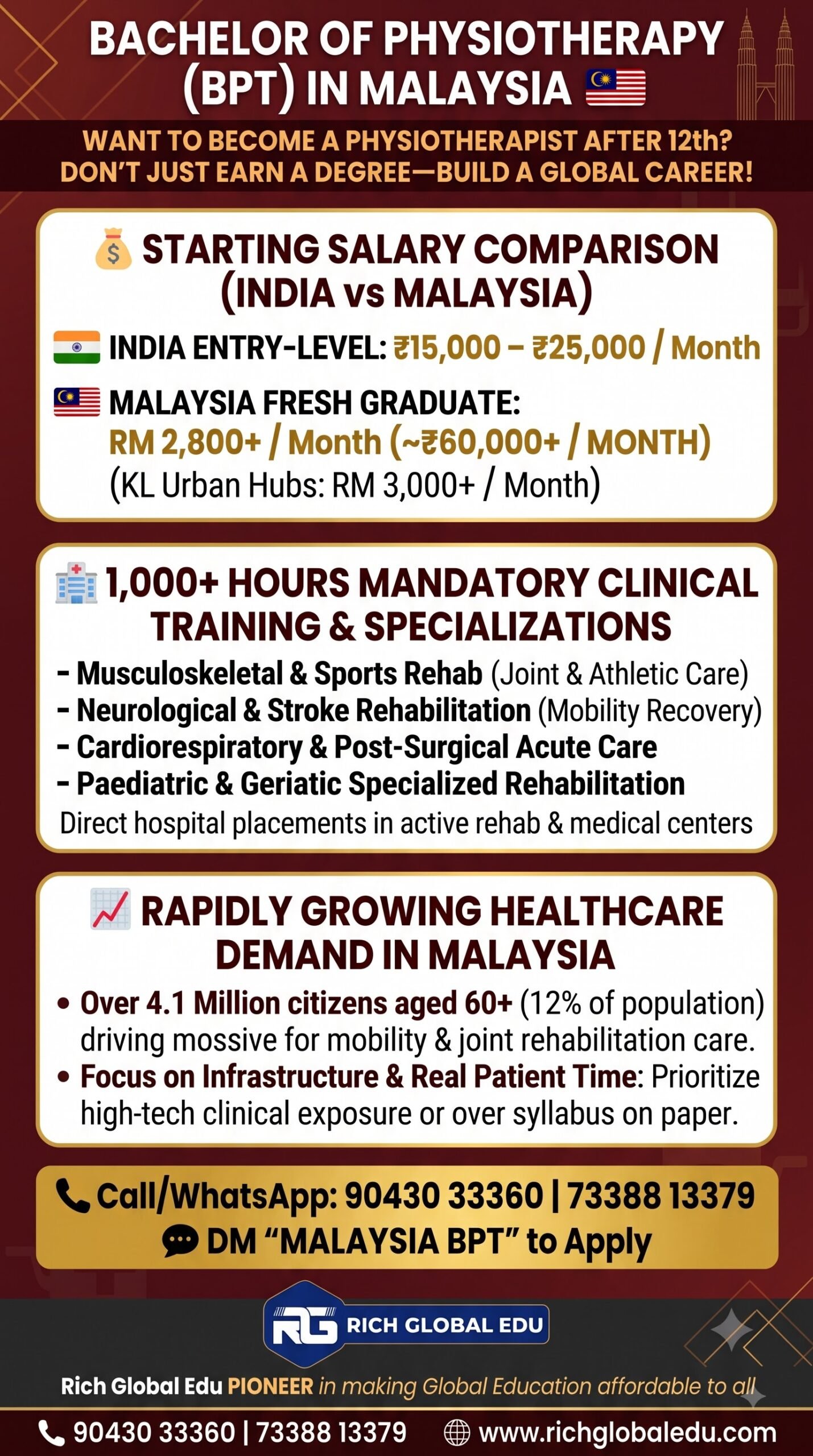
One of the most critical factors when evaluating a BPT degree abroad is the depth of clinical training. Malaysian national benchmarks mandate 1,000 hours (or 25 weeks) of clinical placement. Selected universities provide 1,000+ hours of structured clinical experience, allowing students to apply classroom concepts in supervised, real-world clinical settings.
Diversity of Clinical Training Environments
Students undergo hands-on clinical rotations across diverse healthcare settings, including:
- Full-Scale Hospitals
- Specialized Physiotherapy Clinics
- Dedicated Rehabilitation Centers
- Outpatient Healthcare Centers
- Community Healthcare Settings
🔬 Specializations & Clinical Exposure Domains
Depending on the chosen university and program track, Indian students gain clinical exposure across seven core domains of modern healthcare:
Musculoskeletal Physiotherapy: Assessment and rehabilitation techniques for muscle, joint, structural movement problems, and traumatic injuries.
Neurological Rehabilitation: Restoring mobility, motor control, and functional independence for patients suffering from neurological conditions or stroke.
Cardiorespiratory Physiotherapy: Diagnostic and therapeutic care for chronic respiratory conditions, cardiovascular health, and post-cardiac recovery.
Sports Physiotherapy & Rehabilitation: Prevention, acute management, exercise prescription, and return-to-play protocols for athletic injuries.
Surgical & Acute Care: Pre-operative and post-operative physical therapy support within hospital wards and intensive care units.
Paediatric Physiotherapy: Specialized developmental, motor, and physical support tailored to neonates, infants, and growing children.
Geriatric Physiotherapy: Enhancing mobility, balance, muscle strength, fall prevention, and functional independence among aging adults.
⚡ Modern Rehabilitation Technology & Infrastructure
Modern Physiotherapy extends far beyond basic exercise routines and manual therapy. Depending on the university, Malaysian institutions equip students with access to cutting-edge rehabilitation technologies, including:
Gait Analysis Systems: Computerized systems for analyzing walking mechanics and biomechanics.
Force Platforms: Specialized equipment for evaluating ground reaction forces, balance, and weight distribution.
Electromyography (EMG): Measuring and evaluating muscular electrical activity during movement.
Real-Time Ultrasound: Visualizing real-time muscle structure, dynamic function, and deep core engagement.
Isokinetic Equipment: Dynamometers used for objective muscle strength assessment and isolation training.
Therapeutic Modalities: Advanced Electrotherapy, Therapeutic Ultrasound, and Hydrotherapy suites.
Clinical Skills Laboratories: Simulation facilities and modern rehabilitation gyms designed for real-time practice.
The Core Question: Infrastructure Over Syllabus
While similar equipment can be found in top Indian institutions, prospective students and parents must ask the defining question: “HOW MUCH WILL I ACTUALLY GET TO PRACTISE?”
A technology listed in a brochure is meaningless if students do not get regular, hands-on time with it. Always evaluate the actual infrastructure, hospital partnerships, patient volume, and guaranteed lab access before selecting a university.
📊 Comprehensive Comparison: BPT in India vs. Physiotherapy in Malaysia
While India features many reputable BPT institutions, the quality of infrastructure, technological access, and hospital rotations varies significantly across colleges.
Practical & Academic Integration: Indian curricula include clinical components, but Malaysian programs feature structured practical modules seamlessly woven into every semester.
Guaranteed Clinical Hours: Malaysian degrees build 1,000+ clinical placement hours directly into the degree framework.
Hospital & Patient Placements: Students in Malaysia complete rotations across diverse public and private hospitals, specialized clinics, and community care centers.
Technological Exposure: Access to advanced biomechanical labs, simulation labs, and real-time diagnostic tools at selected campuses.
Curriculum Breadth: Dedicated coursework across Neurological, Musculoskeletal, Sports, Cardiorespiratory, Paediatric, and Geriatric fields.
Research & Global Perspective: Integrated research dissertations coupled with direct experience within an international, multicultural healthcare ecosystem.
👵 The Demographics Factor: Malaysia's Rapidly Ageing Population
When selecting a healthcare career path, understanding future market demand is essential. Malaysia is experiencing a significant demographic shift toward an aging society:
- In 2025, approximately 4.1 million Malaysians were aged 60 and above.
- Senior citizens account for roughly 12% of Malaysia's total population, a statistic projected to climb steadily.
What This Means for Physiotherapists
An aging population creates an exponential, long-term demand for specialized physical therapy and rehabilitation in:
- Fall prevention and balance restoration
- Joint replacement and musculoskeletal rehabilitation
- Post-stroke recovery and neurological care
- Post-surgical mobilization
- Strength maintenance and long-term geriatric independence
This growing demographic reality ensures sustained demand for skilled rehabilitation professionals across the region.
💰 Salary Expectations: India vs. Malaysia
Career earning potential is a crucial consideration for students and families:
Physiotherapist Starting Salary in India: Fresh BPT graduates in India typically start with earnings between ₹15,000 to ₹25,000 per month. Actual figures vary based on employer type, city, and individual skill sets.
Physiotherapist Starting Salary in Malaysia: Reported average starting salaries for physiotherapists in Malaysia hover around RM 2,800 per month (which converts nominally to approximately ₹60,000+ per month). In major urban healthcare hubs like Kuala Lumpur, reported averages reach RM 3,000+ per month.
Note: Earning figures depend on regional living costs, individual employer terms, local work permit guidelines, and professional registration rules at the time of graduation.
🌐 Post-Graduation Work Opportunities & Career Planning
Graduating from a Malaysian university provides a strong foundation for an international healthcare career, though employment and residence rights require meeting local professional registration and immigration criteria.
Because navigating foreign healthcare registrations and work visas requires foresight, career planning must begin before choosing a university—not after graduation.
🚀 Build Your Global Physiotherapy Career with Rich Global Edu
If you are going to invest four years into earning your BPT degree, choose an institution based on what those four years will give you: Practical Learning | 1,000+ Clinical Hours | Modern Rehabilitation Tech | International Healthcare Exposure | Patient-Centered Training | Sustained Industry Demand.
Don't just study Physiotherapy. Build a high-impact global career.
Take the First Step Today with Rich Global Edu
Rich Global Edu helps Indian students navigate Malaysian university admissions based on your academic profile, budget, clinical preferences, and long-term career goals.
📞 Call / WhatsApp: 90430 33360 | 73388 13379
🌐 Website: www.richglobaledu.com
📲 Direct Message: Send us a DM with "MALAYSIA BPT" on Instagram or WhatsApp to check your eligibility immediately!
Rich Global Edu – Making Global Education Affordable for All🌍🎓🚀