
Study Electrical & Electronics Engineering Technology in Malaysia After Class 12: Bachelor’s Degree Guide for Indian Students
Want to become an Electrical & Electronics Engineer after 12th? Before deciding where to pursue your B.E. / B.Tech in Electrical & Electronics Engineering, take a moment to look four years into your future.
Ask yourself two fundamental questions:
- Will I graduate with just an engineering degree, or will I possess the practical skills, laboratory experience, and industry exposure needed to build a successful engineering career?
- Will I begin my career with a modest starting salary, or can I prepare myself for better-paying opportunities in the growing global technology and engineering industry?
For students looking beyond conventional classroom learning, studying Electrical & Electronics Engineering Technology in Malaysia offers a powerful combination of practical education, modern engineering laboratories, industry exposure, applied learning, international experience, and access to a growing electronics and technology ecosystem.
⚡ Why Choose Malaysia for Electrical & Electronics Engineering Technology?
Electrical and Electronics Engineering Technology is an inherently hands-on technical profession. Becoming a successful engineer requires far more than studying formulas, attending lectures, and passing written examinations. To excel, students require daily opportunities to:
Analyse Circuits: Master complex electrical and electronic circuit analysis.
Understand Power Systems: Study electrical grid infrastructure and high-voltage power technologies.
Work with Embedded Systems: Code microcontrollers and design smart, integrated hardware systems.
Develop Power Electronics Knowledge: Master conversion systems for electric vehicles, industrial machines, and renewables.
Learn Automation & Robotics: Work directly with industrial control systems, PLCs, and manufacturing automation.
Utilize Modern Lab Equipment: Gain practical experience with advanced measurement, testing, and diagnostic instruments.
Explore IoT & Renewable Energy: Master connected smart devices, solar technologies, and smart-grid infrastructure.
Master Engineering Standards: Build practical troubleshooting skills, apply industrial standards, and solve real-world problems.
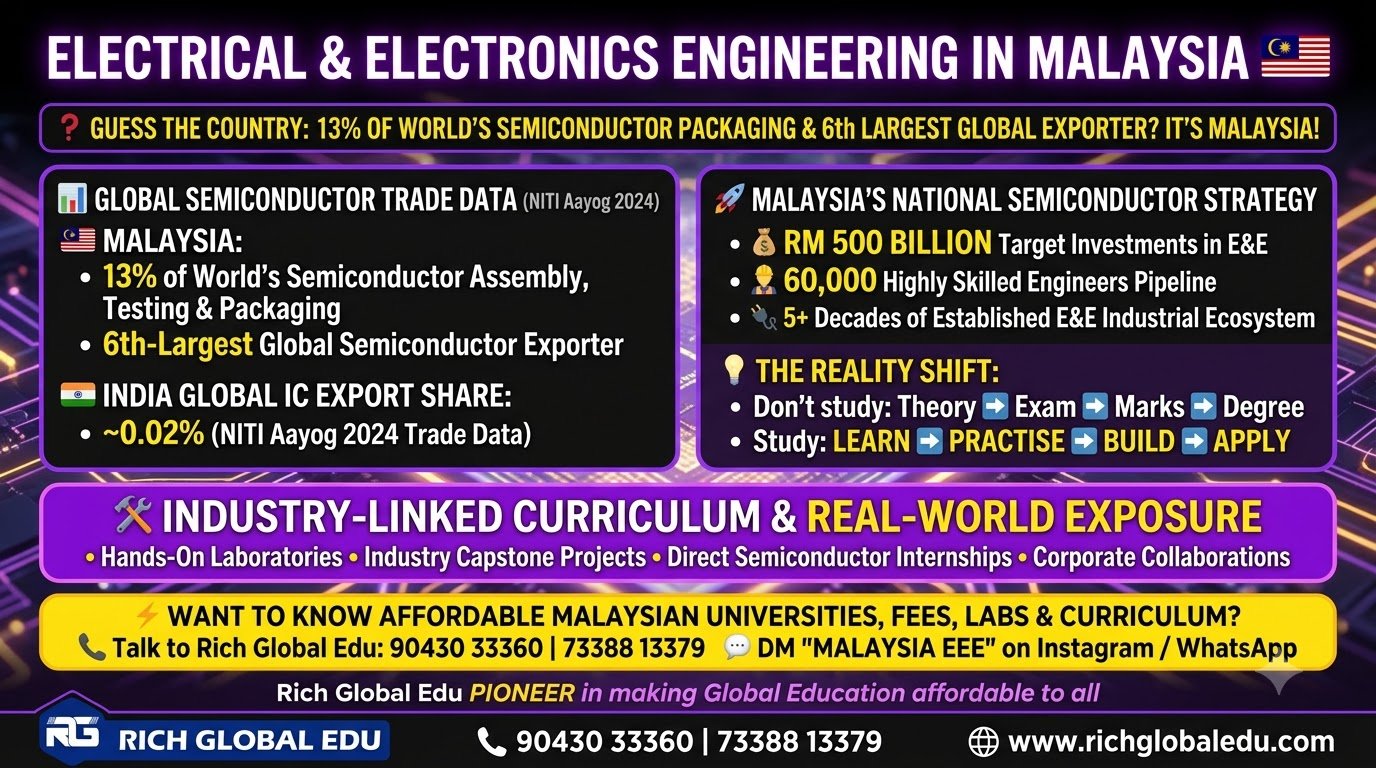
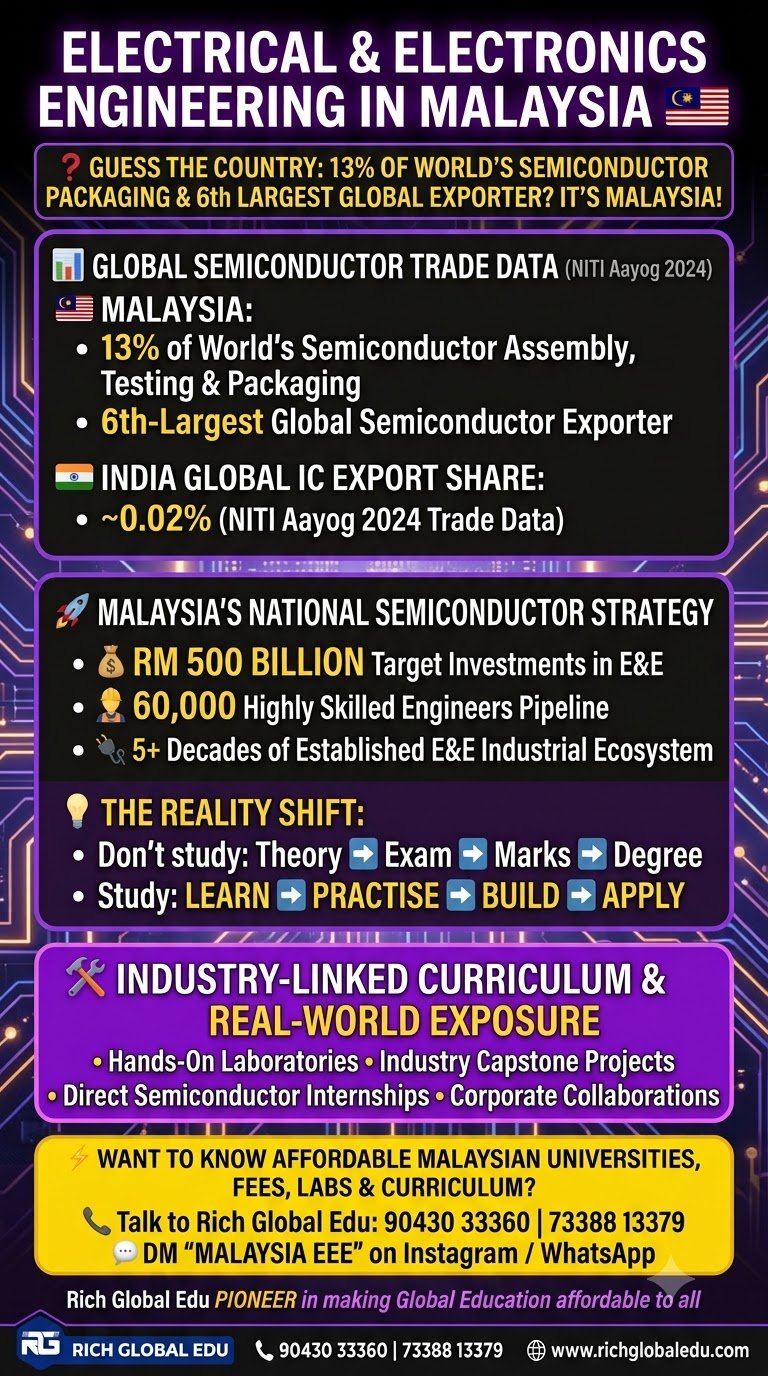
Malaysia’s engineering education environment places heavy emphasis on combining Theory + Practical Laboratory Training + Industry Placement + Applied Research. The curriculum moves away from a basic "Study $\longrightarrow$ Examination $\longrightarrow$ Degree" model and focuses instead on LEARN ⟶ PRACTISE ⟶ APPLY⟶ INDUSTRY EXPOSURE ⟶ ENGINEERING CAREER.
🔬 Practical Training & Real-World Laboratory Exposure
Engineering is an applied profession. While a student may understand circuit theory academically, real engineering demands the ability to design, test, analyze, troubleshoot, and optimize operational systems. Selected Malaysian Engineering Technology programs deliver extensive practical laboratory work and mandatory industrial placements, connecting classroom theory with real-world engineering environments.
Diversity of Training Environments
Students gain practical exposure across a broad spectrum of high-tech technical facilities:
- Advanced Engineering Laboratories
- High-Tech Manufacturing Facilities
- National Technology Parks
- Power Generation & Utility Companies
- Electronics & Semiconductor Production Industries
- Industrial Automation Facilities
🧩 Key Specializations & Focus Areas
Depending on the university and chosen program track, Indian students gain hands-on training across eight core engineering domains:
Electrical Power Systems: Fundamentals of power generation, transmission, distribution, and modern industrial electrical infrastructure.
Power Electronics: Electronic systems that convert and control electrical power, powering everything from industrial machinery to electric vehicles and renewable energy grids.
Embedded Systems & Microcontrollers: Programming intelligent microcontrollers to control electronic devices, serving as the foundation for IoT, robotics, and smart tech.
Renewable Energy & Smart Grids: Technologies behind solar power, energy management, smart-grid infrastructure, and sustainable power grids.
Industrial Automation & Robotics: Control systems, sensors, programmable logic controllers (PLCs), and industrial robotics transforming modern smart factories.
Circuit Design & Electronics: Comprehensive component testing, PCB layout, circuit design, and performance optimization for real-world devices.
Control Engineering: Systems used to monitor, regulate, and automate complex industrial processes and machine operations.
Telecommunications & Communication Systems: Principles behind high-speed digital communications, network infrastructure, and electronic data transfer.
⚙️ Modern Engineering Laboratories & Facilities
Modern engineering education requires state-of-the-art facilities. Depending on the university selected, students gain hands-on lab access to:
Electrical Machines & Power Systems Labs: Power system training equipment, machines, and high-voltage grid simulators.
Power Electronics & Circuit Labs: Specialized benches for testing power conversion, electronic components, and circuit design.
Embedded Systems & Microcontroller Platforms: Development platforms for microcontrollers, microprocessors, and hardware debugging.
Automation, Robotics & Control Systems: Industrial automation setups, PLC racks, robotic arms, and sensor networks.
IoT & Telecommunications Labs: Development platforms for connected IoT devices, RF testing, and modern telecommunication suites.
Renewable Energy Training Systems: Solar array, energy storage, and green power integration simulators.
Advanced Engineering Software: Industry-standard simulation, CAD, and circuit modelling software.
The Defining Question: Infrastructure Over Brochure Claims
While advanced equipment exists in select Indian institutions, prospective students and parents must ask: “HOW MUCH WILL I ACTUALLY GET TO PRACTISE?”
A lab listed in a brochure is meaningless without guaranteed, regular access. Always evaluate the actual laboratory infrastructure, equipment availability, industry partnerships, project opportunities, and practical lab hours before selecting an engineering university.
🏬 Industry Placements & Industrial Training
Engineering education reaches its full potential when students experience real-world technical operations. Selected Malaysian Engineering Technology programs integrate structured industrial training within key economic sectors including Manufacturing, Electronics, Semiconductors, Industrial Automation, Power & Energy, Telecommunications, and Engineering Services.
Through these placements, students learn how engineering teams operate, how industrial equipment is tested, how electronic products are developed, how automated assembly lines function, and how complex engineering projects are managed.This transitions your journey from "Theory⟶ Exam ⟶ Degree" to THEORY⟶ PRACTICAL ⟶ INDUSTRY ⟶ EXPERIENCE ⟶ CAREER.
📊 Comprehensive Comparison: Engineering in India vs. Malaysia
While India features many established engineering colleges, the quality of laboratory infrastructure, actual machine time, industry placements, and global perspective varies significantly across institutions.
Practical Learning Integration: Indian curricula feature lab components, but Malaysian Engineering Technology programs seamlessly weave applied practical modules into every semester.
Structured Industrial Training: Malaysian programs offer guaranteed, structured industry placements built directly into the degree framework.
Laboratory Facilities & Equipment: Direct student access to modern electrical machines, power electronics units, automation equipment, and control systems.
Embedded Technology & IoT: Extensive practical exposure to microcontrollers, embedded hardware development, and IoT sensor platforms.
Automation & Renewable Integration: Hands-on experience with industrial robotics, PLC programming, smart grid systems, and solar power training units.
Industry & Applied Research: Direct training opportunities inside Malaysia's thriving manufacturing and semiconductor hubs, combined with applied engineering projects.
International Environment & Perspective: Experience an international, multicultural campus life while connecting directly with Malaysia's global technology supply chain.
Rather than choosing a destination based purely on geography, evaluate programs based on: PRACTICAL TRAINING + LABORATORY EXPOSURE + INDUSTRY TRAINING + INFRASTRUCTURE + CAREER POTENTIAL.
🏭 Why Malaysia's Semiconductor & Electronics Industry Matters
Studying engineering is about preparing for future technological demand. Malaysia is an essential global hub within the global semiconductor and electronics supply chain. The country holds a major worldwide presence in Semiconductor Assembly & Testing, Electronics Manufacturing, Electrical Components, Industrial Automation, and Engineering Services.
Malaysia’s booming ecosystem creates high demand for skilled engineers across booming technical sectors:
Electric Vehicles & Battery Tech: High demand for engineers skilled in power electronics, battery management, and electric drivetrains.
Smart Grid Infrastructure: Need for professionals who understand automated power distribution, intelligent monitoring, and renewable integration.
Automation & Industrial Robotics: Automated assembly, robotic manufacturing lines, and intelligent factory control systems.
Semiconductor Manufacturing: Precise electrical, electronic, testing, and cleanroom automation environments.
Renewable Energy Systems: Solar power integration, energy storage systems, and power conversion.
IoT & Embedded Solutions: Smart hardware, sensor integration, microcontroller programming, and hardware-software communication.
💼 Diverse Career Pathways for Graduates
An Electrical & Electronics Engineering Technology degree provides a versatile foundation across high-tech sectors. Depending on specialisation, skills, and employer requirements, graduates can pursue career roles such as:
- Electrical Engineer / Electronics Engineer
- Electrical Design Engineer / Electronics Design Engineer
- Power Systems Engineer / Renewable Energy Engineer
- Automation Engineer / Control Systems Engineer / Robotics Engineer
- Embedded Systems Engineer / IoT Engineer
- Electronics Testing Engineer / Instrumentation Engineer
- Maintenance Engineer / Manufacturing Engineer
- Semiconductor Engineer / Telecommunications Engineer
💰 Salary Expectations: India vs. Malaysia
Career earning potential is an important factor for prospective students and their families:
Fresh Engineer Salary in India: Entry-level electrical and electronics engineering graduates in India typically start with earnings between ₹18,000 to ₹30,000 per month. Actual salaries vary based on employer type, geographic location, technical specialization, individual skills, and institution tier.
Fresh Engineer Salary in Malaysia: Reported starting salaries for Electrical & Electronics Engineers in Malaysia range between RM 2,800 to RM 4,500 per month. In major industrial hubs like Kuala Lumpur and Penang, starting salaries average RM 3,500+ per month.
Note: Salary figures depend on local living costs, individual employer terms, industry sector, work permit policies, and economic conditions at graduation
🌐 Post-Graduation Work Opportunities & Planning
Graduating from a Malaysian university builds a strong foundation for an international engineering career, though foreign work rights require fulfilling local immigration, employer, and professional engineering registration rules. Because work passes and foreign employer hires require strategic foresight, career planning must begin before choosing a university—not after graduation.
🚀 Build Your Engineering Career with Rich Global Edu
If you are going to invest four years studying Electrical & Electronics Engineering Technology, choose a university based on what those four years will give you: Practical Learning | Extensive Lab Exposure | Industry Placements | Modern Automation & Electronics Tech | Global Ecosystem Exposure | High Industry Demand.
Don't just study engineering. Build a high-impact global career.
Take the First Step Today with Rich Global Edu
Rich Global Edu helps Indian students shortlist top Malaysian engineering universities based on your academic profile, budget, technical specialization (power, electronics, embedded systems, robotics, IoT, semiconductors), lab facilities, and long-term career goals.
📞 Call / WhatsApp: 90430 33360 | 73388 13379
🌐 Website: www.richglobaledu.com
📲 Direct Message: Send us a DM with "MALAYSIA EEE" on Instagram or WhatsApp to check your eligibility immediately!
Rich Global Edu – Making Global Education Affordable for All🌍🎓🚀