"Every learner who places their trust in Rich Global becomes our responsibility."

Study Engineering in Malaysia After 12th standard completion

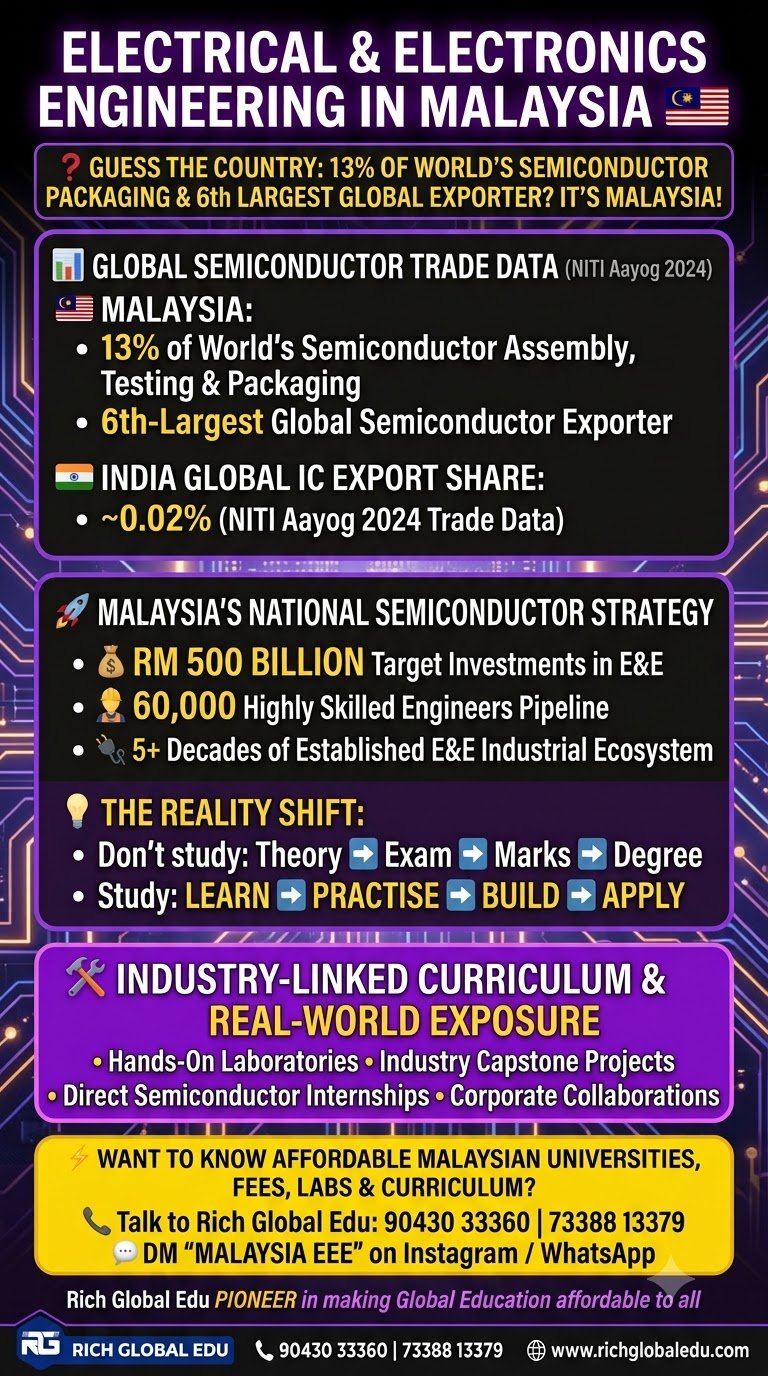
Planning to Study Engineering After 12th? The ₹4 Lakh Truth Every Indian Student Needs to Know

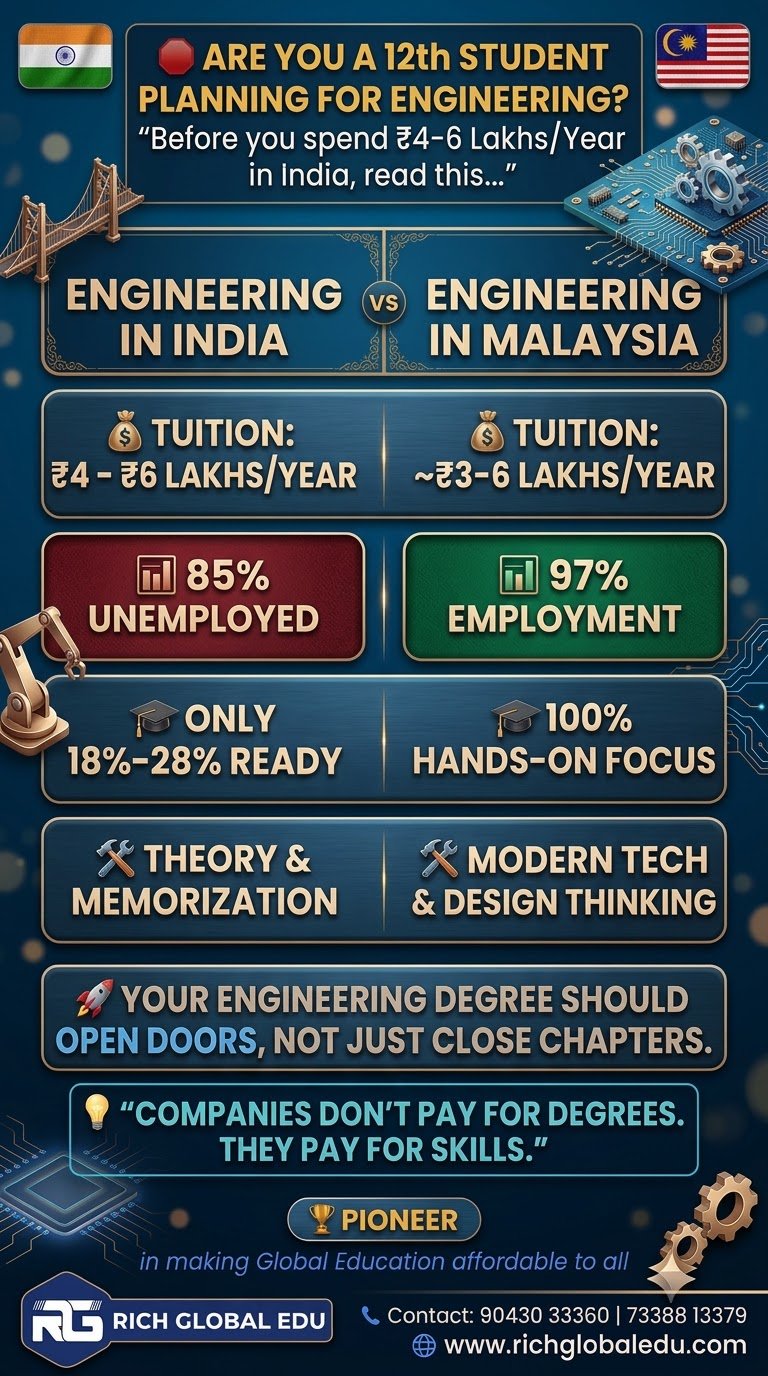
Are you currently in 12th standard and planning to pursue an Engineering degree? Before you or your parents commit to spending ₹4–6 Lakhs per year on private engineering colleges in India, pause and consider the real outcome of that investment.

India produces nearly 15 lakh engineering graduates every year. However, employability reports suggest that approximately 85% of engineering graduates finish their degree without a job or internship offer in hand.

Even more alarming, industry assessments show that only 18% to 28% of engineering graduates possess industry-ready technical skills. In contrast, the engineering unemployment rate in countries like the U.S. remains around 3%, while Malaysia's overall unemployment rate stands low at approximately 3%.

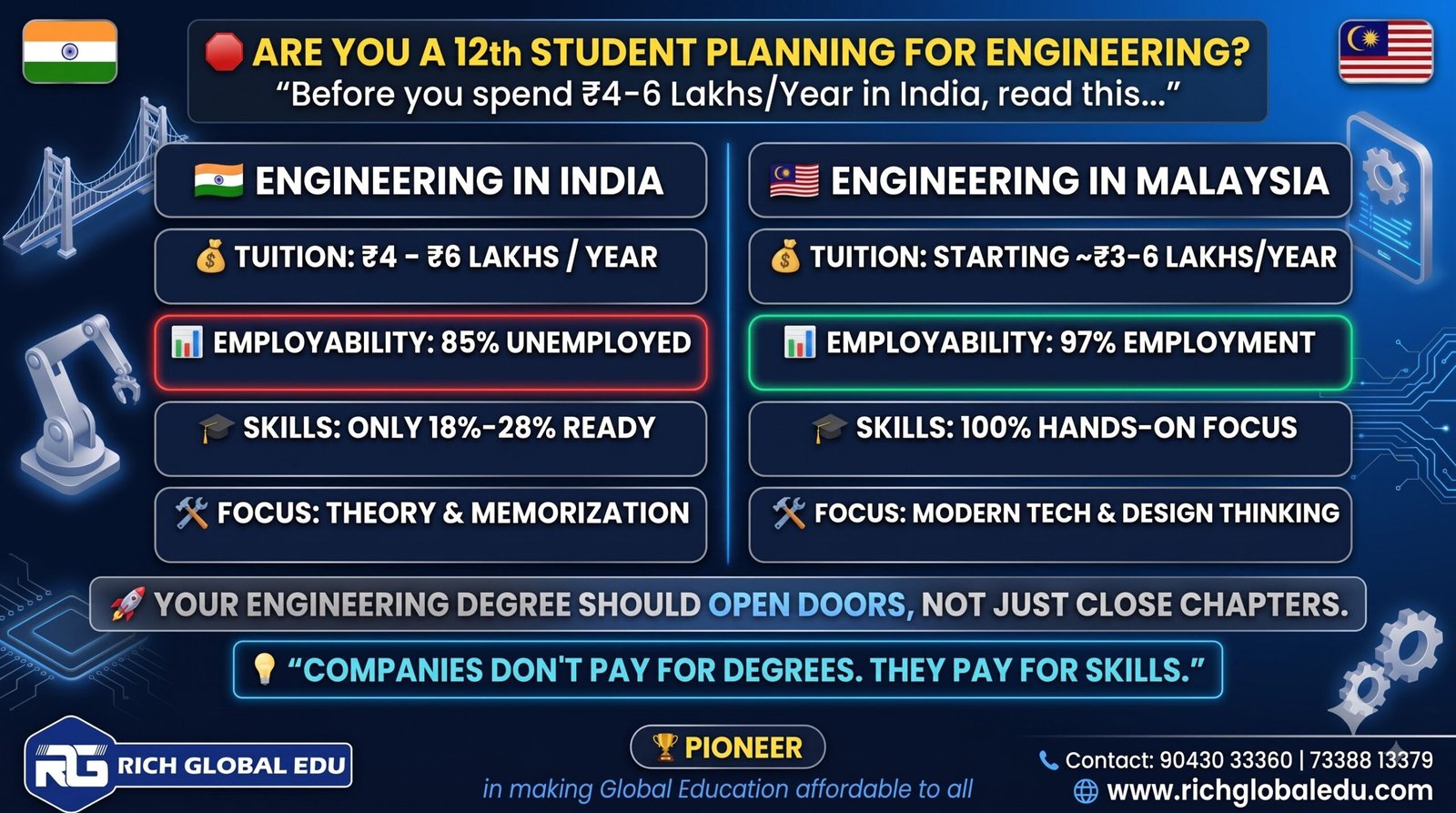
Engineering education comparison between India and Malaysia highlighting tuition fees, employability, practical skills, and career opportunities.

What Is Going Wrong with Traditional Engineering Degrees?

The gap between classroom learning and actual industry requirements comes down to a few major factors:

- Over-Reliance on Rote Learning: Heavy focus on theoretical exams rather than modern tech stack, design thinking, and practical problem-solving.
- Lack of Industrial Training: Minimal quality internship opportunities leave students unprepared for real-world engineering environments.
- Critical Skill Gaps: Employers consistently report deficits in communication, teamwork, data literacy, and practical execution.

Why Smart Students Are Choosing Malaysia for Engineering?

You don't need to spend crores in the US or UK to get a world-class, career-focused engineering education. Malaysia has emerged as a premier global education destination offering hands-on, job-ready training at nearly the same cost as private Indian colleges.

Comparison Criteria of Private Colleges in India V/S Engineering Universities in Malaysia:

Annual Tuition Fee : ₹4.0 Lakhs – ₹6.0 Lakhs / Year v/s ₹3.0 Lakhs – ₹6.0 Lakhs / Year.
Learning Methodology :  Theory & exam-centric focus v/s Hands-on, project-based & practical focus.
Industry Integration : Variable / Limited internship support v/s Built-in mandatory industry internships.
Global Exposure : Local campus environment v/s Multicultural, international environment.
Graduate Employability : High skill gap reported by recruiters v/s Job-ready technical & soft skill focus.

Bridge the Skill Gap with Rich Global Edu

Companies don't pay for degrees; they pay for skills. At Rich Global Edu, we help students from Tamil Nadu access practical, affordable global engineering programs that set them up for international career success.

Ready to Build a Job-Ready Engineering Career?

Call / WhatsApp: 90430 33360 | 73388 13379
Website: www.richglobaledu.com
Direct Message:
Send us a DM with "MALAYSIA ENG" on Instagram or WhatsApp for instant details!

Rich Global Edu – Making Global Education Affordable for All

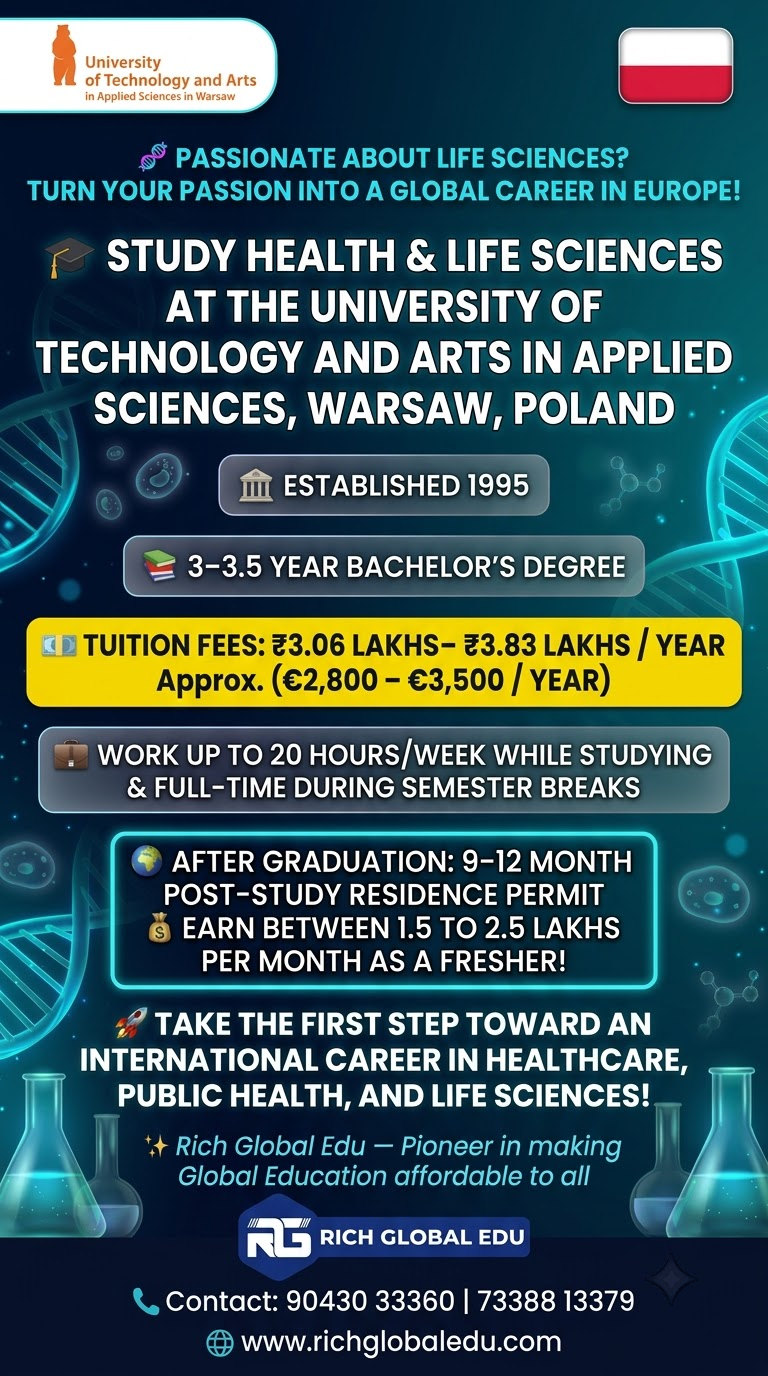
Poland – Bachelor’s in Health and Life Sciences at the University of Technology and Arts in Applied Sciences in Warsaw, Poland

Are You a 12th Biology Student? Here’s How You Can Build a ₹2 Lakh/Month Career in Europe’s Life Sciences Sector

If you are currently completing or have finished your 12th Standard with Biology in Tamil Nadu, you might feel like your choices are limited to MBBS exam prep or basic degree courses.

However, the global job market tells a completely different story.

Fields like Health Sciences, Public Health, and Life Science Technologies are booming worldwide. Graduates in these sectors are stepping into high-demand, high-paying roles across Europe—without the intense competition and massive financial burden of traditional medical seats.

If you are looking for a direct, affordable pathway to an international degree and a lucrative European career, studying at the University of Technology and Arts in Applied Sciences in Warsaw, Poland is a game-changer.

Why Study Life Sciences in Poland?

Poland is recognized as one of Central Europe's main centers for medical research, public health infrastructure, and pharmaceutical manufacturing.

Key Highlights for International Students:

Schengen European Advantage: Live, study, and travel freely across 29 Schengen countries.
Budget-Friendly Education: Enjoy high academic standards at low tuition costs.
Earn While You Learn: Work up to 20 hours per week during classes and full-time during semester breaks to manage living expenses.
Post-Study Work Permit: Secure a 9 to 12-month post-study residence permit after graduation to transition smoothly into the European workforce.

University Spotlight: University of Technology and Arts in Applied Sciences, Warsaw

Established in 1995, the University of Technology and Arts in Applied Sciences (ATA) in Warsaw is focused on practical, hands-on learning. Situated in Poland’s capital, it connects students directly with local healthcare networks and life science organizations.

Program Overview & Details:

Field of Study : Health & Life Sciences / Public Health
Institution : University of Technology and Arts in Applied Sciences, Warsaw
Established Year : 1995
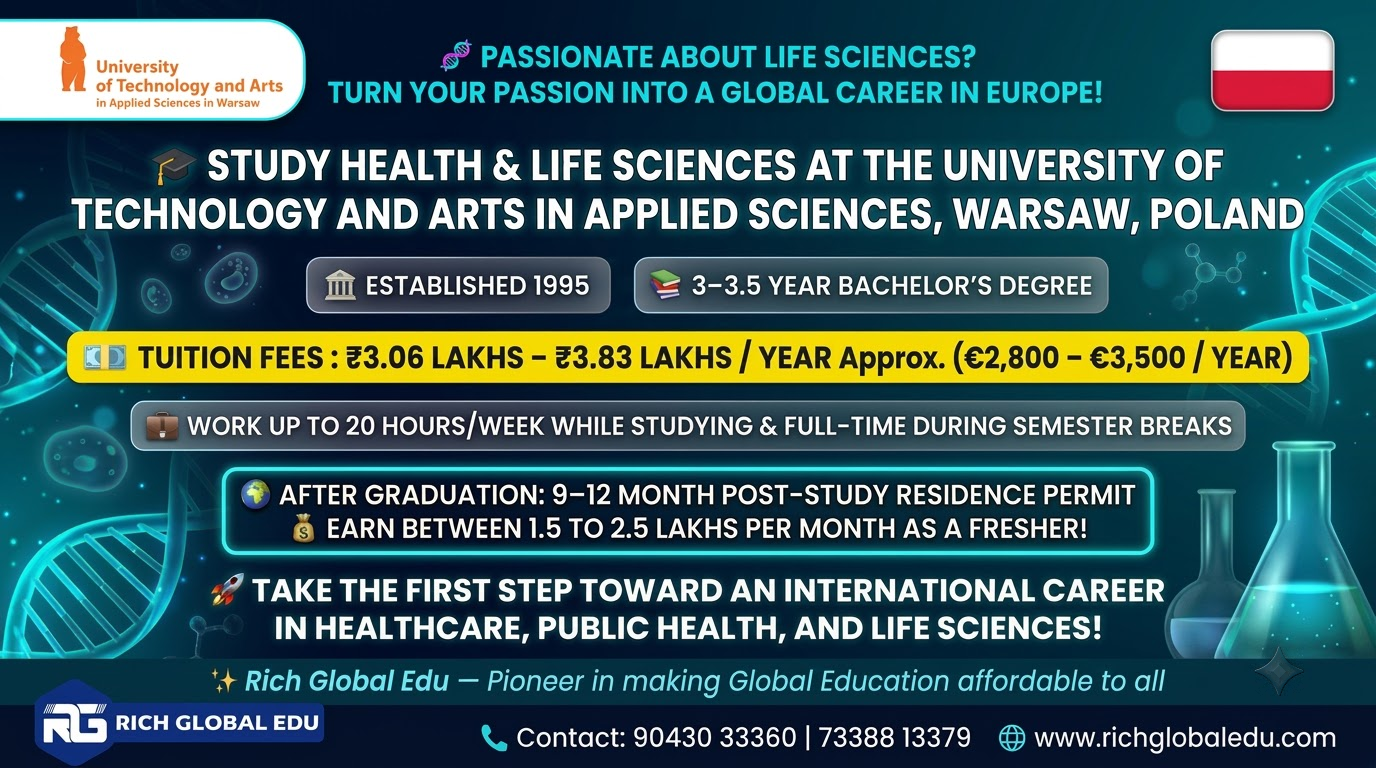
Program Duration : 3 – 3.5 Years (Bachelor's Degree)
Annual Tuition Fee : €2,800 – €3,500 / Year (Approx. ₹3.0 Lakhs – ₹3.8 Lakhs / Year)
Instruction Language : 100% English
Location : Warsaw, Poland

Strong Financial Return on Investment (ROI)

Graduating with an applied Life Sciences or Public Health degree opens doors to high-paying positions across the healthcare and corporate wellness sectors.

Fresher Salary Expectation : Entry-level professionals in healthcare administration and life sciences research in Poland earn between ₹1.5 Lakhs to ₹2.5 Lakhs per month (€1,600 – €2,700/month approx.).

Promising Career Options:

- Public Health & Healthcare Administrator
- Life Sciences & Clinical Research Coordinator
- Environmental Health & Safety Officer
- Healthcare Operations & Data Analyst

Eligibility Criteria

- Students who have completed 12th Standard (HSC / CBSE / ISC) with Biology, Chemistry, or Physics background.
- High motivation to study in Europe and pursue an international career in health and life science industries.

Take Your First Step with Rich Global Edu

Managing admissions, document legalizations, Schengen student visas, and pre-departure planning can seem complex—but Rich Global Edu makes it simple. We assist Tamil Nadu students through every step of the study-abroad process.

Ready to Launch Your Global Healthcare Career?

Get personalized counseling and complete course details today!

Call / WhatsApp: 90430 33360 | 73388 13379
 Website: www.richglobaledu.com
Direct Message: Send us a DM with "HEALTH" on Instagram or WhatsApp for instant details!

Rich Global Edu – Your Study Abroad & Work Abroad Partner

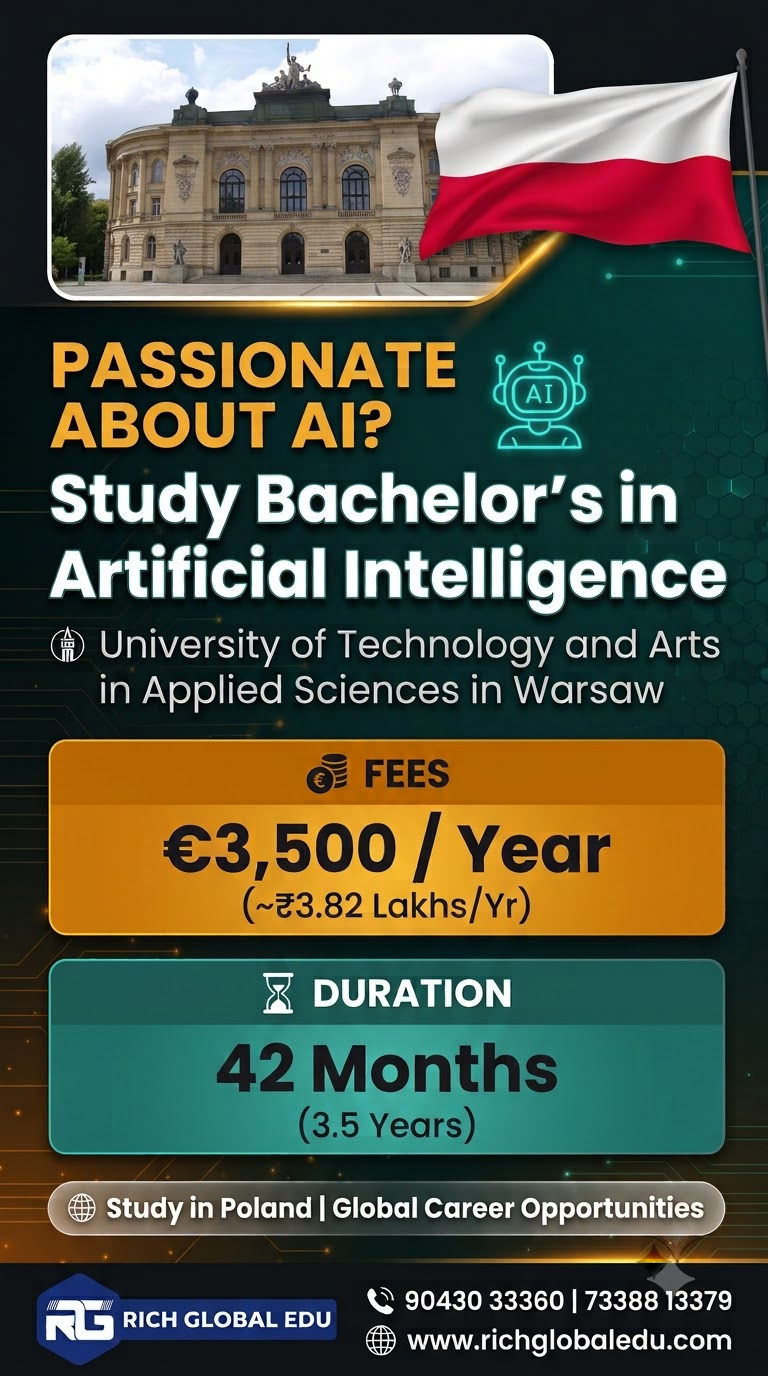
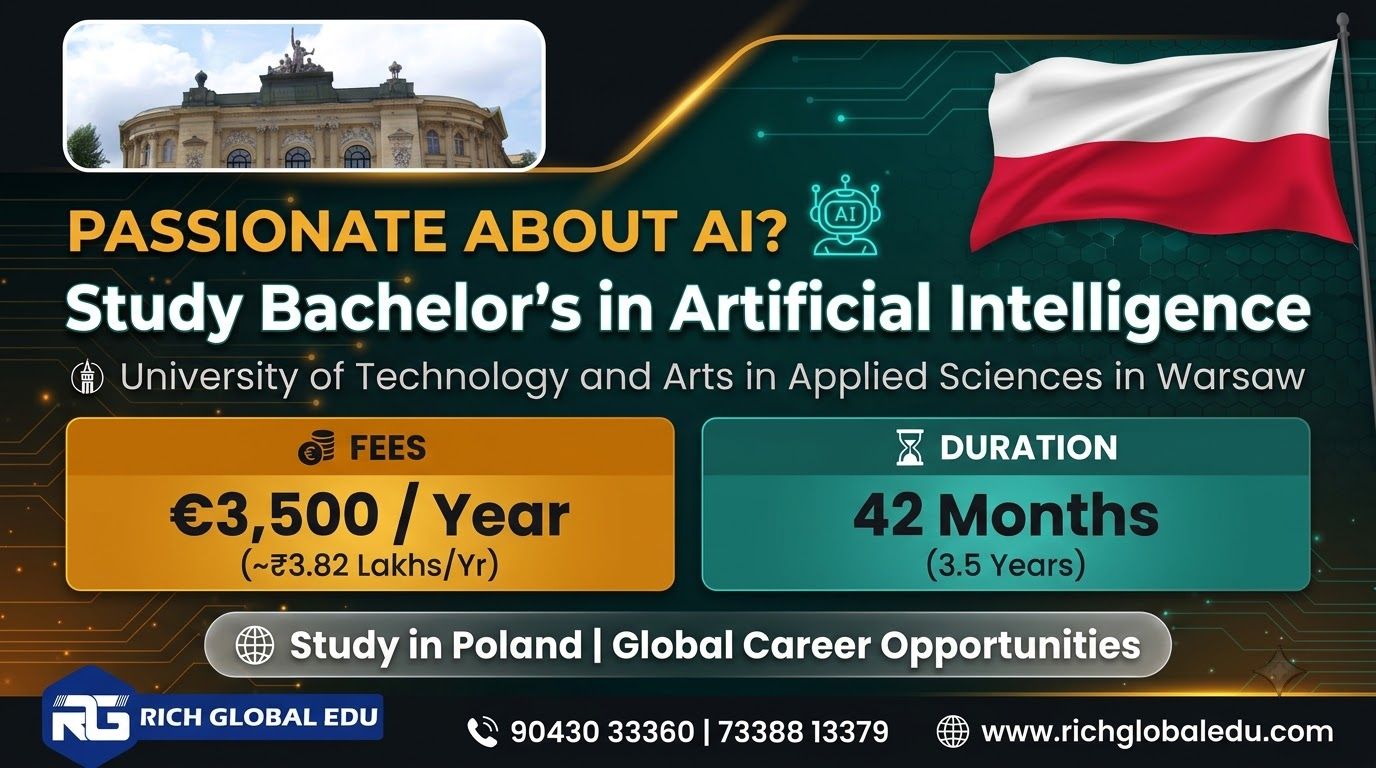
Poland – Bachelor’s in Artificial Intelligence at University of Technology and Arts in Applied Sciences in Warsaw

Study Bachelor’s in Artificial Intelligence in Poland Under ₹3.82 Lakhs/Year: Your Gateway to Global Tech Careers

Are you passionate about technology, coding, and the future of Artificial Intelligence?
   
          With AI revolutionizing every industry—from software and finance to healthcare and robotics—getting a specialized degree in AI is one of the smartest career moves you can make right now.If you are a student or parent in Tamil Nadu searching for an affordable European degree in cutting-edge tech, Poland offers world-class education at a fraction of typical international tuition costs.here

Why Study Artificial Intelligence in Poland?

Poland is one of Europe's fastest-growing technology hubs, home to regional engineering centers for global giants like Google, Microsoft, Amazon, and Intel.

Key Advantages for Students:

Schengen European Degree: Live, study, and travel freely across 29 Schengen countries.
Unbeatable Affordability: High-quality European education with low tuition and comfortable living expenses.
Earn While You Study: International students are permitted to work part-time during their studies.
Post-Study Work Opportunities: Stay back in Europe after graduation to kickstart your tech career.

University Spotlight: University of Technology and Arts in Applied Sciences, Warsaw

Located in Poland's vibrant capital city of Warsaw, the University of Technology and Arts in Applied Sciences combines practical engineering training with modern technology to ensure graduates are job-ready from day one.

Program Feature and Details:

Degree Program: Bachelor's in Artificial Intelligence (Computer Science / Engineer Title).
Institution: University of Technology and Arts in Applied Sciences in Warsaw .
Duration: 42 Months (3.5 Years).
Annual Tuition Fee: €3,500 / Year (Approx. ₹3.82 Lakhs / Year).
Medium of Instruction: 100% English
Location: Warsaw, Poland

What Will You Learn & Career Opportunities

This 3.5-year hands-on engineering program focuses on practical application, building intelligent systems, and data analysis. You’ll master algorithms, machine learning, neural networks, and software engineering principles.

High-Demand Career Paths After Graduation:

AI / Machine Learning Engineer: Design and implement intelligent algorithms for modern tech applications.
Data Scientist & Big Data Analyst: Analyze massive datasets and build predictive models for tech, finance, and healthcare.
NLP & Speech Recognition Specialist: Develop systems for natural language understanding and virtual assistants.
Software & Automation Engineer: Build smart automation tools for multinational tech firms.

Who Can Apply?

- Students who have completed 12th Standard (Higher Secondary / HSC / CBSE / ISC) with a background in Mathematics/Science, or relevant Diploma holders.
- Students with a strong interest in technology, problem-solving, and computer programming.

Plan Your Study in Poland with Rich Global Edu

From selecting your university and managing document verification to securing your Schengen student visa and pre-departure preparation, Rich Global Edu guides you through every step.

Ready to Take the Next Step?

Don't miss the opportunity to study Artificial Intelligence in Europe at an affordable tuition fee!
Call / WhatsApp: 90430 33360 | 73388 13379
Website: www.richglobaledu.com
Direct Message: Send us a DM with "AI POLAND" on Instagram or WhatsApp to receive full admission details!

Rich Global Edu – Your Study Abroad & Work Abroad Partner

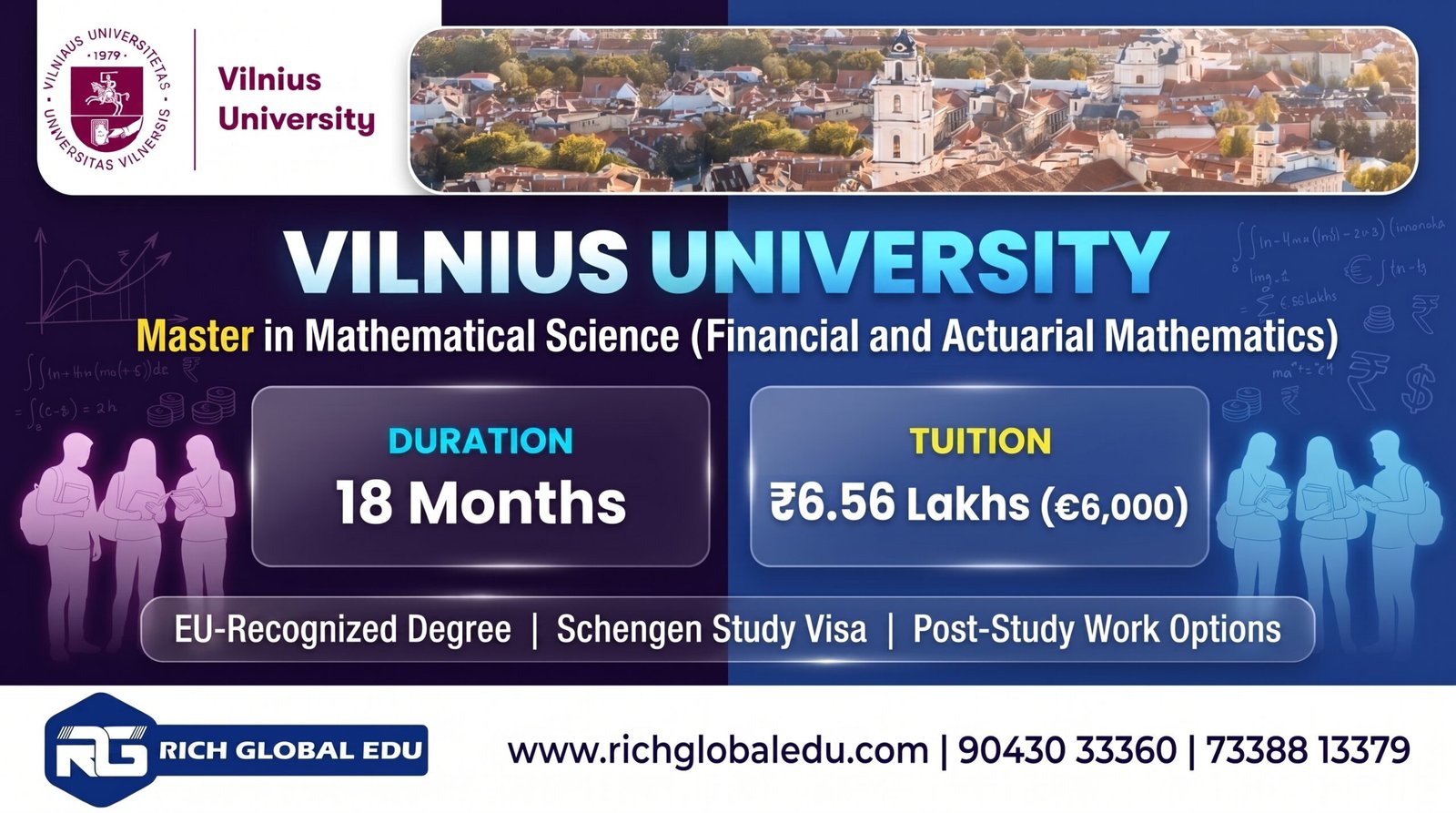
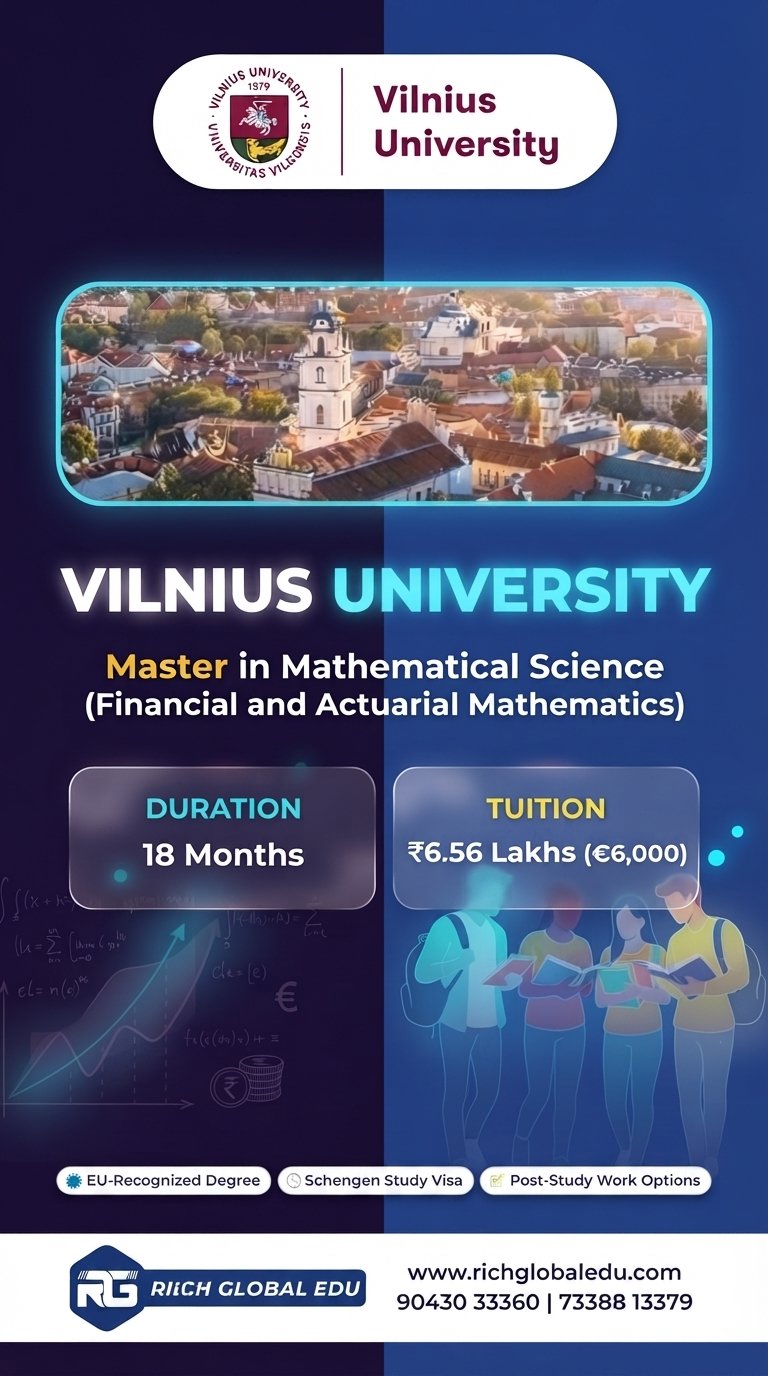
Vilnius University: Masters in Financial & Actuarial Mathematics

Study in Europe Under ₹7 Lakhs: Why Tamil Nadu Math Grads Are Choosing Lithuania ?

Are you wrapping up your B.Sc in Mathematics, Applied Mathematics, or Statistics in Tamil Nadu and asking yourself: “What comes next?”

For years, the standard path for math graduates has been limited to school teaching, government exam prep, or entry-level data analytics roles. But in today’s global economy, your mathematical skills are worth far more—especially in high-income fields like Actuarial Science, Risk Management, and Financial Analytics.

If you’ve dreamed of an international career in Europe without facing overwhelming costs, Lithuania is quickly becoming the top choice for ambitious students across Tamil Nadu.

Why Lithuania is Europe's Best-Kept Secret for Math Graduates?

Located in Northern Europe, Lithuania is a vibrant, tech-forward Schengen Area nation. Studying here means you get world-class European education, a high standard of living, and the freedom to travel across 29 Schengen countries during your breaks.

The Highlights:

Globally Recognized Degree: Earn a European Master’s qualification valid anywhere in the world.
Schengen Access: Experience European culture and build international networks.
Earn While You Learn: Work part-time during your studies to help cover living expenses.
Post-Study Work Visa: Stay back after graduation to step directly into the European job market.

Spotlighting Vilnius University: MSc in Financial & Actuarial Mathematics

Founded in 1579, Vilnius University is Lithuania's flagship institution and a globally ranked academic powerhouse. Their M.Sc in Financial & Actuarial Mathematics is specifically engineered for students who want to apply theoretical math to high-stakes financial environments.

Program Detail Overview:
Degree Title : M.Sc in Financial & Actuarial Mathematics
Duration: 18 Months (Fast-track to your career)
Total Tuition Fee: Approx. €6,000 – €6,600 total (Approx. ₹6.5 Lakhs – ₹7.2 Lakhs total)
Location : Vilnius, Lithuania
Medium of Instruction : 100% English

High-Paying Careers Waiting for You

Financial institutions, insurance giants, fintech startups, and investment banks rely heavily on mathematical models to protect billions in capital. Upon completing this program, you can step into roles such as:

Actuarial Analyst: Calculate risk, design insurance products, and set financial strategies.
Quantitative Financial Analyst: Build algorithm-driven trading models for global banks.
Risk Management Specialist: Help corporations navigate economic shifts and market fluctuations.
Data & Financial Modelling Expert: Turn massive data streams into actionable financial insights.

Who Can Apply?

To qualify for this program, you need:

 A completed B.Sc in Mathematics, Applied Mathematics, Statistics, or a closely related quantitative background.A drive to build an international career in finance and analytics.

Take the First Step with Rich Global Edu

Navigating university applications, document verification, Schengen student visas, and admission deadlines doesn't have to be overwhelming. At Rich Global Edu, we specialize in guiding Tamil Nadu students through every step of their study abroad journey—from selecting the right course to securing your visa approval.

Ready to Start Your European Journey?

Don't let application deadlines pass you by. Connect with our senior education counselors today!
Call / WhatsApp: 90430 33360 | 73388 13379
Direct Message: DM "MATHS" on Instagram or WhatsApp for instant program details!
Partnering with You: Rich Global Edu – Your Study Abroad & Work Abroad Partner

The Hidden Advantage of Studying MBBS in Kazakhstan That Most Students Don’t Know

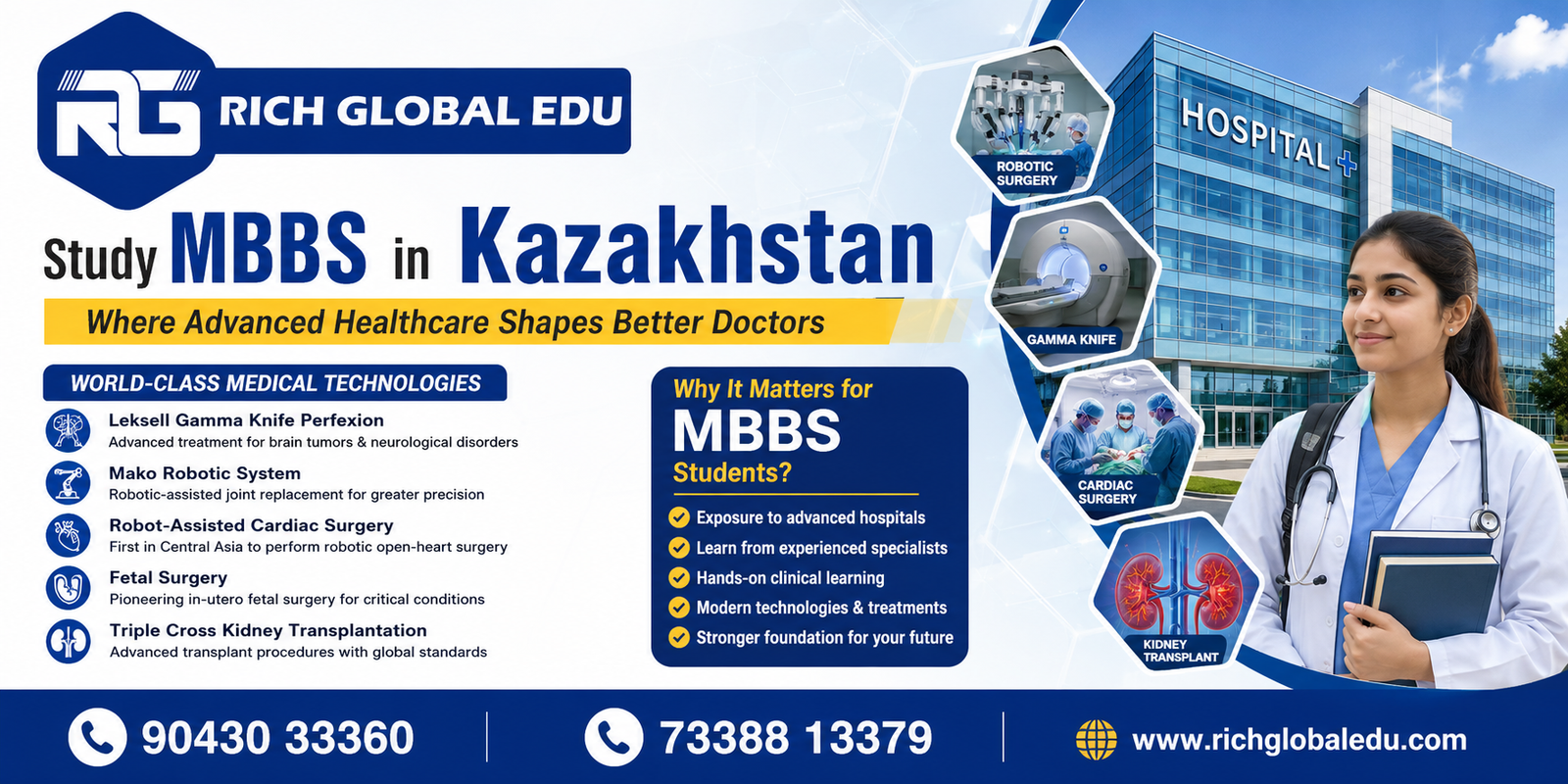
MBBS in Kazakhstan banner showcasing advanced healthcare technologies including robotic surgery, Gamma Knife treatment, cardiac surgery, kidney transplantation, modern hospitals, and clinical training opportunities for international medical students.

Why Kazakhstan’s Healthcare Development Matters for MBBS Students

Many students focus only on university rankings or tuition fees when choosing a country for MBBS abroad. However, one of the most important factors is often overlooked:

How advanced is the country’s healthcare system?

After all, medical education does not happen only inside classrooms. Future doctors learn from hospitals, experienced clinicians, advanced medical technologies, and real patient cases.

A Rapidly Developing Nation with Strong Infrastructure

Kazakhstan is the largest country in Central Asia, the 4th largest in Asia, and the 9th largest country in the world by land area.

With one of the region’s strongest economies, Kazakhstan has invested heavily in modernizing its healthcare sector over the past two decades. These investments have contributed to the development of advanced hospitals, specialized medical centers, and high-technology treatment facilities.

Today, Kazakhstan has established itself as a regional leader in high-tech medicine, offering access to more than 80 types of advanced medical procedures across multiple specialties.

Advanced Medical Technologies Available in Kazakhstan

Kazakhstan’s healthcare system includes technologies and specialized procedures commonly associated with medically advanced countries such as India, China, Japan, South Korea, Thailand, and Malaysia.

Some notable examples include:

Leksell Gamma Knife Perfexion

A highly advanced radiosurgery system used to treat brain tumors and certain neurological disorders without conventional open surgery by delivering precisely focused gamma radiation.

Mako Robotic System

A robotic-assisted orthopedic platform used for joint replacement procedures, helping surgeons achieve greater precision and potentially improving patient outcomes and recovery.

Robot-Assisted Cardiac Surgery

Kazakhstan became the first country in Central Asia to perform robot-assisted open-heart surgery, demonstrating significant progress in advanced cardiovascular care.

Fetal Surgery

Kazakhstani specialists were among the first in the region to successfully perform in-utero fetal surgery, a highly specialized field focused on treating selected congenital abnormalities before birth.

Triple Cross Kidney Transplantation

Kazakhstan has demonstrated the capability to perform highly complex triple cross kidney transplantation procedures, reflecting the expertise and sophistication of its transplant medicine programs.

Why Does This Matter for MBBS Students?

The answer is simple.

Medical students do not learn only from textbooks.

They develop clinical skills through exposure to hospitals, patients, specialists, diagnostic equipment, operating rooms, and evolving medical technologies.

When a country invests in:

  • Advanced tertiary care hospitals
  • Robotic surgery programs
  • Neuroscience centers
  • Cardiac institutes
  • Organ transplantation services
  • Modern diagnostic technologies

students benefit from studying within a more advanced clinical ecosystem.

Even if every student does not directly participate in these highly specialized procedures, learning in an environment where such technologies exist provides valuable exposure to modern medical practice and contemporary healthcare delivery.

A Strong Clinical Learning Environment

Kazakhstan’s emphasis on healthcare modernization has created an environment where MBBS students can gain exposure to structured clinical training and modern hospital systems alongside their academic education.

For Indian students planning to return home and practice medicine, studying within a healthcare ecosystem that incorporates advanced technologies and evidence-based medicine can provide an additional educational advantage.

When selecting a country for MBBS abroad, it is therefore important to evaluate not only university rankings and affordability but also the quality of the surrounding healthcare infrastructure—because the hospitals where students observe and train are an integral part of their medical education.

MBBS in Kazakhstan for Indian Students: Complete Guide

Why Choose Kazakhstan for MBBS? Top 10 Reasons Why Indian Students Are Choosing Kazakhstan in 2026

Introduction

Choosing the right country for MBBS abroad is one of the most important decisions for any student and parent.

With options like Russia, Kyrgyzstan, Uzbekistan, Georgia, Bangladesh, Vietnam, and many others, selecting the right destination can be challenging.

In recent years, Kazakhstan has emerged as one of the most preferred destinations for Indian students pursuing MBBS abroad.

But what exactly makes Kazakhstan attractive?

Let’s explore the Top 10 Reasons to Choose Kazakhstan for MBBS.


1. Strong FMGE Performance

For Indian students, clearing the licensing examination after graduation is one of the most important considerations.

Kazakhstan has recorded an FMGE pass percentage of 51.08%, making it one of the stronger-performing MBBS destinations in Central Asia.

While success ultimately depends on the student’s effort and university choice, this performance demonstrates that many graduates from Kazakhstan have successfully qualified to practice medicine in India.

Why It Matters

  • Better focus on medical fundamentals
  • Growing number of successful FMGE candidates
  • Increasing confidence among Indian students

2. NMC-Compliant Medical Education

Many leading medical universities in Kazakhstan offer MBBS programs that align with current NMC requirements.

Students should always verify:

  • Course duration
  • Internship structure
  • Medium of instruction
  • Clinical training opportunities

before taking admission.

Why It Matters

Choosing an NMC-compliant university helps ensure eligibility for future licensing pathways in India.


3. Affordable MBBS Fees

One of Kazakhstan’s biggest advantages is affordability.

Compared to private medical colleges in India, Kazakhstan offers medical education at a significantly lower cost.

Benefits

  • Affordable tuition fees
  • Budget-friendly accommodation
  • Lower living expenses
  • Better value for money

This makes medical education accessible to a larger number of students.


4. English-Medium MBBS Programs

Most universities offer complete MBBS programs in English for international students.

This allows students to focus on medical education without facing language barriers in academics.

Benefits

  • Easier understanding of medical subjects
  • Smooth transition for Indian students
  • Better preparation for international licensing exams

5. Excellent Clinical Exposure

Medicine cannot be learned only from textbooks.

Clinical exposure plays a crucial role in shaping a competent doctor.

Many universities in Kazakhstan are attached to large teaching hospitals and healthcare networks.

Students Gain Exposure To

  • Outpatient departments (OPD)
  • Inpatient wards
  • Clinical case discussions
  • Bedside teaching
  • Surgical observation

Why It Matters

The greater the patient exposure, the stronger the clinical confidence and practical understanding.


6. Modern Medical Training Facilities

Medical education today requires advanced training methods.

Many universities in Kazakhstan provide:

  • Clinical Skills Laboratories
  • Simulation Centers
  • Cadaver-Based Anatomy Training
  • Digital Learning Platforms
  • Research Facilities

Benefits

Students develop practical skills before interacting with real patients.


7. European Higher Education Area (EHEA) Membership

One of Kazakhstan’s most underrated advantages is its membership in the European Higher Education Area.

The country’s higher education system follows principles associated with the Bologna Process.

Benefits

  • Internationally comparable education structure
  • Academic mobility opportunities
  • Greater international recognition
  • Enhanced educational transparency

This is an advantage many students overlook while comparing countries.


8. International Collaborations and Global Exposure

Many Kazakhstan universities maintain partnerships with institutions across the world.

Collaboration Countries Include

  • United Kingdom
  • Australia
  • Canada
  • South Korea
  • Turkey
  • Lithuania
  • European nations

Benefits

  • Student exchange opportunities
  • Research collaborations
  • International conferences
  • Academic mobility programs

Global exposure is becoming increasingly important in modern medical careers.


9. Convenient Location for Indian Students

Kazakhstan’s geographical location offers several practical advantages.

Benefits

  • Relatively shorter travel time from India
  • Multiple international flight connections
  • Easier travel during holidays
  • Convenient access for visiting parents

Travel convenience becomes an important factor during a six-year medical journey.


10. Global Career Opportunities

An MBBS degree today opens doors to opportunities around the world.

Many graduates pursue:

  • FMGE / NExT (India)
  • USMLE (United States)
  • PLAB (United Kingdom)
  • AMC (Australia)
  • Middle East Licensing Examinations

Why It Matters

Students can build careers not only in India but also in various international healthcare systems.


Why More Indian Students Are Choosing Kazakhstan

When evaluating a country for MBBS abroad, students should focus on:

✔ Academic Quality

✔ Clinical Exposure

✔ Hospital Network

✔ FMGE Performance

✔ NMC Compliance

✔ International Recognition

✔ Student Support

✔ Licensing Opportunities

✔ Career Outcomes

✔ Overall Value for Money

Kazakhstan performs strongly across many of these parameters.


Final Thoughts

Choosing a country for MBBS abroad is not just about finding the lowest fees.

It is about finding the right balance between:

  • Quality Education
  • Clinical Training
  • Global Exposure
  • Licensing Opportunities
  • Career Growth

For many Indian students in 2026, Kazakhstan continues to be one of the most attractive destinations because it offers exactly that balance.

Looking for MBBS Admission in Kazakhstan?

Rich Global Edu

Your Study Abroad & Work Abroad Partner

📞 +91 93452 92880

📞 +91 70945 57469

Get expert guidance on:

  • University Selection
  • NMC Compliance Verification
  • Admission Process
  • Visa Assistance
  • Travel Support
  • Pre-Departure Guidance
  • FMGE & Licensing Awareness

Start your MBBS Abroad journey with informed decisions and the right guidance.

MBBS in Uzbekistan: Fergana Medical Institute Overview

“Are you planning to study MBBS abroad? But confused about which country or which university to choose? Then this information is for you…

Uzbekistan is currently becoming one of the most preferred MBBS destinations for Indian students. The climate is almost similar to North India, so harsh winters and extreme snowfall are not major concerns. This makes student life comparatively more comfortable.

More importantly, the practical exposure here is very strong. Students get clinical training through government hospitals and affiliated hospitals. From the early years itself, patient interaction begins. This provides real-time hands-on medical experience and helps maintain a good balance between theory and practical learning.

However, there is one very important point to note. Recently, there have been warnings from the India Embassy / NMC side regarding some Uzbekistan universities. Concerns like quality issues, over-admission, clinical training gaps, and compliance problems have been highlighted.

So what should students do? It is important to check university recognition, verify hospital tie-ups and clinical exposure, and confirm FMGL / NMC compliance. Without proper guidance, admission decisions should not be taken.

In this context, one strong and popular option is the Fergana Medical Institute of Public Health, established in nineteen ninety two. It is a government medical institute with a structured MBBS program, English-medium education system, hospital-based clinical training, and a comfortable environment for Indian students. It also provides strong patient exposure and clinical practice.

Classroom learning is not the only focus here; real hospital exposure helps students develop confident doctor training. A strong balance between theory and practical learning is maintained.

When it comes to clinical exposure, the main university hospital itself has a seven hundred and fifty-bed on-campus teaching hospital. In addition, the Fergana region has a hospital network of more than three thousand five hundred beds.

This includes Fergana City Hospital with three hundred and eighty beds, Emergency Center with three hundred and fifty five beds, Regional Multi-specialty Hospital with three hundred and fifty five beds, Maternity Hospital with one hundred and eighty beds, and Children’s Hospital with one hundred and fifty beds.

Because of this, students get high patient inflow exposure, multiple department rotations, real emergency case handling experience, early bedside clinical training, and strong practical confidence building.

Along with this, there is Indian faculty support and mentoring, English-medium teaching, and FMGE / NExT-oriented guidance.

So overall, in the MBBS abroad journey, the most important factors are correct university selection, proper clinical exposure, verified recognition, and right guidance. Without these, admission decisions should not be made, because your future as a doctor depends on it.”

MBBS in Georgia: Important Licensing and Financial Considerations for Indian Students Under NMC Regulations

MBBS in Georgia: Important Licensing and Financial Considerations for Indian Students Under NMC Regulations

Chennai-based Rich Global Edu urges students and parents to verify licensing pathways before choosing MBBS in Georgia

MBBS in Georgia: Important Licensing and Financial Considerations for Indian Students Under NMC Regulations

As thousands of Indian students continue exploring overseas medical education opportunities, Rich Global Edu, a Chennai-based overseas education consultancy specializing in international medical admissions, has raised important regulatory and financial concerns regarding students planning to pursue MBBS in Georgia.

The concern follows official written replies received from the Medical and Pharmaceutical Activities Regulation Agency under the Ministry of Health of Georgia in response to queries submitted by Rich Global Edu regarding medical licensing eligibility, internship pathways, and junior doctor registration options for foreign medical graduates in Georgia.

According to the official communication received from the Georgian authority, a foreign medical graduate seeking an independent medical practitioner license in Georgia must complete several additional steps beyond the undergraduate medical degree. The authority clarified that an individual must pass the unified postgraduate qualification examination, complete a postgraduate residency program in the relevant specialty, undergo training in an accredited medical institution, and subsequently pass the state certification examination in order to obtain a state medical certificate for independent medical practice.

The authority further clarified that internship-based practice pathways are not defined under current Georgian legislation.

In a separate official reply dated May 8, 2026, the Georgian regulatory agency additionally stated that registration for “Junior Doctors” is not provided for under existing legislation and that such a registration process is not conducted by the agency.

MBBS in Georgia: Important Licensing and Financial Considerations for Indian Students Under NMC Regulations

These clarifications are particularly important for Indian students because the Foreign Medical Graduate Licentiate Regulations (FMGL) 2021 issued by the National Medical Commission require foreign medical graduates to obtain registration or legal eligibility to practice medicine in the country where they complete their medical education before becoming eligible for registration in India.

According to Rich Global Edu, many students and parents considering MBBS in Georgia may not fully understand the long-term licensing requirements involved after completion of the six-year undergraduate medical program.

“Today, many students focus primarily on tuition fees, course duration, and English-medium education while selecting a medical university abroad. However, under current NMC regulations, the licensing pathway in the country of study has become one of the most important factors students must evaluate before admission,” said Raphael Sebastian, Director of Rich Global Edu.

The consultancy also expressed concern that some education agents may be selectively interpreting Clause Reg. 4 (b) of the FMGL Regulations 2021, particularly the phrase “registered with the respective professional regulatory body or otherwise competent to grant license to practice medicine.”

According to Rich Global Edu, this phrase is sometimes being presented to students and parents as though temporary registration or junior doctor eligibility alone may satisfy Indian licensing requirements. However, the official replies received from Georgian authorities indicate that no formal junior doctor registration mechanism currently exists under Georgian law.

Another major concern highlighted by Rich Global Edu is the financial impact on students planning to pursue MBBS in Georgia.

Many Indian students and parents typically plan their overseas medical education budget based on a six-year undergraduate MBBS program. However, according to the official clarification received from Georgian authorities regarding medical licensing requirements, students may also need to complete a postgraduate residency program in order to become eligible for independent medical practice licensing in Georgia.

This could significantly increase the total duration and financial commitment required for students pursuing MBBS in Georgia, including additional tuition fees, living expenses, examination costs, licensing procedures, and residency-related expenditures.

Rich Global Edu emphasized that students and parents should carefully evaluate not only the admission process and tuition structure, but also the long-term licensing pathway and the financial resources required to complete the entire medical qualification process abroad.

Rich Global Edu further noted that the licensing pathway described by Georgian authorities may require completion of both undergraduate and postgraduate medical education before obtaining full independent licensure, potentially extending the total education duration beyond nine years.

This raises important questions regarding the feasibility of completing the entire qualification and licensing process within the timelines contemplated under India’s FMGL Regulations 2021.

Rich Global Edu has advised students and parents planning MBBS in Georgia to:

  • Verify licensing pathways directly with foreign medical regulators,
  • Confirm eligibility under current NMC regulations,
  • Seek written clarification from universities regarding licensing eligibility,
  • Understand residency and postgraduate requirements before admission,
  • Evaluate the complete financial commitment required beyond the undergraduate program.

The consultancy stated that the publication of these official communications is intended solely for student awareness, transparency, and informed decision-making regarding overseas medical education.

For more information:
Rich Global Edu Official Website

Good News for Indian Students: Kazakhstan Allows You to Work as a Doctor After MBBS — Without Mandatory Residency

Good News for Indian Students: Kazakhstan Allows You to Work as a Doctor After MBBS — No Mandatory Residency | Rich Global Edu

Good News for Indian Students: Kazakhstan Allows You to Work as a Doctor After MBBS — Without Mandatory Residency

Published: | Author:

TL;DR: Indian students pursuing MBBS in Kazakhstan from 2022 to 2025 can now start working as doctors in Kazakhstan immediately after completing their training and internship — without mandatory residency. This is critical because NMC FMGL 2021 Guidelines require that the country where you study must allow you to get a license to practice. Kazakhstan's new law makes this possible.

Why This Matters for Every Indian Student Studying MBBS in Kazakhstan

If you are an Indian student currently pursuing MBBS in Kazakhstan — or planning to — there is big news that directly affects your future. The Kazakhstan government has passed a landmark amendment that allows medical graduates admitted from 2022 onwards to start working as doctors after completing their training and internship, without the need for mandatory residency. This is not just a policy update; it is a game-changer for thousands of Indian students who have chosen Kazakhstan as their destination for medical education.

Under the previous system, after completing MBBS in Kazakhstan, graduates had to go through a mandatory residency period before they could practice medicine. This created a significant hurdle, especially for Indian students who needed to return to India and clear the FMGE or NExT exam. But now, with the new law passed by the Mazhilis (the lower house of Kazakhstan's Parliament) in April-May 2026, the pathway has become significantly smoother.

For Indian students specifically, this development is crucial because of the National Medical Commission's Foreign Medical Graduate Licentiate (FMGL) Regulations, 2021. These regulations clearly state that for an Indian student's foreign medical degree to be valid in India, the country where they studied must grant them a license or registration to practice medicine there. Until now, Kazakhstan's mandatory residency requirement made this difficult. Not anymore.

Will the Kazakhstan Government Allow Indian Students to Work as a Doctor After Completing the MBBS Degree?

Direct Answer: Yes, absolutely. Under the new law approved by the Mazhilis of Kazakhstan, Indian students who enrolled from 2022 onwards can work as doctors in Kazakhstan after completing their MBBS training and internship — without mandatory residency — in six core medical specialties.

This is the question that every Indian parent and student asks before choosing to study MBBS abroad: "Will that country allow me to work as a doctor after I complete my degree?" With Kazakhstan's new amendment, the answer is a resounding yes. The amendment, introduced by Deputy Askhat Aimagambetov and approved in both first and second readings by the Mazhilis, specifically states that graduates who enrolled from 2022 onwards will be allowed to begin medical practice after completing their training and internship, without the previously mandatory residency requirement.

This means that when you complete your MBBS in Kazakhstan, you are not just getting a degree — you are getting a clear, legal pathway to practice medicine in that country. And this is exactly what the NMC FMGL 2021 regulations demand from you.

How This Connects to NMC FMGL 2021 Guidelines — The "License to Practice" Rule

The National Medical Commission's Foreign Medical Graduate Licentiate (FMGL) Regulations, 2021, contain several non-negotiable requirements for Indian students who study MBBS abroad. One of the most important — and often overlooked — clauses is the requirement that the foreign country must grant you a license or registration to practice medicine there. The NMC's official FAQ document states it plainly: "FMGs need to be registered with the respective professional council in the country which awards them the degree."

What does this mean in simple terms? It means that if you study MBBS in a country that does not allow you to practice as a doctor after graduation, your degree may not be considered valid for practice in India. This is why the choice of country for MBBS abroad is so critical. Countries like Russia, China, and some others have made it increasingly difficult for foreign graduates to obtain a local medical license, putting Indian students at risk of their degrees not being recognized by the NMC.

This is exactly where Kazakhstan's new amendment becomes a lifeline for Indian students. By removing the mandatory residency barrier and explicitly allowing graduates (including international students) to work after completing their training and internship, Kazakhstan is ensuring that Indian students can meet the NMC's "license to practice" requirement. When you apply for registration in India, you can show that Kazakhstan has granted you the right to practice — and that makes your FMGL application significantly stronger.

Six Core Specialties Where You Can Work Without Residency in Kazakhstan

The new amendment specifies that graduates who complete their MBBS training and internship in Kazakhstan can start working without mandatory residency in the following six core medical specialties:

S.No. Specialty Career Scope for Indian Students
1General PracticePrimary care, family medicine — most in-demand in India
2Internal MedicineHospital-based physician, broad career options
3PediatricsChild healthcare — high demand in both India and Kazakhstan
4SurgerySurgical specialty, further super-specialization possible
5Obstetrics & GynecologyWomen's health — critical shortage in rural India
6PsychiatryMental health — fastest growing specialty in India

These six specialties cover the vast majority of medical practice areas that Indian students aim for. Whether you want to return to India and practice as a general physician or specialize further, having the legal right to work in one of these areas in Kazakhstan gives you the critical license-to-practice credential that the NMC requires.

Understanding the New 7-Year Integrated Medical Education Model in Kazakhstan

Along with the residency waiver, Kazakhstan is also transitioning its medical education system from the current 6-year model to a new 7-year integrated model. Here is what this means for Indian students:

Current Model (Before the Amendment)

The existing MBBS program in Kazakhstan runs for 6 years, which includes approximately 5 years of academic study and about 6 months of internship. The problem was that this 6-month internship had no clearly defined legal status. Students worked in hospitals during their internship without being officially recognized as practitioners, without access to medical information systems, and without the ability to get registered as doctors.

New Model (After the Amendment)

The new integrated medical education model extends the program to 7 years, structured as 6 years of theoretical training at the university followed by 1 year of full-fledged practical internship at medical organizations. The critical difference is that during this internship year, students will receive a new legal status called "doctor-intern". This is no longer a student status — it is a recognized specialist status with defined responsibilities, access to medical information systems, and integration into the healthcare system.

What This Means for Your Batch

If you enrolled between 2022 and 2025, your course duration remains 6 years, but you will have an enhanced practical component and, most importantly, the right to work after completing your training and internship without mandatory residency. If you enroll from 2026 onwards, you will follow the full 7-year integrated model with the first graduation expected in 2033.

Old vs. New: What Has Changed for MBBS in Kazakhstan?

Feature Old System New System (2022 Onwards)
Course Duration6 years total6 years (2022–2025 batch) / 7 years (2026+)
Internship6 months, no legal status1 year, full legal status as "doctor-intern"
Work After GraduationMandatory residency requiredCan work immediately in 6 specialties
License to PracticeNot guaranteed after MBBSGuaranteed after training + internship
NMC FMGL 2021 ComplianceUncertain — residency was a barrierFully compliant — license to practice available
Intern Legal StatusStudent with no formal rightsSpecialist with defined responsibilities

Why This Makes Kazakhstan One of the Best NMC-Compliant Countries for MBBS Abroad

Ever since the NMC published the FMGL Regulations in November 2021, Indian students and their parents have been anxious about choosing the right country for MBBS abroad. The regulations introduced strict requirements including a minimum 54-month course duration, a mandatory 12-month internship in the same foreign institution, and most importantly, the requirement that the country must grant you a license to practice medicine.

Many popular MBBS abroad destinations have struggled with this last requirement. In some countries, the licensing exam is conducted in the local language, making it nearly impossible for Indian students to pass. In others, the licensing process is so bureaucratic or restrictive that foreign graduates are effectively shut out of practice. This has left thousands of Indian students in limbo, holding degrees that may not be fully recognized in India.

Kazakhstan's new amendment directly addresses this problem. By creating a clear legal pathway for MBBS graduates to practice medicine without mandatory residency, Kazakhstan is positioning itself as one of the most NMC-compliant countries for Indian students pursuing MBBS abroad. The Indian Embassy in Astana has already noted that medical universities in Kazakhstan follow NMC guidelines, including the 5-year study plus 1-year internship structure mandated by the 2021 gazette notification.

Frequently Asked Questions (FAQs) About MBBS in Kazakhstan After the New Law

Q: Can Indian students work as doctors in Kazakhstan after completing MBBS?

A: Yes. Under the new amendment signed in June 12 2026, Indian students who enrolled from 2022 onwards can work as doctors in Kazakhstan after completing their MBBS training and internship, without mandatory residency, in six core specialties: General Practice, Internal Medicine, Pediatrics, Surgery, Obstetrics & Gynecology, and Psychiatry.

Q: Is an MBBS degree from Kazakhstan valid in India?

A: Yes, provided you meet all NMC FMGL 2021 requirements. You must complete your degree from an NMC-approved university, finish the mandatory 12-month internship, obtain a license to practice in Kazakhstan (now possible under the new law), and clear the FMGE or NExT exam upon returning to India. Kazakhstan has 11 NMC-approved medical universities.

Q: What is the duration of MBBS in Kazakhstan for Indian students in 2026?

A: For students admitted between 2022 and 2025, the course duration remains 6 years (5 years of academic study + 1 year of internship). For students admitted from 2026 onwards, the duration will be 7 years under the new integrated model (6 years of theoretical training + 1 year of practical internship).

Q: Does Kazakhstan allow Indian students to get a medical license?

A: Yes. The new law explicitly allows graduates who complete their training and internship to practice medicine in Kazakhstan. This is crucial for NMC FMGL 2021 compliance, which requires that the country where you study must grant you a license to practice. You can apply for registration with the Kazakhstan medical licensing authority after completing your internship.

Q: Is residency still required after MBBS in Kazakhstan?

A: No, not anymore for the six core specialties. The new amendment waives the mandatory residency requirement for graduates admitted from 2022 onwards in General Practice, Internal Medicine, Pediatrics, Surgery, Obstetrics & Gynecology, and Psychiatry. However, if you want to specialize beyond these six areas, residency may still be required.

Q: Can I return to India after completing MBBS in Kazakhstan?

A: Absolutely. After completing your MBBS in Kazakhstan, you can return to India, clear the FMGE or NExT exam, and apply for permanent registration with the State Medical Council. The fact that Kazakhstan now allows you to practice as a doctor there strengthens your FMGL application because you can demonstrate that you meet the NMC's "license to practice" requirement.

Why MBBS in Kazakhstan Just Became More Attractive for Indian Students

Before this amendment, MBBS in Kazakhstan was already a popular choice for Indian students because of affordable fees (ranging from 3 to 5 lakh rupees per year), English-medium instruction, NMC-approved universities, and a safe living environment. However, the mandatory residency requirement was always a concern, especially for students who needed to demonstrate NMC compliance.

With the new law removing that barrier, Kazakhstan has effectively resolved the biggest concern that Indian students and their parents had. Here is why MBBS in Kazakhstan now stands out even more among MBBS abroad options:

First, you now have a guaranteed legal pathway to practice medicine in Kazakhstan after graduation, which directly satisfies the NMC FMGL 2021 requirement. Second, you save 2–4 years that would otherwise be spent on mandatory residency, allowing you to either start working in Kazakhstan or return to India sooner. Third, the new "doctor-intern" status gives you real clinical experience with proper legal recognition during your internship year, making you a more competent and confident doctor. Fourth, the six specialties exempted from residency cover the most common career paths that Indian medical students pursue, so this waiver benefits the vast majority of students.

What Should Indian Students Currently Studying MBBS in Kazakhstan Do Now?

If you are an Indian student currently enrolled in a medical university in Kazakhstan (2022–2025 batch), here is what you should do to take full advantage of this new law:

1. Verify your university's NMC approval status. Make sure your university is listed among the 11 NMC-approved medical universities in Kazakhstan. You can check this on the NMC's official website or contact Rich Global Edu for the latest list.

2. Understand the internship requirements. Ensure that your 12-month internship is completed at the same university or an affiliated hospital, as the NMC requires the internship to be done in the same institution where you study.

3. Apply for your Kazakhstan medical license. After completing your internship, apply for registration with the Kazakhstan medical licensing authority. Keep all documentation safe — you will need this when applying for FMGL registration in India.

4. Prepare for FMGE or NExT. While the Kazakhstan license satisfies the NMC's "license to practice" requirement, you still need to clear the FMGE or NExT exam to practice in India. Start preparing early.

5. Stay updated on the law's implementation. While the Mazhilis has approved the amendment, it needs to pass the Senate and receive the President's signature. Follow Rich Global Edu's updates for the latest developments.

The Bottom Line: Kazakhstan Is Now One of the Safest Bets for MBBS Abroad

For Indian students considering MBBS abroad, the combination of affordable education, NMC-approved universities, English-medium instruction, and now a clear legal pathway to practice medicine makes Kazakhstan one of the most compelling options available. The new amendment resolves the single biggest concern that students and parents had about studying MBBS in Kazakhstan — the ability to get a license to practice in the country of study.

If you are already studying in Kazakhstan (2022–2026 batch), this is genuinely good news. Your degree just became more valuable and more NMC-compliant than it was before the amendment. If you are considering Kazakhstan for your MBBS, there has never been a better time to take that step.

Need guidance on MBBS in Kazakhstan? Rich Global Edu has helped thousands of Indian students secure admissions in NMC-approved medical universities in Kazakhstan. Contact us today for free counselling, university selection, and complete admission support. Visit www.richglobaledu.com or call us for personalized guidance.

Disclaimer: This article is based on the amendment passed by the Mazhilis of Kazakhstan in April-May 2026. The law is subject to Senate approval and Presidential signature. Students are advised to verify all details with official sources and consult with Rich Global Edu counsellors for the most current information. NMC regulations may be updated; always refer to the NMC's official website for the latest guidelines.

Study in Russia – Your Gateway to a Global Career!

Study Abroad. Get Licensed. Go Global.

Book your Free Counselling

About Us

Business Legal Name

RICH GLOBAL

Quick Links

Countries for MBBS Abroad

Top Universities for MBBS

FAQs

Best Countries for Studying MBBS Abroad

MBBS in Moldova

MBBS in Nepal

MBBS in USA

© 2024 Rich Global Edu

error: Content is protected !!